

Breaking into the Etsy world really comes down to three big phases: figuring out your product, nailing your brand, and then actually building the shop. A lot of the real work happens before you ever hit "publish" on that first listing. The goal is to launch with a crystal-clear vision that pulls in buyers right from the start.
Building Your Foundation for Etsy Success
Before you even think about opening your digital doors, you need a solid blueprint. This is the strategic thinking that separates the shops that thrive from the ones that fizzle out. It's about getting past the "I could make that" phase and finding a profitable niche that you're genuinely excited about and that people are actually looking for.
This foundational work isn't just about what you'll sell, but how you'll sell it. You've got to define your ideal customer, figure out what makes your products special, and decide how you'll present your brand to the world. Get this right, and everything else—from your photos to your marketing—becomes a whole lot easier.
Finding Your Profitable Niche
One of the biggest mistakes I see new sellers make is trying to be everything to everyone. You can't. The secret is to narrow your focus. Think about where your passions, your skills, and actual market demand meet. A wedding stationer, for instance, has a much better shot by specializing in "floral wedding stationery for boho brides" than just generic "wedding invitations."
Drilling down like this helps you in a few key ways:
- Less Competition: You’re no longer fighting every stationery shop on the platform, just the ones in your specific micro-market.
- Sharper Marketing: You know exactly who you’re talking to, which makes your product descriptions and social media posts hit harder.
- Instant Authority: You quickly become the go-to expert for a particular style or product.
To see if your niche has legs, spend some serious time just browsing Etsy. Search for your product idea and see who the top sellers are. What are they doing well? Even more important, what are they not doing? Those gaps are your opportunities.
Crafting a Memorable Brand Identity
Your brand is so much more than a logo. It's the whole vibe a customer gets from your shop—from the style of your product photos and the tone of your descriptions to the story you tell in your "About" section. A consistent brand builds trust and makes you memorable.
My two cents: Think of your brand identity as your silent salesperson. It communicates quality, personality, and trustworthiness before a customer even reads a single word.
Start with a shop name that’s easy to remember, spell, and say out loud. It should give a hint about what you sell without boxing you in, just in case you want to expand your product line down the road. After that, pick a simple color palette and a couple of fonts to use everywhere—your shop banner, logo, and any marketing you do.
The infographic below really nails the flow, from discovering your niche to getting your brand's look and feel just right.
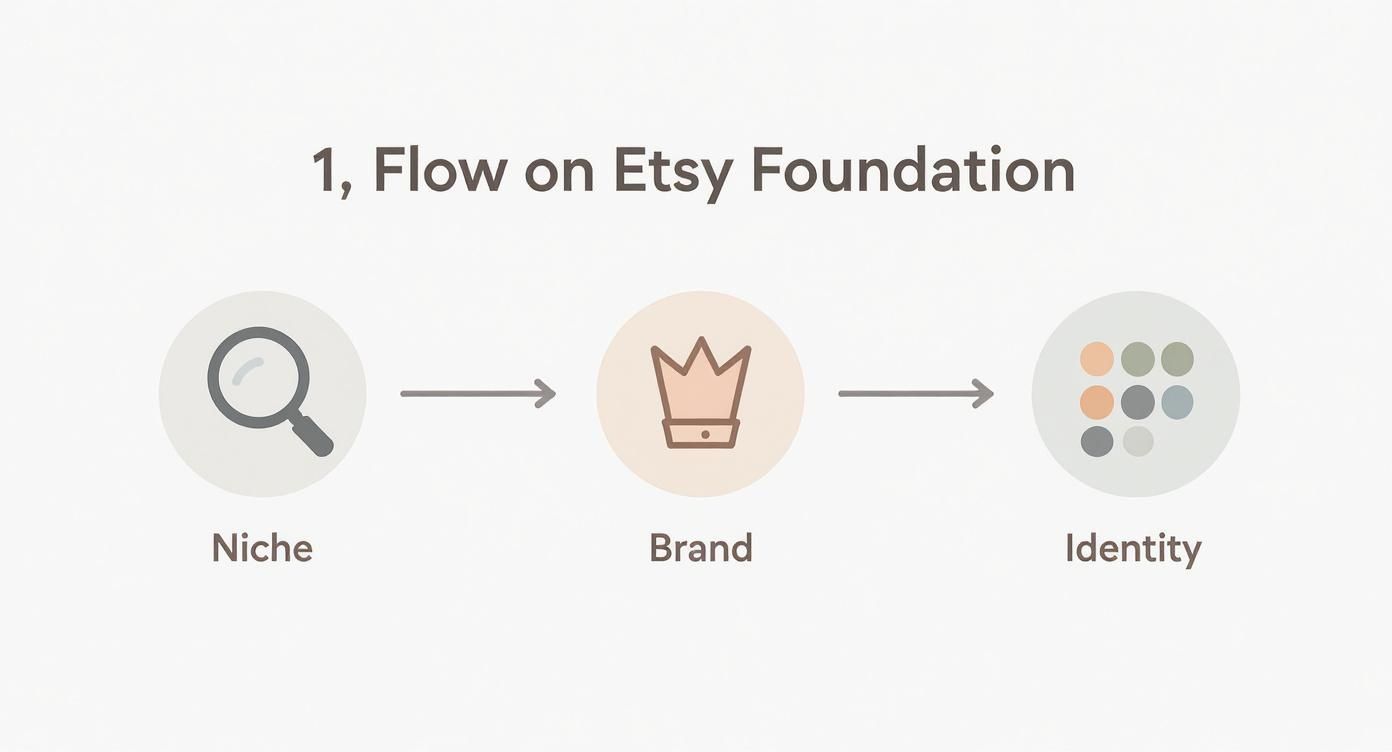
You can see how each step builds on the last, creating a strong, coherent foundation for your whole Etsy business.
Speaking of visuals, your product images are everything. The quality of your photos can be the single biggest factor in whether a buyer clicks "add to cart." If you're looking to get that polished, professional look without spending months learning photography, checking out services for professional Etsy product photography can give you a massive head start. This initial groundwork sets the stage for a shop that doesn't just look good, but truly connects with the right people.
Navigating the Etsy Shop Setup Process
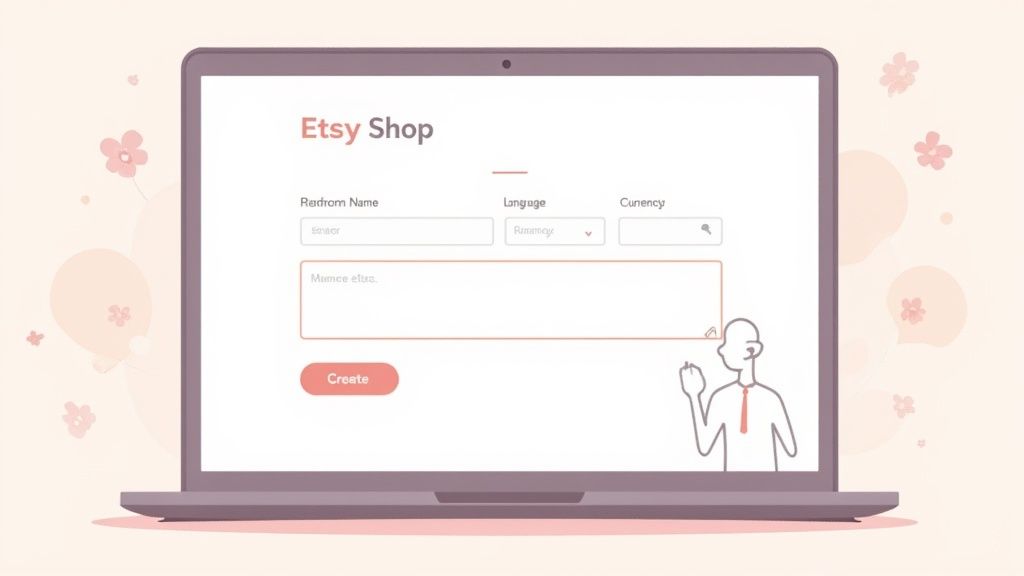
You’ve got your brand foundation sorted, so now it's time for the exciting part: actually building your shop. This is where you translate your vision into a real, functional storefront. It might feel like a long checklist, but every single step is designed to create a professional and trustworthy experience for your future customers.
Think of this initial setup as pouring the concrete for your house. It’s your one chance to get the core settings right from the very beginning. Let’s walk through the critical decisions and creative touches that will turn this blank page into a shop people want to buy from.
Setting Your Shop Preferences
Before you can even think about listing a product, Etsy needs to know the absolute basics about your business. This first screen seems simple, but these choices have long-term consequences.
You'll need to select your:
- Shop Language: This is the default language for your descriptions and customer messages. Stick to the language your target audience actually speaks.
- Shop Country: This tells everyone where your business is located, which impacts currency, shipping estimates, and even search results.
- Shop Currency: This is the currency you'll use for pricing. Don't worry, customers in other countries will see prices automatically converted on their end.
Getting these right from the get-go just makes everything smoother down the line.
Choosing a Memorable Shop Name
Alright, now for the fun stuff—naming your shop. This is a massive piece of your brand identity and a huge factor in how people will find you. It needs to be unique, easy to remember, and if possible, give a little hint about what you sell.
Don't get discouraged if your first choice is already taken. It happens to everyone. Try adding a simple word like "Co," "Designs," or "Studio" to the end. The real goal is to find a name that’s available on Etsy and as a social media handle. Consistency is key.
Your shop name isn't just a label; it’s an SEO tool. If you sell "Boho Wedding Decor," including terms like "Boho" or "Wedding" can give you a slight edge in search visibility from day one.
Building Out Your Shop's Visuals and Story
This is where you get to inject your personality into the shop. You'll upload your logo (which acts as your profile picture) and design a shop banner. That banner is prime real estate—use it to show off your best products, announce a sale, or just display a beautiful photo that screams your brand's aesthetic.
After the visuals, you’ll focus on the words. Your "About" section is your opportunity to connect with buyers on a human level. Share your story. Talk about your passion for your craft and what makes your products special. Shoppers genuinely love buying from real people, and this is where you show them who's behind the curtain.
Configuring Payments and Policies
The final steps are all about the business logistics. You’ll set up how you get paid and how Etsy bills you for fees. This means providing your bank account information for those sweet, sweet deposits and a credit card for seller fees.
Just as important are your shop policies. You need to be crystal clear about your processing times, shipping methods, and your stance on returns or exchanges. Clear policies prevent misunderstandings and protect both you and your buyers. It’s all about building a foundation of trust. Taking the time to set these up correctly now will save you a world of headaches later.
This is a rewarding path, especially when you consider the platform's incredible reach. As of 2025, Etsy is home to 5.6 million active marketplace sellers and 89.6 million active buyers. The platform has recently sharpened its focus on enforcing 'Creativity Standards' to improve listing quality, making it more important than ever for new sellers to launch a polished, professional shop from the start. You can dig deeper into the evolving Etsy marketplace and its sellers on linkmybooks.com.
Creating Product Listings People Want to Buy
Okay, your products are ready and your shop is officially set up. Now comes the fun part: building the digital equivalent of a gorgeous storefront window. Your product listings are your silent salespeople, doing all the heavy lifting to turn a casual browser into a loyal customer.
A great listing is so much more than a photo and a price tag. It’s an experience. It has to answer every question a buyer might have, build confidence, and get them excited to click "add to cart." Let's walk through how to craft listings that don't just show your product, but actively sell it.
Mastering Product Photography (Without a Fancy Camera)
Let's be real: your photos are the first thing anyone sees, and they might just be the most important part of your entire listing. We're visual creatures, and a great photo instantly screams quality, care, and professionalism.
The best part? You absolutely do not need a multi-thousand-dollar camera to get stunning shots. Your smartphone is more than powerful enough. It’s all about technique, not gear.
- Find the Light: Natural light is your best friend, period. Set up near a big window and turn off all your indoor lights to avoid that weird yellow glow. Believe it or not, a slightly overcast day is perfect—it gives you soft, diffused light that minimizes harsh shadows.
- Keep Your Background Simple: Your product is the star of the show. Use a clean, uncluttered backdrop like a simple white poster board, a cool piece of wood, or a neutral fabric.
- Show Every Angle: Your customers can't pick up and inspect your item, so your photos have to do that for them. Make sure you include shots from the front, back, and sides. Add a close-up to show off the texture and details, and toss in a "lifestyle" shot to show the item in use and give a sense of scale.
Even with great raw photos, a little post-production polish can make a world of difference. If you find photo editing a bit overwhelming, you can always explore product photo editing services to give your images that clean, consistent look that builds trust and makes your shop look top-notch.
Writing Titles and Descriptions That Actually Convert
Once your photos have hooked a buyer, your words need to reel them in. Your listing title is a huge piece of the Etsy SEO puzzle. You have to think like your customer—what words would they actually type into the search bar?
Instead of a generic title like "Blue Beaded Necklace," go for something descriptive and packed with keywords. Try something like, "Sky Blue Seed Bead Choker, Dainty Layering Necklace, Minimalist Boho Jewelry." See how that covers way more search possibilities?
Your description then fills in the story, but here’s a pro tip: focus on benefits, not just features.
A feature is what your product is (e.g., "made from 100% merino wool"). A benefit is what your product does for the customer (e.g., "incredibly soft and cozy, keeping you warm without any itch").
Use short paragraphs and bullet points for the nitty-gritty details like dimensions, materials, and care instructions. Making this info easy to scan helps buyers find what they need in a flash and keeps them from clicking away out of confusion.
Strategic Pricing for Profitability
Pricing can feel like the most intimidating step, but it doesn't have to be a guessing game. A solid price needs to cover your costs, your time, and Etsy's fees, all while making sense for your market.
A great starting formula is:
Materials + Labor + Expenses + Profit = Wholesale Price
From there, you can figure out your final retail price. It's also critical to have a clear understanding of the fees Etsy charges. Let's take a quick look at the main ones.
Etsy Listing Fee Breakdown
When you're setting your prices, don't forget that Etsy takes a small cut to keep the platform running. Factoring these into your calculations from the start ensures you're actually profitable on every sale.
| Fee Type | Cost | When It's Charged |
|---|---|---|
| Listing Fee | $0.20 USD | When you publish or renew a listing |
| Transaction Fee | 6.5% of the total order | When an item sells |
| Payment Processing | Varies by country (e.g., 3% + $0.25 in the US) | When you process a payment through Etsy Payments |
Knowing these numbers inside and out is crucial for building a sustainable business. It's a busy marketplace out there—the Etsy seller base has exploded by 800% since 2013. Today, over 6.6 million active sellers are on the platform, and a massive 97% of them run their shops right from home. Getting your pricing right is how you stand out and thrive.
Getting Found with Etsy SEO and Marketing
Having a beautiful shop filled with amazing products is a fantastic start, but that's only half the battle. If shoppers can't find you, all that hard work goes completely unnoticed. This is where mastering Etsy's ecosystem becomes your most important skill.
Think of Etsy as more than just a storefront—it’s a powerful search engine. Your job is to feed its algorithm all the right clues so it can connect your products with the right people. It all comes down to knowing how to use keywords, categories, and attributes to your full advantage.
Decoding the Etsy Algorithm
At its core, the Etsy algorithm has one main goal: to show shoppers the most relevant items for what they’re looking for. It scans your listings for keywords and matches them to a buyer's search query. This is called "query matching."
Once it finds a bunch of matches, Etsy ranks them. This ranking is based on a few key things, including the quality of your listing, how recently it was posted, and your shop's overall customer service history. A shop with a track record of great reviews and clear shipping policies will almost always get a visibility boost.
Key Takeaway: Etsy rewards sellers who create a great customer experience. Good SEO gets you in the game, but positive reviews and a solid track record help you win it.
The best way to improve your standing is to be meticulous. Fill out every single possible section of your listings. This gives Etsy more data, helping it understand exactly what you sell and who it’s for.
Using Keywords, Tags, and Attributes
Keywords are the bridge between your product and your customer. The trick is to think exactly like a shopper. What specific phrases would they actually type into the search bar to find your item?
Instead of just "handmade candle," a real buyer is probably searching for "soy wax lavender candle" or "cozy autumn home decor." Your titles, descriptions, and especially your tags should be packed with these specific, long-tail keywords.
You have 13 tags available for each listing—use every last one. Don't be afraid to mix it up with broad terms and super-specific phrases to cast the widest net possible.
- Attributes: These are the little filters you see on the left side of Etsy search results (color, size, material, etc.). Filling these out is non-negotiable. It’s how you show up when a buyer starts narrowing down their search.
- Categories: Choosing the most specific category possible is absolutely crucial. If you sell a "gold necklace," don't just put it under "Jewelry." Drill all the way down to "Jewelry > Necklaces > Pendants."
This level of detail is precisely how you connect with motivated buyers who know exactly what they want.
Marketing Your Shop Beyond Etsy
While Etsy's internal traffic is a powerhouse, the most successful sellers don't rely on it alone. They drive their own traffic. Building a presence on other platforms helps establish your brand and diversifies your traffic sources, which makes your business much more resilient.
Social media is a natural fit for visual products. Platforms like Pinterest and Instagram are perfect for showcasing your items in a real-world, lifestyle context. A single, well-staged photo or video can lead directly to a sale. If you're looking to expand your reach, mastering social media marketing strategies for fashion brands can be a game-changer, even if you sell other types of handmade goods.
Building an email list is another brilliant move. It gives you a direct line to your most loyal customers, letting you announce new products or run special promotions without having to fight an algorithm for attention. A great way to get started is by offering a small discount for signing up.
Finally, never, ever underestimate the power of excellent customer service. A happy customer is your best marketing tool. Quick, friendly responses and a genuine willingness to solve problems lead to glowing reviews—which Etsy's algorithm loves. These positive reviews build social proof and encourage new buyers to trust your shop, creating a powerful cycle of growth.
Flipping the switch to "open" on your Etsy shop is a huge moment, but let's be real—it's just the starting line. The real work begins now. Those first few weeks are all about building momentum, turning your brand-new shop into a living, breathing business that actually makes sales and keeps customers happy.
https://www.youtube.com/embed/-nPZGeZvI5A
Your first mission, should you choose to accept it, is simple: get your first handful of sales and, just as importantly, your first reviews. Social proof is king on Etsy. Think about it—shoppers feel much more comfortable buying from a store that has a history of happy customers, even if it's just a few to start.
Landing Your First Sales and Reviews
Look, you can't just sit back and wait for the sales to roll in. You've got to give things a little nudge.
One of the best ways to get the ball rolling is to reach out to friends and family. Let them know you're officially open for business! Ask them to check out your shop, maybe make a small purchase, or even just share the link on their social media. It feels a little weird at first, but it's a game-changer.
This initial push does two critical things:
- It breaks the seal. Seeing that first sale notification pop up is an incredible confidence boost.
- It wakes up the algorithm. Every sale and positive interaction sends a signal to Etsy that your shop is active and legitimate, which can seriously help you get seen.
Once someone buys from you, wait until they've received their order, then send a friendly, non-pushy message. A simple "Thank you so much for your order!" goes a long way. You can also mention that if they love their item, a review would mean the world to your new shop. That personal touch often makes all the difference.
The Art of Fulfilling Orders
As soon as the sales start coming, your focus pivots to creating an unforgettable post-purchase experience. This is your golden opportunity to turn a first-time buyer into a loyal fan.
Packaging is a massive part of this. You don't need to break the bank, but your packaging should be clean, secure, and feel like you. Small details like branded stickers or a handwritten thank-you note can leave a huge impression. A customer who has a fantastic unboxing experience is so much more likely to leave that glowing five-star review.
Pro Tip: Never underestimate the power of a simple business card. One seller I know had a TikTok influencer unbox their package and flash the business card on camera. The result? They completely sold out of their inventory overnight. It’s a tiny investment with a massive potential payoff.
Shipping can feel overwhelming at first. My advice? Use Etsy Shipping Labels. It saves you money with discounted postage rates and handles all the tedious stuff for you—it automatically marks orders as shipped and adds the tracking info. Customers absolutely love that.
Nailing Your Customer Communication
On Etsy, your reputation is built one conversation at a time. Make it a rule to respond to every message and inquiry promptly and professionally. Even if you get a tough question or, heaven forbid, some negative feedback, handle it with grace.
Think of every message as a chance to show how much you care about customer satisfaction. A friendly, helpful reply can often turn a potential problem into a positive experience. Remember, your public reviews and how you respond to them are on display for every future buyer to see.
To see where your shop fits in, it helps to know the lay of the land. In 2024, Etsy's global revenue hit a staggering $2.808 billion, and the US market alone drives 53.25% of the platform's traffic. While the average seller earns around $2,900 a year, top sellers show what's truly possible. These figures from BusinessDasher.com prove the incredible opportunity is there if you master the basics.
Using Your Seller Dashboard to Grow
Your Etsy Seller Dashboard is your mission control. It’s packed with data that can help you make smarter decisions. Don't just glance at your sales numbers; you need to dig into your stats to figure out how people are actually finding you.
Keep a close eye on these key metrics:
- Visits and Orders: See which of your listings are getting the most eyeballs and which ones are actually converting into sales.
- Search Terms: This is gold. It shows you the exact keywords shoppers are typing in to find you. Use this intel to tweak your SEO and get in front of more people.
- Traffic Sources: Are people finding you through Etsy search? Social media? A blog? This tells you exactly where to focus your marketing energy.
By checking your stats regularly, you can pinpoint your bestsellers, identify listings that need a little love, and make data-driven choices to scale your shop. And while your initial photos got you launched, you might notice your most-visited listings aren't converting as well as they could. This is the perfect time to explore the cost of professional product photography. A small investment to upgrade the photos on your top products could be the key to unlocking serious growth.
Diving into the world of Etsy is thrilling, but it's totally normal for a million questions to start popping up. Let's tackle some of the biggest ones I hear from new sellers all the time, from the money stuff to the legal bits, so you can get started with confidence.
How Much Does It Really Cost to Start?
This is always question number one, and the answer is one of the best things about Etsy: you can get your shop off the ground for almost nothing. Seriously. There's no fee to open your shop, which makes the initial risk super low.
Your real startup costs are pretty minimal:
- Listing Fees: It costs a flat $0.20 USD to publish a listing, and that keeps it active for four months. If you start with 10 products, you're only investing $2.00.
- Materials: This is your biggest variable, and it completely depends on what you're making or selling.
- Shipping Supplies: In the beginning, just get scrappy! I saved a ton of money early on by reusing boxes and mailers I got from my own online orders.
You absolutely don't need a fancy shipping scale or a special label printer right away. Just take your first few packages to the post office and let them handle the weighing and shipping. As you start making sales, you can reinvest that cash back into your business for equipment that makes your life easier.
Do I Need a Business License to Sell on Etsy?
The classic "it depends." Etsy itself doesn't require you to have a business license to sell on its platform. The rules that matter are your local ones—city, state, or even country.
For most new sellers in the U.S. who are just starting out, you can usually operate as a sole proprietorship without any fancy paperwork. This just means you and your business are considered the same legal entity. Down the road, as you grow, you might want to look into forming an LLC to protect your personal assets, but that's rarely a day-one necessity. A quick call or visit to your local city or county clerk's office will give you the specific rules for your area.
My Two Cents: Don't let the legal stuff paralyze you into not starting. Get your shop up and running first. You can always handle the formal business registration once you've got some momentum and know this is something you want to pursue seriously.
Can I Sell on Etsy Without Holding Any Inventory?
Absolutely, and it's a brilliant way to start with minimal risk. A lot of successful sellers use this model. There are two popular ways to do it:
- Print-on-Demand (POD): This is perfect for artists and designers. You create amazing designs for things like t-shirts, mugs, or art prints. When a customer buys one, the order goes straight to a production partner. They're the ones who print it, pack it up, and ship it directly to your customer. You never have to touch a single box.
- Digital Products: Think printable planners, digital art, e-books, or social media templates. You create the file just once, list it, and you can sell it an infinite number of times. There are no inventory costs and no shipping to worry about.
Both of these are fantastic ways to test out different ideas and really learn how to start an Etsy shop without needing a bunch of money upfront.
Your product photos are your best salesperson. ProdShot can take a simple picture from your phone and turn it into a stunning, professional-quality image in seconds. It's the fastest way to make your listings stand out and get more sales. Give it a try for free at https://prodshot.net.