
So, you’re thinking about starting an online retail business. It’s an exciting thought, but let's be real—it can also feel completely overwhelming. The good news? It’s not about finding some secret formula. Success is really just about tackling a series of logical steps, one after the other.
This guide is designed to be your high-level roadmap, cutting through the noise to show you exactly what to focus on. We'll break the whole thing down into manageable chunks, giving you a solid foundation before you even think about spending a dollar.
The Three Pillars of a Solid Launch
Every successful online store, whether it’s a side hustle or a full-blown brand, is built on three core pillars. Get these right, and you're setting yourself up for a much smoother ride.
-
Strategic Planning: This is where the real work begins, long before you have a website. It’s all about deep-dive research. You’ll be figuring out a profitable niche, getting inside the head of your ideal customer, sourcing products, and nailing down your brand's identity. The goal here is simple: prove your idea has legs before you build anything.
-
Building Your Digital Infrastructure: Once you have a solid plan, it’s time to build your storefront. This is the fun part for many—choosing an ecommerce platform, designing your site, taking product photos, and writing descriptions that actually sell. You’ll also set up the less glamorous but crucial backend stuff like payments and shipping. Your mission is to create a store that looks great and works flawlessly.
-
Launching and Growing: With your store live, your job shifts from builder to marketer. Now, it's all about getting eyeballs on your products. This means diving into marketing, search engine optimization (SEO), providing top-notch customer service, and looking at the data to see what’s working. The objective is to drive traffic, make sales, and turn one-time buyers into loyal fans.
The opportunity out there is absolutely massive. Global eCommerce sales are projected to hit a staggering $7.4 trillion in 2025, with an expected 2.77 billion people shopping online. Yes, there's competition—over 28 million online stores are out there—but the pie is getting bigger every single year.
If there's one mistake I see new entrepreneurs make over and over, it's jumping straight into building a website without a real plan. A well-researched strategy is what separates a passion project that fizzles out from a business that actually grows.
To give you a clearer picture, I've broken down the entire journey into a simple roadmap.
Your Online Retail Launch Roadmap
This table gives you a bird's-eye view of the entire process. It's designed to keep you focused on what truly matters at each stage of your launch.
| Phase | What It Involves | Key Goal |
|---|---|---|
| 1. Ideation & Planning | Niche research, competitor analysis, identifying your target audience, defining your brand. | Validate your business idea and create a clear strategic direction. |
| 2. Product Sourcing | Choosing between manufacturing, dropshipping, or wholesale. Finding and vetting suppliers. | Secure a reliable source for high-quality products with healthy profit margins. |
| 3. Store Setup | Selecting a platform (e.g., Shopify, Etsy), designing your site, product photography & descriptions. | Build a professional, trustworthy, and user-friendly online storefront. |
| 4. Operations & Logistics | Setting up payment gateways, figuring out shipping rates, and defining your fulfillment process. | Create a seamless and efficient system for getting paid and delivering orders. |
| 5. Pre-Launch & Launch | Final testing, building an email list, creating social media buzz, and officially opening your store. | Generate initial excitement and drive your first wave of traffic and sales. |
| 6. Post-Launch Growth | Marketing campaigns, SEO, customer service, analyzing sales data, and optimizing your store. | Build momentum, acquire new customers, and foster long-term loyalty. |
Think of this as your checklist. Following these phases in order will help you build your business on solid ground, avoiding common pitfalls along the way.
For a deeper dive into each of these steps with structured guidance, checking out a resource like a seller success academy can be a game-changer. Having a structured path to follow can give you the confidence you need to turn your vision into a real, profitable business.
Finding Your Niche and Sourcing Products
This is where the fun begins. But it's also the single most important decision you'll make. Deciding what to sell is the bedrock of your entire business—it shapes who you sell to, how you market, and whether you'll turn a profit.
So many new sellers make the mistake of jumping into a massive, crowded market with no clear angle. Forget trying to be the next Amazon. The real money, especially when you're starting out, is in a specific niche market. This just means finding a dedicated corner of a larger market with unique needs. Think less "selling shoes" and more "selling waterproof trail running shoes for cold weather." See the difference?
Discovering Your Niche
Finding a great niche isn't about some once-in-a-lifetime, revolutionary idea. It's about spotting a gap or an audience that isn't being served well. The best place to start looking is where people gather, not just where products are sold.
- Lurk in Online Communities: Seriously. Dive into Reddit subs, specialized Facebook Groups, and niche forums. What problems are people constantly complaining about? What do they wish existed? These conversations are pure gold.
- Ride the Trend Wave: Tools like Google Trends are your friend. They show you what's gaining steam. Getting in on a rising trend means you can catch the wave of demand before the market gets completely flooded with competitors.
- Follow Your Passion: Your own hobbies are a secret weapon. If you're obsessed with sustainable pet products, you already get the customer. You know their pain points, what they value, and what makes a product great. That's a huge head start.
This whole process—from planning to launch to growth—is a journey. It's not just about flipping a switch and opening a store.
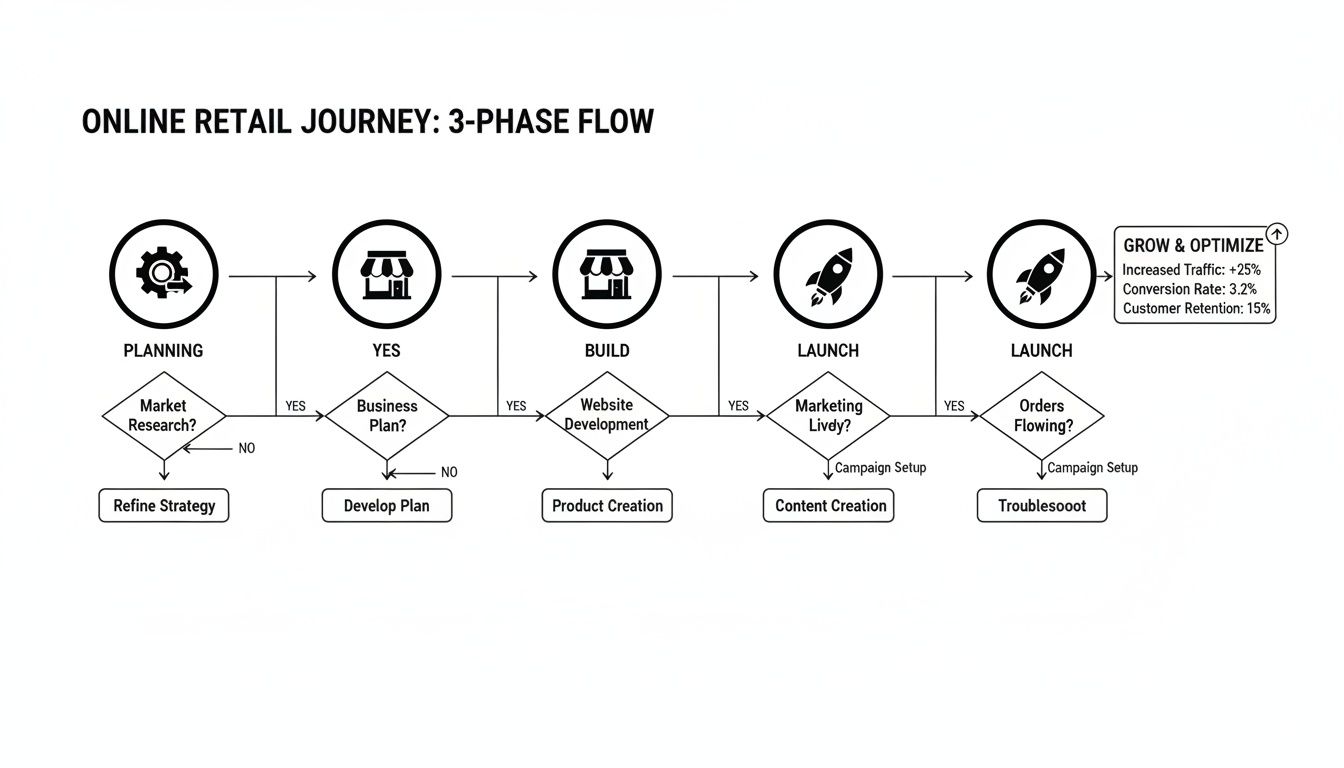
As you can see, building the actual store is just one piece of a much larger puzzle. The real work happens before and after.
Vetting Your Product Idea
Okay, you've got a few ideas buzzing around. Now it's time to put them to the test. A cool idea means nothing if it can't be a real business.
Be brutally honest and ask yourself:
- Is there real demand? Is this a five-minute fad or something people will want a year from now?
- Who am I up against? Check out the competition. What are they doing? Can you do it better, offer a unique twist, or build a more compelling brand?
- Can I actually make money? Tally up the potential costs—the product itself, shipping, marketing, fees. Is there enough of a margin left to build on?
How to Get Your Products
Once you've landed on a promising niche, the next question is: where do you get the stuff? There are three main ways to stock your digital shelves, and each one comes with its own set of pros and cons.
The sourcing method you choose directly impacts your startup costs, daily workload, and profit margins. It's crucial to select the model that aligns with your budget, risk tolerance, and long-term business goals.
Let's break down the big three.
| Sourcing Method | Best For | Key Advantage | Major Challenge |
|---|---|---|---|
| Dropshipping | Beginners with low startup capital testing a new niche. | No need to buy or store inventory, minimizing financial risk. | Lower profit margins and less control over shipping and quality. |
| Wholesale | Sellers who want more control over branding and stock. | Buying in bulk offers better profit margins and branding. | Requires upfront investment in inventory and a place to put it. |
| Manufacturing | Unique product ideas or those wanting full brand control. | Complete control over the product design, quality, and branding. | Higher initial costs, longer lead times, and complex vetting. |
Your personal situation is what matters most here.
Dropshipping is the easiest way to get your foot in the door. You find a supplier who holds all the inventory and ships orders directly to your customers for you. You only pay for a product after a customer pays you. It's no wonder the global dropshipping market was valued at over $365 billion in 2024—it's a massively popular low-risk model. And these days, it's easier than ever; you can even learn how to find winning products for your dropshipping store using AI.
Buying wholesale is the next step up. You purchase products in bulk from a distributor, which gets you a better price per item. This gives you way more control over your own inventory and lets you ship things out fast, but it means you have to tie up cash in stock upfront.
Finally, there's manufacturing your own unique product. This gives you the ultimate control and the highest potential profit margins, but it's also the most involved. You're responsible for everything from design to finding a factory, which can be a long and expensive road.
Building Your Digital Storefront and Brand Identity
Think of your online store as your 24/7 salesperson. It's the digital equivalent of a brick-and-mortar shop, and it’s where your brand truly comes to life. A clean, professional-looking site builds instant trust, while great product presentation is what turns a casual browser into a paying customer.
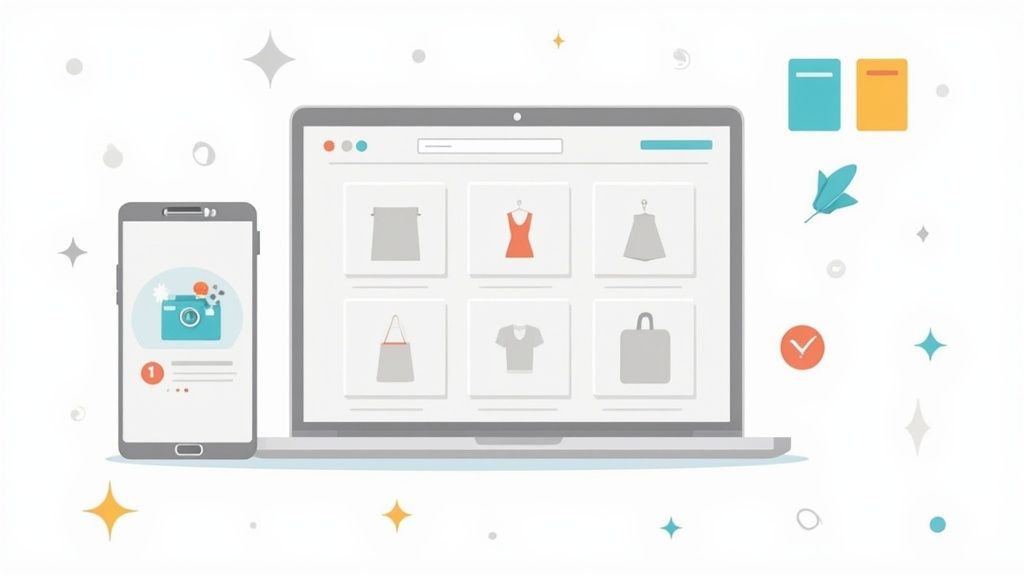
The first big decision you'll make here is picking your ecommerce platform. This is the engine that runs your entire operation, handling everything from the website's look and feel to processing orders and payments. Choosing the right one from the get-go will save you massive headaches later on.
Choosing the Right Ecommerce Platform
For anyone just figuring out how to start an online retail business, the number of platform options can be dizzying. Let's cut through the noise and focus on what actually matters when you're starting out: simplicity, affordability, and the room to grow.
The big three you'll hear about are Shopify, BigCommerce, and WooCommerce. Each has its own strengths, but they cater to slightly different types of sellers.
Your platform isn't just a tool; it's a business partner. The best choice is the one that lets you focus on selling products, not on fixing technical issues. For most beginners, an all-in-one solution is the fastest path to launch.
I've put together a quick comparison to help you see which one might be the best fit for your budget and technical skills.
Choosing the Right Ecommerce Platform
Here’s a head-to-head look at the most popular platforms, focusing on the features that matter most when you're just starting out.
| Platform | Best For | Typical Monthly Cost | Why It Wins for Beginners |
|---|---|---|---|
| Shopify | Absolute beginners who want an all-in-one, easy-to-use solution. | Starts at $29/month (Basic Plan) | Exceptionally user-friendly with a guided setup, 24/7 support, and a huge app store for adding features as you grow. |
| BigCommerce | Sellers who anticipate scaling quickly and want more built-in features. | Starts at $29/month (Standard Plan) | Offers more advanced features out of the box without transaction fees, making it great for ambitious startups. |
| WooCommerce | Tech-savvy entrepreneurs who want full control and already use WordPress. | Free plugin, but you pay for hosting ($10-$30/month). | Provides total customization and is open-source, but requires more hands-on management of hosting, security, and updates. |
Honestly, for 9 out of 10 new sellers, Shopify is the clear winner. Its drag-and-drop builder means you can have a professional-looking store up and running in a single weekend, no coding required.
Crafting Product Pages That Convert
Once you’ve picked your platform, it’s all about the products. Your product pages are where the magic happens—it’s where a shopper decides to click "add to cart" or hit the back button. Simply listing features isn't enough; you have to sell the experience.
A great product description doesn't just describe, it persuades. It connects what your product does to what your customer wants.
- Speak Your Customer's Language: Write like you're talking to a friend. Is your brand playful? Luxurious? Straight-to-the-point? Let that personality shine through.
- Focus on Benefits, Not Just Features: Instead of saying "waterproof fabric," try "stay completely dry on your rainy-day hike." See the difference?
- Anticipate Questions: Include all the details—size, materials, care instructions, what’s in the box. The more info you give, the less hesitant a customer will be.
- Use Scannable Formatting: Nobody reads a wall of text. Use short paragraphs, bullet points, and bold text to make key info pop.
This is how you turn a boring listing into a sales pitch that works for you around the clock.
Turning Smartphone Photos into Professional Shots
Let’s be clear: in online retail, your photos are your product. Customers can't touch or hold your items, so your images have to do all the heavy lifting. Great visuals are non-negotiable—they're the single most important factor in building trust and showing off quality.
But here’s the good news: you don’t need a fancy photo studio or a pricey DSLR camera. The smartphone in your pocket is more than powerful enough to take incredible, marketplace-ready photos. The secret is all in the setup and a little editing magic.
Here’s my simple process for getting professional shots with just a phone:
- Find Good, Natural Light: This is the #1 rule. Set up near a big window on a slightly overcast day. Avoid harsh, direct sun, which creates ugly shadows.
- Use a Simple Background: A plain white or light gray background always works. It makes your product the hero. A cheap poster board from a craft store is perfect for this.
- Stabilize Your Phone: The slightest handshake causes blur. Prop your phone against a stack of books or grab a cheap mini-tripod. This one simple trick makes a world of difference for crispness.
- Edit for Polish and Consistency: Raw photos are never perfect. The final step is editing to brighten colors, remove any distracting background elements, and make sure every photo in your store has the same clean, professional vibe.
Manually editing every single photo can be a huge time sink. This is where AI-powered tools come in. For example, a dedicated Shopify photo editor can integrate right into your store, transforming your basic smartphone pictures into high-converting product shots with just a few clicks. It’s a huge time-saver and ensures your whole catalog looks cohesive and trustworthy from day one.
Alright, you’ve built your digital storefront. Now it’s time to get into the nitty-gritty—the operational gears that make your business actually run and make money. Getting your pricing, payments, and shipping sorted out is what separates a real business from a side hobby.
These three pieces are the foundation of your profitability and, just as important, your customer's experience.
A clunky checkout process or a surprise shipping fee at the end is a surefire way to lose a sale. In fact, unexpected costs are the #1 reason shoppers abandon their carts. If you're serious about this, you absolutely have to nail the backend details.
Pricing Your Products for Profit
Pricing can feel like you're just throwing a dart at a board, but it needs to be a real strategy. Just copying a competitor or picking a number that "feels right" is a quick path to frustration and failure. Your price has to cover everything, leave you with a real profit, and match the value people see in your brand.
The starting point for any smart pricing strategy is knowing your Cost of Goods Sold (COGS). This isn't just the sticker price you paid for the product itself; it's every single penny it takes to get that item into a customer's hands.
- Product Cost: What you paid your supplier for each unit. Simple enough.
- Shipping & Freight: The cost to get the inventory from them to you.
- Packaging: All of it—the boxes, mailers, tape, bubble wrap, and any branded inserts.
- Transaction Fees: The cut your payment processor takes from every single sale.
Once you’ve added all that up for a single item, you have your true COGS. Now you can set a retail price that actually makes you money. A classic method to start with is keystone pricing—you just double your COGS. So, if your total COGS is $15, you’d price the item at $30.
Don't forget, your price tells a story. A rock-bottom price might pull in bargain hunters, but a higher price can signal quality and a premium experience. Make sure your pricing feels consistent with the brand you're trying to build.
Accepting Payments Securely
You need to make it incredibly easy for people to give you their money. A smooth, trustworthy checkout builds confidence and gets more people to click "buy." Thankfully, modern e-commerce platforms like Shopify have made this part pretty straightforward with their own built-in payment systems.
Solutions like Shopify Payments, or integrations with giants like Stripe and PayPal, are the industry standard for a reason. They handle all the heavy lifting on security and let customers pay however they want.
Here’s what you should be looking for in a payment solution:
- Lots of Payment Options: Credit and debit cards are a must, but don't sleep on digital wallets like Apple Pay and Google Pay. Those one-click payment options are a game-changer for reducing friction at checkout.
- Clear Fees: Processors typically charge a percentage plus a small flat fee (a common one is 2.9% + $0.30 per transaction). You have to know these numbers and bake them into your COGS.
- Rock-Solid Security: Make sure your provider is PCI compliant. This is the industry standard for protecting customer credit card info from fraud, and it's non-negotiable for building trust.
Getting this up and running is usually a simple process in your store’s dashboard. It often just takes a few clicks to connect your business bank account and you're good to go.
Navigating Shipping and Fulfillment
For many new sellers, shipping is the most intimidating part of the entire operation. Your shipping strategy has a massive impact on both your profit margins and your customers' happiness. We all know that high shipping fees are a conversion killer, so finding a system that’s both efficient and affordable is crucial.
You really have three main ways to get orders out the door.
| Fulfillment Model | How It Works | Best For |
|---|---|---|
| In-House Fulfillment | You personally pick, pack, and ship every order from your home, garage, or a small storage space. | New businesses with a manageable number of orders who want full control over the experience. |
| Dropshipping | Your supplier ships orders directly to your customers for you. You never even touch the inventory. | Sellers who want to avoid upfront inventory costs and the hassle of physical stock. |
| Third-Party Logistics (3PL) | You ship your inventory to a specialized warehouse, and they handle all the picking, packing, and shipping. | Growing businesses that are getting too swamped with orders to handle it all themselves. |
When you're just starting, doing it all yourself (in-house fulfillment) is often the most logical first step. It gives you total control over the customer experience—from the custom-branded box to a handwritten thank-you note inside.
To keep your costs down, dive into your e-commerce platform's shipping settings. They almost always have built-in tools that give you access to discounted shipping rates from major carriers like USPS, UPS, and DHL. This is one of the best practical tips for anyone trying to figure out how to start an online retail business without a massive budget. And don't forget that how your products look online is just as important as how they look when they arrive; you can learn more about the cost of professional product photography to make sure your items shine.
Marketing Your Store and Getting Your First Customers
Your digital storefront is officially built, but now comes the real work: getting people to actually visit it. A beautiful store with no traffic is just an expensive hobby. The key isn't some massive ad budget; it's a smart, focused approach to finding your first customers and building momentum from day one.

Think of marketing less like shouting into the void and more like starting conversations where your ideal customers are already hanging out. Your goal is to build a mix of strategies that work together, drawing people in and giving them a reason to stick around.
Becoming Discoverable with SEO Basics
Search Engine Optimization (SEO) sounds way more technical than it really is. At its core, it's just about making it easy for search engines like Google to find your shop when people are looking for the exact things you sell. Since most shoppers start with a search, showing up in those results is like having a storefront on the busiest street in town.
You don't need to be a guru to get started. Just focus on these foundational tasks:
- Write Keyword-Rich Titles and Descriptions: Get inside your customer's head. What words would they actually type into Google? Instead of just "Blue T-Shirt," try something like "Men's Navy Blue Cotton Crewneck T-Shirt." Be descriptive and use the natural language your audience uses.
- Use High-Quality, Optimized Images: Search engines can't "see" pictures, so you have to tell them what they are. Use descriptive file names (
mens-navy-cotton-shirt.jpgis much better thanIMG_1234.jpg) and fill out the "alt text" for each image with a brief, keyword-focused description. - Consider Helpful Blog Content: This is a powerful long-term play. If you sell hiking gear, an article like "5 Essential Items for Your Next Day Hike" can attract potential customers before they’re even ready to buy.
Since visuals are so critical, you might want to consider specialized photo editing services for ecommerce to ensure your pictures are not just beautiful but also properly optimized to load quickly and look professional.
Building a Community on Social Media
Social media isn't just a billboard for your products; it's a place to build a genuine community. The goal is to create content that feels natural and valuable, not like a constant sales pitch. Pick one or two platforms where you know your target audience is most active and pour your energy there.
A great starting point is to showcase your products in real-world scenarios. If you sell handmade ceramic mugs, don't just post a sterile photo of the mug on a white background. Show someone enjoying their morning coffee with it, or create a short video of your crafting process. This behind-the-scenes stuff builds a story around your brand that people can actually connect with.
Stop selling and start helping. When you create content that genuinely serves your audience, you build trust. Trust is the foundation of any long-term customer relationship, and it's something paid ads can never buy.
Driving Repeat Business with Email Marketing
Email is one of the most powerful tools in your entire marketing arsenal. Why? Because unlike on social media, you own your email list. It's a direct line of communication to your most engaged audience—the people who have already shown interest by signing up.
Start building your list from day one by offering a small incentive, like 10% off their first order in exchange for their email. It's a simple, effective trade. Once you have subscribers, you can start nurturing that relationship.
Your email strategy can be simple but incredibly effective:
- The Welcome Email: As soon as someone signs up, send them a welcome message. Thank them and deliver the discount you promised.
- Product Spotlights: Showcase new arrivals or best-sellers, but focus on the benefits and tell the story behind the product.
- Exclusive Offers: Reward your subscribers. Give them early access to sales or special promotions that aren't available to the general public.
This consistent communication keeps your brand top-of-mind, turning one-time buyers into loyal fans who come back again and again.
Your First 90 Days: A Realistic Growth Plan
Getting your store launched is the starting line, not the finish. Those first three months are where the real work begins—turning a website into a business. This isn't about some "overnight success" fantasy. It's about laying a solid foundation, learning from your very first customers, and building real momentum.
Let's break it down into three distinct sprints, each with a clear focus. Having a plan like this stops you from getting overwhelmed and makes sure you're putting your energy in the right place at the right time.
The First 30 Days: Focus on Feedback and First Sales
Your number one goal in the first month is brutally simple: get a few sales in the door and soak up every bit of feedback you can. This is your reality check. It proves people will actually open their wallets for what you're selling and helps you iron out the inevitable kinks in your process.
Forget about massive ad campaigns for now. Your initial marketing needs to be direct and personal.
- Friends and Family Launch: Think of this as your "soft opening." Get people you know and trust to buy something and give you their completely honest, no-holds-barred feedback on everything from navigating the site to the unboxing experience.
- Engage in Niche Communities: Remember those forums and social media groups where your ideal customers live? Go back there. Share your story and your products authentically. Be a member of the community, not a spammy advertiser.
- Gather Testimonials: Every single positive comment is marketing gold. When a customer is happy, don't be shy—ask if you can share their feedback.
At this point, every single order is a masterclass. Was the shipping process smooth? Did the product live up to the pictures? This early data is more valuable than you can imagine.
The Next 30 Days: Analyze and Double Down
By month two, you'll have a small but vital pile of data from your first sales and website visitors. Now it's time to put on your detective hat and figure out what’s actually working. Get comfortable inside your ecommerce platform’s analytics.
You're looking for patterns:
- Which products are moving? Even with just a few sales, you might already see an early winner emerging.
- Where is your traffic coming from? Did that one post in a niche Facebook group send way more people to your site than anything else?
- What are people typing into your search bar? This is gold. It’s customers telling you exactly what they want in their own words.
Once you spot something that's working—a channel, a specific product—it's time to double down. If a certain type of social media post brought in sales, make more content just like it. If one product is crushing it, stick it on your homepage and make it impossible to miss.
Don’t try to do everything at once. The key to early growth is identifying the one or two things that are generating real results and pouring your limited time and resources into them.
The Final 30 Days: Scale and Systematize
In month three, your mindset shifts from just getting by to building for the future. You have a good idea of what works, so now you build systems around it and start to scale. This is when you can cautiously dip your toes into paid advertising, maybe targeting an audience that looks a lot like your first handful of happy customers.
This is also the perfect time to get serious about customer retention. The goal is to turn those first-time buyers into fans who come back again and again. You could start a simple email newsletter offering exclusive content or early access to new products—nothing fancy, just something to keep the connection going.
By the end of these 90 days, you should have a steady trickle of traffic, a proven workflow for getting orders out the door, and a much clearer picture of which marketing strategies are actually worth your time and money.
Ready to make your product photos look as professional as your business plan? ProdShot uses AI to turn simple smartphone pictures into stunning, high-converting images for your online store in seconds. Stop worrying about expensive photoshoots and start creating a beautiful, trustworthy brand today. Try it for free at https://prodshot.net.