
You can't fix what you don't measure. That's the golden rule of cost reduction. Before you can start slashing expenses, you need a brutally honest picture of every single dollar flowing out of your business—from what you pay for inventory to that software subscription you forgot you had.
Finding Your Financial Starting Point
The first step isn’t about making cuts; it’s about getting clarity. A deep-dive cost audit is way more than a quick glance at your bank statement. It's about systematically digging in, categorizing every expense, and seeing where your money really goes. This is the foundation for any smart cost-cutting strategy, letting you make decisions based on data, not guesswork.
For a lot of online sellers, this sounds about as fun as a root canal. I get it. But the goal here is to move from a vague, stressful feeling of "we're spending too much" to a clear, actionable list of savings opportunities.
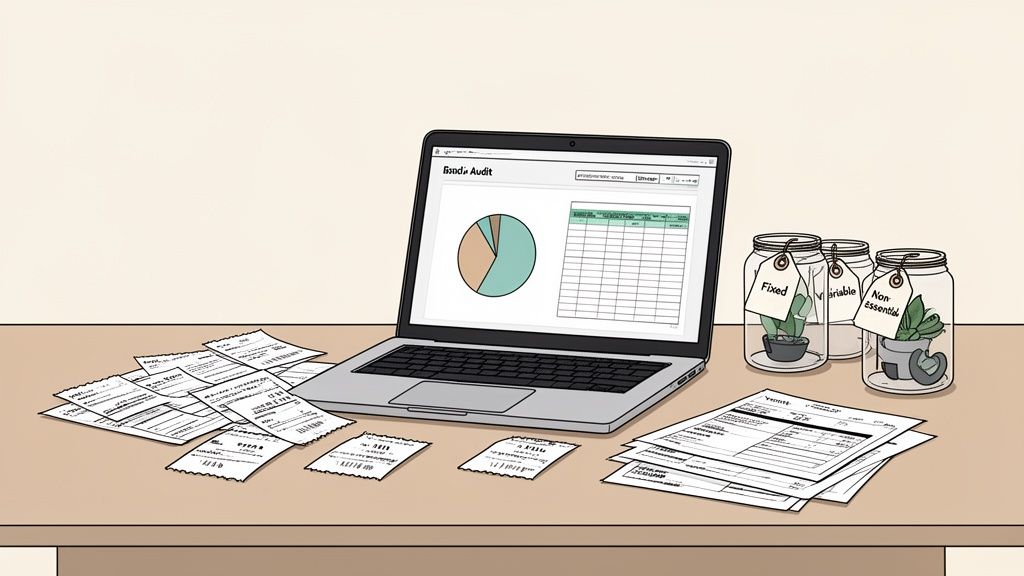
Unpacking Your E-commerce Expenses
Grab all your financial records from the last quarter or, even better, the last year. That means bank statements, credit card bills, software invoices, and every report you can pull from your sales channels like Shopify or Amazon. Don't leave anything out.
Now, sort every single expense into one of three buckets:
- Fixed Costs: These are your predictable, recurring bills that stay the same no matter how much you sell. Think Shopify subscriptions, website hosting, or the rent on your storage space.
- Variable Costs: These costs are directly tied to your sales volume. The more you sell, the more you spend. This is your cost of goods sold (COGS), payment processing fees, and shipping expenses.
- Non-Essential Costs: Be honest with yourself here. This is the "nice-to-have" stuff that isn't critical to your daily operations. It might be a premium analytics tool you barely log into or fancy packaging that isn’t driving repeat business.
Just doing this exercise will immediately shine a spotlight on problem areas. Are your fixed costs bloated with unused software? Are your shipping rates creeping up higher than the industry average? These are the questions that lead to your biggest wins.
Setting Up Your Key Performance Indicators
An audit gives you a snapshot. Key Performance Indicators (KPIs) give you a live feed. For an e-commerce business, tracking a few core metrics is absolutely non-negotiable if you’re serious about controlling costs.
"A common mistake is trying to cut everything at once. Instead, focus on the 2-3 KPIs that have the biggest impact on your profitability. Small, consistent improvements in these areas compound over time."
What you track, you can improve. Here are the must-haves for any e-commerce seller looking to get lean.
Key KPIs for Tracking E-commerce Costs
| KPI (Key Performance Indicator) | What It Measures | Why It's Critical for Cost Reduction |
|---|---|---|
| Cost of Goods Sold (COGS) | The direct costs of producing your products (materials, labor). | A high or rising COGS eats directly into your profit margin on every sale. Tracking this helps you find better suppliers or production methods. |
| Customer Acquisition Cost (CAC) | The total marketing and sales cost to acquire one new customer. | If your CAC is climbing, your ad spend is becoming less efficient. This is an early warning to re-evaluate your marketing channels and campaigns. |
| Average Order Value (AOV) | The average dollar amount spent each time a customer places an order. | Increasing AOV (through bundles, upsells) allows you to absorb fixed costs like shipping more easily, making each transaction more profitable. |
| Return on Ad Spend (ROAS) | The amount of revenue generated for every dollar spent on advertising. | This tells you which ad campaigns are actually making you money and which are just burning cash. It’s crucial for optimizing your marketing budget. |
| Inventory Turnover Rate | How many times you sell and replace your entire inventory over a period. | A low turnover rate means you have cash tied up in slow-moving stock, which also costs you money in storage fees and potential obsolescence. |
Setting up a simple dashboard to watch these numbers weekly turns cost management from a one-time project into a core business habit.
This disciplined approach is what separates the pros from the amateurs. Research shows that while most businesses want to cut costs, they often fall short, achieving only 48% of their targeted savings. But the ones who build a true cost-conscious culture see real results, like 11% gains in production efficiency.
Tracking your KPIs also gives you a baseline for making smart spending decisions. For instance, if you’re trying to figure out how to reduce product photography costs, understanding the pricing of AI photo solutions gives you a clear number to compare against what you're spending now.
By pairing a deep-dive audit with consistent KPI tracking, you build a powerful system. You’ll not only find waste but also measure the real impact of your changes, ensuring every decision is backed by solid data.
Chasing Quick Wins for Immediate Savings
You’ve done the hard work of a cost audit, and now you have a clear map of where every dollar is going. So, what's next? It's time to act.
The best way to build momentum and see an immediate impact on your bottom line is to go after the quick wins. I'm talking about low-effort changes that can free up cash within weeks, not months. These early victories are a huge morale booster and can even fund bigger cost-saving projects down the road.
A lot of small business owners I talk to think they don't have enough leverage to make a real difference. That’s a myth. You can start making meaningful dents in your expenses today.
Have a Friendly Chat with Your Suppliers
Think you're too small to negotiate? Think again. Your suppliers want to keep your business, even if you aren't their biggest account. Consistency is incredibly valuable to them. Before you even pick up the phone, pull up your payment history and order frequency to build your case.
When you reach out, approach it as a partnership, not a demand. Ask if they offer discounts for paying early or for placing slightly larger orders. For example, if you consistently order 80 units of a product, just ask what the price break is at 100. The answer might surprise you.
A simple phone call can go a long way. Frame it like this: "We're looking at ways we can grow our business with you this year, and one path is finding some cost efficiencies together. Are there any options for better pricing based on our order history?"
This one conversation can directly lower your Cost of Goods Sold (COGS), which is one of the most powerful ways to increase the profit on every single item you sell.
Tame Your Software and Subscription Jungle
Software-as-a-Service (SaaS) tools are the lifeblood of modern e-commerce, but they can quickly create a "SaaS sprawl." This is what happens when you slowly accumulate a bunch of subscriptions that are redundant, barely used, or just completely forgotten. A quick audit here can uncover some serious savings.
Comb through your bank and credit card statements and list every single recurring software payment. For each one, be brutally honest and ask:
- Is this tool absolutely critical for my daily operations? If you haven't logged in for 90 days, it's probably not.
- Am I using all the features of my current plan? So many businesses pay for a premium or pro tier when a basic plan would do the job just fine. Downgrading can save hundreds of dollars a year.
- Can another tool I already pay for do the same thing? You might be paying for a standalone email marketing tool when your Shopify or BigCommerce plan has a perfectly good one built-in.
Get Smart About Packaging and Shipping
For anyone selling physical products, shipping is a massive, and often unpredictable, cost. Carriers like USPS, FedEx, and UPS all use dimensional weight pricing. In simple terms, this means the size of your box matters just as much as its weight.
Shaving off even an inch can drop you into a lower shipping cost tier.
Take a look at your top-selling products and the boxes you ship them in. Is there a lot of empty space? Could you get away with a smaller mailer or a more compact box? Swapping heavy bubble wrap for lighter packing materials like air pillows can also make a difference.
These tiny adjustments, when multiplied across hundreds or thousands of orders, add up fast. It's easily one of the simplest ways to cut business costs without ever touching the quality of your product.
Using Automation to Slash Manual Work
Your time is your most valuable asset, and it's the one thing you can't get more of. For any e-commerce seller, those little repetitive tasks are the silent profit killers. They just chip away at your day, pulling you away from the big-picture work that actually grows your business.
Every hour you spend manually updating inventory, answering the same customer questions for the tenth time, or scheduling social media posts one-by-one is an hour you’re not spending on marketing, developing a new product, or planning your next move.
Cutting business costs almost always starts with clawing back that lost time. Automation isn't about firing your team; it's about freeing everyone up from the boring stuff to focus on the high-value activities that need a human brain and a personal touch.
Finding Where to Automate First
Before you can start automating, you have to find the waste. I always tell sellers to think like a manufacturer on an assembly line. Where are the bottlenecks? What repetitive motions are you making every single day?
Take a few hours and map out your entire workflow, from the moment an order hits your store to the second it’s on a customer's doorstep.
You'll quickly spot the usual suspects—the tasks you do over and over without even thinking:
- Order Processing: Manually typing order details from your store into your shipping software.
- Inventory Management: Constantly double-checking stock levels and updating them on Shopify, then Etsy, then Amazon. It’s a nightmare.
- Customer Service: Answering "Where's my order?" and "What's your return policy?" all day, every day.
- Marketing: Manually posting to Instagram, then Facebook, then TikTok. Or forgetting to send those abandoned cart emails.
Each of these is a goldmine for automation. The goal is to kill manual data entry and repetitive messages wherever you can. You’ll not only save a ton of time, but you’ll also drastically cut down on those small (and sometimes expensive) human errors.
"Process automation and technology modernization have emerged as some of the most effective cost reduction levers available today… Companies that invest in AI and automation with a focus on measurable unit-cost reduction are prioritizing these initiatives, recognizing that productivity gains directly improve margins."
Practical Automation Tools That Actually Work
You don’t need a six-figure budget or a team of developers to get started. There are so many affordable, easy-to-use tools built specifically for small e-commerce shops.
My favorite place to start is with a tool like Zapier or Make. Think of them as the glue that connects all the different apps you already use. They let you build simple "if this happens, then do that" recipes.
For example, when a customer places an order on your Shopify store, a single automation could instantly:
- Add their email to your newsletter list in Mailchimp.
- Create the shipping label in Shippo.
- Ping you a notification in Slack.
Just like that, one workflow zaps three manual steps. It might only save you a few minutes per order, but when you're processing dozens or hundreds of orders a week, those minutes explode into hours of your life back.
Along the same lines, if you want to cut down on staffing costs while keeping customers happy, look into practical strategies to automate customer service using simple chatbots and automated email replies.
Automation Isn't Just for Orders
This thinking can be applied way beyond just fulfillment. You can use a scheduler like Buffer or Later to plan out and automate an entire month's worth of social media content in a single afternoon. Email platforms can automatically send a welcome series to new subscribers or follow up with customers who haven't bought from you in a while.
Even creative work is getting a massive boost. Manually editing hundreds of product photos is a huge time-suck and a serious bottleneck for most sellers. This is where AI-powered tools come in.
Our own AI product photo generator, for instance, lets you take a simple picture with your phone and automatically creates professional, on-brand images in seconds. It completely removes the need for tedious manual editing or hiring an expensive photographer.
When you start systematically finding and automating these repetitive tasks, you're not just saving a few minutes here and there. You're building a smarter, more efficient, and ultimately more profitable business from the ground up.
Optimizing Your Inventory and Fulfillment
If you sell physical products, your inventory and fulfillment operations are almost always two of the biggest line items on your budget. It's not just about the products themselves; it’s about cash tied up on shelves and the surprisingly complex process of getting those items into your customers' hands. Slashing costs here isn’t about finding a cheaper box—it's about building a smarter, leaner system from the ground up.
Holding too much inventory is like letting cash gather dust. It locks up capital you could be using for marketing or developing new products. Even worse, it drives up storage costs and increases the risk of products becoming damaged, obsolete, or out of season, forcing you into margin-killing clearance sales.
This decision tree is a great mental model for figuring out where you can claw back time and money in your operations.
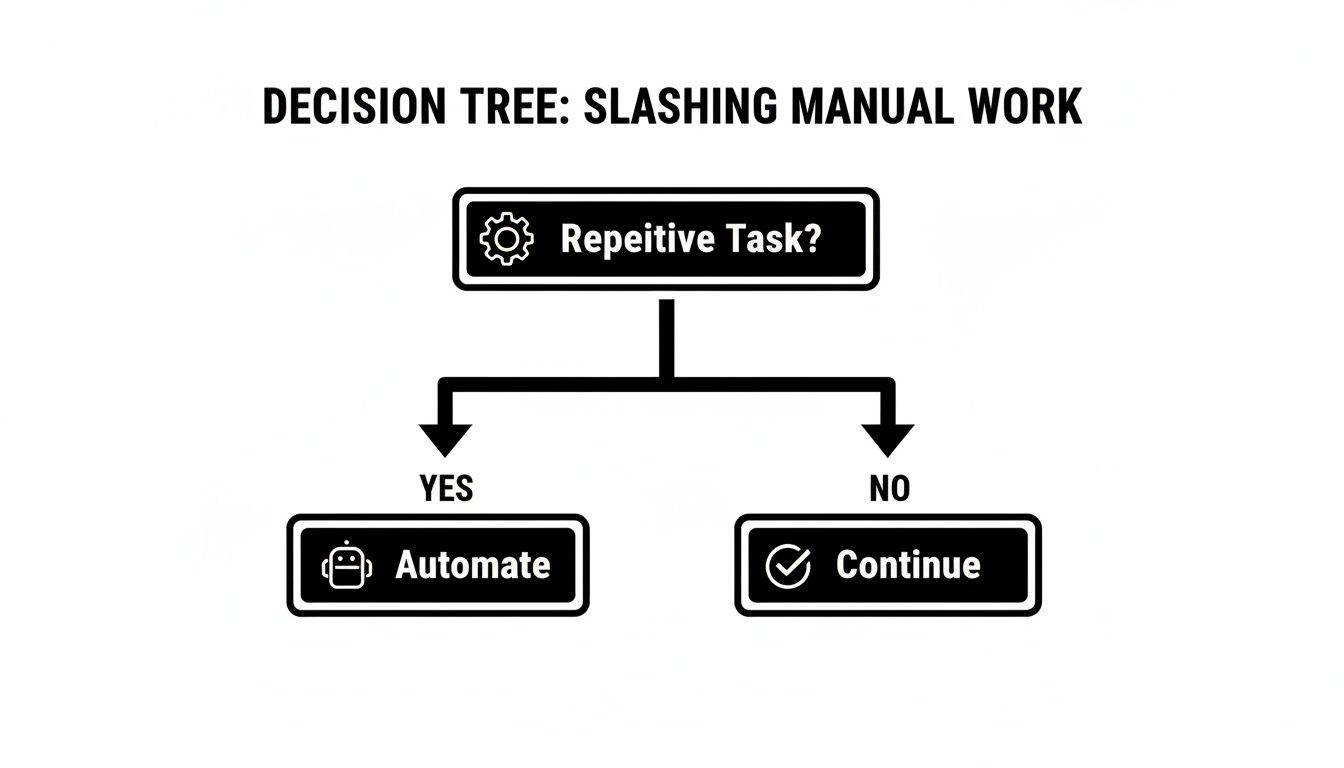
The takeaway is simple: if a task is repetitive, automating it is almost always the right move. It’s a direct path to boosting efficiency and cutting down on those hidden labor expenses that quietly eat away at your profits.
Adopting a Lean Inventory Model
A lean inventory approach is all about holding the absolute minimum amount of stock you need to meet customer demand without selling out. It’s a bit of a balancing act, but one that pays off big time. You’re essentially shifting from a "just-in-case" mindset to a "just-in-time" reality.
Stop guessing what you’ll sell in the next six months and start using your own sales data to forecast more accurately. Look at the sales velocity for each product over the last 30, 60, and 90 days. This historical data is your crystal ball for predicting future needs, helping you avoid both costly stockouts and profit-draining overstock.
A classic mistake is ordering inventory based on a gut feeling or a supplier's recommendation. Let your data do the talking. If a product hasn't sold in 90 days, it's dead stock—and it's costing you money every single day it sits there.
Choosing the Right Fulfillment Strategy
Once you’ve got a handle on your inventory, the next big question is how to actually get it to your customers. The fulfillment model you choose has a massive impact on your costs, your ability to scale, and the experience your customers have. For a small seller, it usually comes down to three main paths.
- In-House Fulfillment: You pick, pack, and ship every order yourself from your home, office, or a small storage space. This gives you total control over quality and branding, but it can quickly become a massive time-suck as you grow.
- Third-Party Logistics (3PL): You hand off your storage and shipping to a specialized company. They handle everything from receiving inventory to packing orders and managing returns. This frees up your time but introduces a new operational cost.
- Dropshipping: You never touch the inventory at all. When a customer orders, you just pass the details to your supplier, who ships directly to them. This model has the lowest startup costs but also the thinnest profit margins and zero control over the shipping experience.
Making the right choice really depends on your business stage, product type, and order volume. For more comprehensive cost control as you grow, it's worth exploring supply chain management outsourcing, which can provide expert guidance on these complex operational decisions.
Making a Data-Driven Decision
So, how do you decide? Start by calculating your current fulfillment costs. Add up everything you spend on shipping supplies, postage, and—most importantly—the value of your time. Now, compare that number to quotes from a few 3PL providers.
Sellers are often surprised to find that while a 3PL has direct fees, the savings from their negotiated bulk shipping rates and the hours you get back make it a more profitable choice much sooner than they expected. Don't let the fear of losing control stop you from making a smart financial move that frees you up to actually grow the business.
Reducing Marketing Spend Without Losing Growth
The idea of slashing your marketing budget can feel like you're pulling the plug on your own business. There's a common (and understandable) fear that spending less automatically means selling less. But that's not the whole story.
The smart way to cut costs here isn't about spending less—it's about spending smarter. It’s about making every single dollar you put into marketing work twice as hard.
This all starts by getting surgical with your campaign data. Before you pause a single ad, you need to know exactly what’s performing and what’s just burning through your cash. Dive into your analytics and find your star players—the campaigns, ad sets, or keywords with the highest Return on Ad Spend (ROAS). Instead of a blanket cut, double down on what's already proven to bring in the money.
At the same time, you have to be ruthless about cutting the dead weight. Any ad campaign that isn't delivering a positive return is a liability. Pausing these underperformers is the quickest way to stop the bleeding and free up funds to reinvest where they'll actually make a difference.
Pivot to High-ROI Organic Channels
Once you've trimmed the fat from your paid ads, the next play is to shift your energy to high-impact, low-cost marketing channels. These are the assets you build over time that keep paying you back long after you've put in the initial work.
- Search Engine Optimization (SEO): This is the ultimate long game. Optimizing your product pages and whipping up some helpful blog content doesn't cost you anything but your time, yet it can bring in highly qualified traffic for months, or even years.
- Email Marketing: Your email list is one of the most valuable things you own. It costs next to nothing to send a campaign to people who already know and trust you, making it one of the highest ROI activities in your toolkit.
- User-Generated Content (UGC): This is your secret weapon. Encouraging customers to share photos and reviews of your products creates a powerful, authentic marketing engine that practically runs itself.
Think of your marketing strategy like an investment portfolio. Paid ads are your high-risk, high-reward stocks, while channels like SEO and email are your steady, reliable bonds. A healthy business needs a mix of both to really thrive.
Turn Your Customers into Your Best Marketers
Nothing sells a product better than seeing a real person loving it. Customer reviews and photos are pure marketing gold, and the best part? They're free. You just need a system to get them consistently.
A simple, automated email sequence that goes out after a purchase is incredibly effective. A few days after a customer gets their order, send a friendly email asking for a review. If you want to really boost response rates, try offering a small incentive, like a 10% discount on their next purchase. It’s a tiny gesture that not only encourages a review but also drives repeat business—a true win-win.
Test New Channels with a Micro-Budget
Cutting costs doesn't mean you should stop trying new things. The key is to test potential growth channels without betting the farm. Set aside a small, dedicated "testing fund"—even $50 or $100 is plenty to start.
Use this micro-budget to run small-scale experiments on new platforms. Maybe it's a TikTok ad, a collaboration with a nano-influencer, or a sponsored post in a niche newsletter. Set a clear goal for each test and watch the results like a hawk. If an experiment shows promise, you can slowly feed it more budget. This disciplined approach lets you find new growth opportunities without breaking the bank.
Slashing Product Photography Costs with AI
In e-commerce, your product photos do all the heavy lifting. They're your digital handshake, the window display of your online shop, and often the single biggest reason a shopper clicks "Add to Cart." But let's be honest, for small sellers, the cost of traditional product photography can be a total gut punch.
A full-blown professional photoshoot can easily rocket into the thousands. You've got to account for the photographer's time, studio rental, fancy lighting gear, and then all the post-production editing. It's a massive expense that often forces sellers into a tough spot, making them compromise on image quality, which almost always means compromising on sales.
The Smartphone and AI Shift
But here's the good news: that supercomputer in your pocket (your smartphone) is more than capable of capturing fantastic source images. The real bottleneck—and where the costs used to balloon—was transforming that simple photo into a polished, professional shot.
This is where AI-powered tools have completely changed the landscape. They handle all the tedious, expensive, and technical parts of photo editing automatically, putting professional-grade results within everyone's reach.
By ditching traditional photoshoots for an AI-assisted workflow, I've seen sellers cut their product photography expenses by as much as 90%. This isn't just a cost-saving measure; it’s about becoming incredibly fast and consistent with your visual branding.
Instead of waiting days or even weeks to get images back from an editor, you can now generate a whole batch of on-brand visuals in just a few minutes.
A Smarter Workflow for E-commerce Imagery
The process couldn't be simpler. You just take a clear, well-lit photo of your product on your phone. Don't even worry about the background. Then, you upload it to a platform like ProdShot.
From there, the AI magic kicks in:
- Flawless Background Removal: It instantly and cleanly snips your product out from its original background.
- Realistic Shadows: The AI adds subtle, believable shadows that give your product depth and prevent it from looking like a flat sticker.
- Lighting and Color Fixes: It automatically brightens up the image and corrects colors, making your product look its absolute best.
- Endless Backgrounds: This is the fun part. You can place your perfectly cut-out product onto a limitless array of AI-generated backgrounds to perfectly match your brand's vibe.
Just look at how a basic phone picture gets an instant upgrade.

This simple before-and-after shows you everything. You’re eliminating the need for Photoshop skills or any manual editing, turning a regular photo into a clean, marketplace-ready image in seconds.
To really see the difference, let's break down the numbers.
Cost Comparison: Traditional vs. AI Photography
| Cost Factor | Traditional Photoshoot | AI Solution (e.g., ProdShot) |
|---|---|---|
| Photographer/Studio | $500 – $5,000+ | $0 (use your smartphone) |
| Equipment Rental | $200 – $1,000+ | $0 |
| Retouching/Editing | $50 – $200 per hour | Included in a low-cost subscription |
| Turnaround Time | 3-14 days | Under 5 minutes |
| Image Variations | Limited to the shoot | Unlimited backgrounds/scenes |
| Total Per Product | $100 – $500+ | $0.10 – $1.00 per image |
The numbers don't lie. The AI approach completely demolishes the old model on both cost and speed.
This modern workflow gets rid of the need for pricey gear, studio space, and freelance editors. You're cutting one of the biggest creative line items in your budget while getting better and more flexible results.
If you want to see it in action, check out an AI product photo generator for yourself. You'll be amazed at how quickly you can create scroll-stopping images. Making this switch is one of the most direct and impactful ways to reduce your business costs and level up your most important sales tool: your product photos.
Common Questions About Cutting Costs
When you start digging into your business finances, a lot of questions come up. It's totally normal. Here are some of the most common ones we hear from sellers, along with some straightforward, real-world answers.
How Often Should I Really Be Looking at My Expenses?
A full, deep-dive audit of every single line item is something you should tackle at least once a year. But don't wait 12 months to check in. I recommend a lighter review of your big-ticket spending categories—think marketing, software, and shipping—every quarter.
This regular pulse-check is what helps you spot rising costs before they spiral out of control. It’s all about staying lean and efficient on an ongoing basis.
The goal isn't just a one-time purge of expenses. It's about building a continuous habit of financial awareness that keeps your business healthy and profitable month after month.
What's the First Thing I Should Try to Cut?
If you're looking for an immediate impact, go straight for your recurring software subscriptions. "SaaS sprawl" is a real thing, and it's incredibly easy to end up paying for tools you forgot you signed up for or features you never use. A quick audit of your monthly software bills can often free up hundreds of dollars without touching your core operations.
Another quick win? Look at your packaging. Seriously. Shaving even an inch off your box dimensions or switching to a lighter void fill can dramatically lower your shipping expenses over time. It all adds up.
Is Slashing Costs Always the Right Move?
Absolutely not. The real key is to cut waste, not investment.
Slashing your marketing budget to zero might save cash this month, but it could kill your sales pipeline for the entire next quarter. In the same way, switching to the absolute cheapest supplier might lower your COGS, but if your product quality tanks, so will your brand reputation.
Always ask yourself: is this expense driving growth, or is it just operational drag? Smart cost reduction is about eliminating inefficiencies, not choking off the resources that actually help your business grow.
Ready to slash your product photography costs by up to 90% without sacrificing quality? With ProdShot, you can turn simple smartphone pictures into stunning, professional images in seconds. Stop overspending and start creating visuals that sell. Explore how at https://prodshot.net.