
Ever walked into a perfectly arranged supermarket? The fresh produce is right there at the entrance, beckoning you in. The seasonal items have their own special display, impossible to miss. And, of course, the pasta and the pasta sauce are conveniently located side-by-side.
None of that is by accident. It’s the result of careful physical merchandising, a strategy designed to make your shopping trip smooth, intuitive, and maybe even a little more expensive than you planned.
Ecommerce merchandising is just that, but for your online store.
What Is Ecommerce Merchandising Anyway?
Instead of arranging physical shelves, you’re organizing digital ones. It's the art and science of presenting your products in a way that guides customers and boosts sales. It’s about strategically placing products, promotions, and content to create a shopping experience that just feels right.
Think of it as the digital equivalent of an expert shopkeeper who knows exactly what their customers want. The core idea is simple: show the right product, to the right person, at the right time. This involves everything from your site's navigation and search bar to the quality of your product photos and the way you suggest other items they might love.
The end goal? To get rid of any friction and create a seamless path from the moment someone lands on your homepage to the second they click "complete purchase."
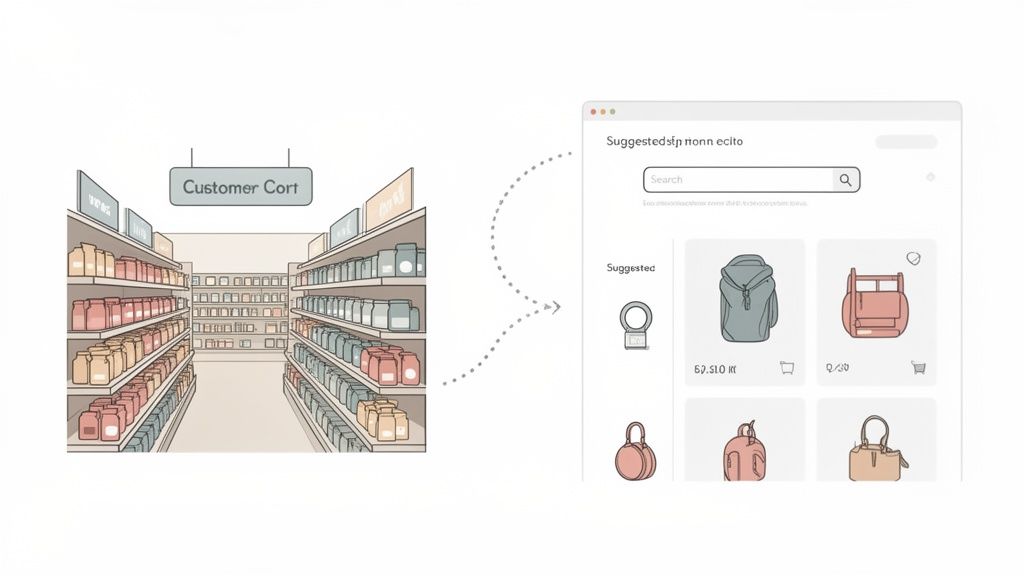
From Physical Aisles to Digital Clicks
While the goal is identical, the tools couldn't be more different. A physical store uses bright signs, eye-catching endcaps, and helpful staff. An online store uses crisp, high-resolution images, smart, personalized recommendations, and targeted banner ads.
Great digital merchandising ensures that when a customer arrives, they don’t just find what they were looking for—they also discover other products that feel like they were picked just for them.
To really get a feel for this shift, it helps to see how old-school retail tactics have evolved for the online world.
Digital Merchandising vs Physical Store Merchandising
This table breaks down how classic brick-and-mortar strategies find their new life online. You'll probably recognize a lot of these from your own online shopping.
| Physical Store Tactic | Ecommerce Equivalent |
|---|---|
| Window Displays | Homepage Banners and Hero Images: These grab attention and showcase your most important promotions or new arrivals. |
| In-Store Signage | Website Navigation and Categories: Clear menus and logical product groupings help shoppers find their way around your store. |
| Endcap Promotions | Featured Collections and "Best Sellers": Highlighting popular or seasonal items on key pages to drive visibility and sales. |
| Helpful Sales Staff | AI-Powered Product Recommendations: Suggesting related or complementary items ("You might also like…") to enhance the shopping experience. |
See the parallels? It's all about guiding the customer's eye and making it incredibly easy for them to buy. The medium has changed, but the fundamental human psychology behind shopping remains the same.
Why Merchandising Is Your Ecommerce Secret Weapon
In a digital world overflowing with choices, just having great products on your virtual shelf isn't enough to make a sale. Your online store isn't just competing with direct rivals; it's fighting for attention against every other tab open in your customer's browser. This is where smart ecommerce merchandising stops being a "nice-to-have" and becomes your most critical tool for driving real growth.
Think of it this way: what’s the difference between a cluttered, confusing flea market and a sleek, high-end boutique? Both might sell quality goods, but only one creates an experience that feels effortless, builds trust, and tempts you to spend more. That's exactly what effective merchandising does for your website.
It has a direct, measurable impact on the numbers that actually matter to your profitability. By guiding customers to the products they’ll fall in love with, you’re not just making a single sale—you’re laying the groundwork for a business that lasts.
Boosting Your Key Business Metrics
A well-oiled merchandising strategy isn't just about making things look pretty; it's a financial lever that moves the needle in several core areas of your business.
- Higher Conversion Rates: When shoppers can easily find what they're looking for—and better yet, discover products they didn't even know they needed—they are far more likely to click "add to cart." Merchandising is all about removing that friction.
- Increased Average Order Value (AOV): Simple tactics like bundling a camera with a lens or showing "Customers Also Bought" suggestions are pure merchandising. They work by encouraging shoppers to add more to their carts, which immediately boosts the value of every single transaction.
- Enhanced Customer Lifetime Value (CLV): A seamless and genuinely enjoyable shopping trip fosters loyalty. Happy customers come back, spend more over time, and turn into your best advocates.
This obsession with presentation and the customer journey is more important than ever. The global ecommerce market is absolutely massive, with sales projected to hit a staggering $6.86 trillion in the upcoming year. In a marketplace that big, how you present your products becomes the tie-breaker for capturing attention and revenue. You can find more details on these trends and discover more insights about ecommerce growth on sellerscommerce.com.
From Shopper Frustration to Brand Loyalty
Without thoughtful merchandising, you’re leaving your customers to fend for themselves. They might land on a page filled with random products, get lost in a confusing navigation menu, or completely miss a promotion that would have sealed the deal. Each one of these small frustrations adds up, and it often ends with a bounced session and a lost sale.
Merchandising transforms your website from a simple product catalog into a guided shopping experience. It anticipates customer needs, answers their questions visually, and builds the confidence they need to click "buy."
By optimizing how your products are displayed, described, and recommended, you kickstart a positive feedback loop. Shoppers feel like you "get" them, their experience is smooth, and they start to trust your brand. This trust is the absolute cornerstone of loyalty, turning one-time buyers into repeat customers who feel a real connection to your store.
Of course, to do this right, your product visuals have to be exceptional. You can learn more about the cost of professional product photography and see how investing in great images fits into your broader merchandising strategy.
The Five Pillars of Digital Merchandising
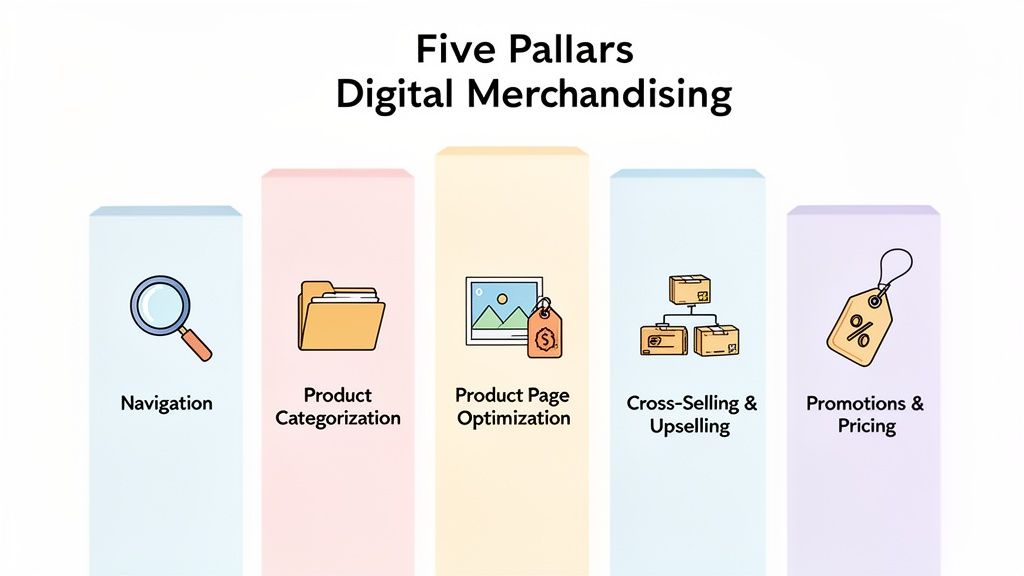
Great ecommerce merchandising isn't something that just happens. It’s a deliberate strategy built on a solid foundation. If you break the process down into five essential pillars, you can build a framework that creates a seamless, high-converting shopping experience from the moment someone lands on your site.
Think of these pillars as the core architecture of your digital storefront. Each one has a specific job, but they all have to work together to guide customers, eliminate friction, and make the path to purchase feel totally intuitive.
Let's dive into each one.
Site Navigation and Search
Your site’s navigation and search bar are the digital equivalent of a physical store’s aisles and signs. It doesn't matter how amazing your products are if customers can't find them. Clean, logical navigation helps shoppers figure out where they are and explore what you have to offer without getting lost.
The search bar is even more important. It’s your most helpful salesperson, especially for shoppers who already know what they want. In fact, one study found that visitors who use on-site search are 1.8 times more likely to convert. Optimizing your search with features like autocomplete and typo correction isn't a luxury anymore; it’s a must-have.
Great navigation anticipates where a shopper wants to go, while a powerful search function takes them there instantly. Together, they form the backbone of a user-friendly store.
Product Categorization
Once shoppers can find their way around, they need to see products organized in a way that makes sense. That’s product categorization—your digital shelf organization. Grouping items into logical categories and subcategories helps customers browse and compare their options without feeling overwhelmed.
For instance, a clothing store wouldn’t just lump everything under "Tops." They’d break it down into more useful subcategories:
- T-Shirts
- Blouses
- Sweaters
- Tank Tops
This kind of detail lets shoppers drill down to find exactly what they’re looking for in just a few clicks, making the whole browsing experience much smoother.
Product Page Optimization
The product page is your final sales pitch. It's where you seal the deal. This page has to be compelling, informative, and above all, trustworthy.
High-quality visuals are the star of the show here. Professional, clear images build confidence and answer a customer's questions before they even think to ask them. To nail this, many store owners use professional photo editing services for ecommerce to make sure every single image is polished and looks consistent.
Beyond great photos, your product page needs detailed descriptions, specs, customer reviews, and transparent pricing. Every element works together to overcome the fact that the customer can’t physically touch the product, building the trust they need to finally click "add to cart."
Cross-Selling and Upselling
Think of these as the strategic impulse buys of the online world. They are classic merchandising tactics designed to increase your Average Order Value (AOV).
- Upselling is about encouraging a customer to buy a more premium, higher-priced version of the item they're looking at (like suggesting the 256GB phone instead of the 128GB one).
- Cross-selling is about recommending complementary products that go with the item in their cart (like showing a camera case and memory card on a digital camera's product page).
When you get this right, these suggestions feel helpful, not pushy. They add real value to the customer's purchase and can significantly boost your revenue.
Promotions and Pricing
Finally, promotions and pricing are your digital "SALE" signs. This pillar covers everything from weekend discounts and BOGO offers to loyalty programs and free shipping thresholds. Smart promotions create a sense of urgency, attract new customers, and can help you move older inventory.
Clear, upfront pricing is just as crucial for building trust. When you present your offers and prices in a straightforward way, with no hidden fees, you create a positive experience that encourages both an immediate sale and long-term loyalty.
Mastering Visual Merchandising for Your Online Store
When you're in a real-life store, you can pick something up, feel its weight, and turn it over in your hands. Your online customers don't have that luxury. Your product visuals—the photos and videos on your site—have to do all that heavy lifting for them. They are the digital stand-in for that critical hands-on experience.
You could argue that visual merchandising is the single most important part of your overall e-commerce strategy. Why? Because it builds instant trust and answers a dozen unspoken questions before a customer even thinks to ask them. Think of your product photos as your best salesperson, working 24/7 to show, not just tell, people why your product is worth buying.
When a shopper sees a crisp, professional image, it sends a powerful signal: this brand is credible and cares about quality. On the flip side, blurry or inconsistent photos can make even the best products feel cheap or untrustworthy, giving potential buyers a reason to hesitate and click away for good.
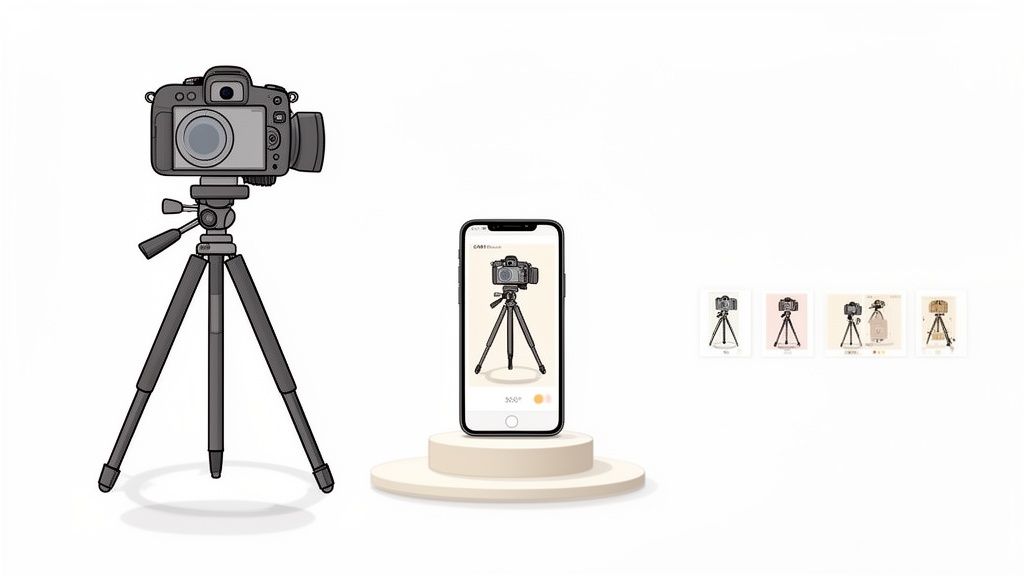
Best Practices for Compelling Visuals
Creating visuals that actually convert doesn't require a Hollywood-sized budget, but it absolutely demands attention to detail. If you focus on getting these fundamentals right, you'll give your products the spotlight they deserve and give customers the confidence they need to buy.
- Use High-Resolution Images: Every photo needs to be sharp and clear. Let customers zoom in and inspect the little details without the image turning into a pixelated mess.
- Show Multiple Angles: Give them the full tour. Show your product from the front, back, side, and any other angle that gives a complete picture of what they’re getting.
- Include Lifestyle and In-Context Shots: Help customers imagine the product in their own lives. A photo of a couch in a stylish living room is infinitely more compelling than one floating in a white void.
- Implement 360-Degree Views or Video: For anything complex or interactive, a 360-degree view or a short demo video can be a game-changer. It dramatically boosts engagement and answers questions about how something actually works.
Following these simple guidelines will make your product pages far more engaging and informative. You can get more great tips on creating that professional look by reading up on professional Shopify product photography.
A single great product video can increase the chances of a purchase by up to 85%. Visuals aren't just website decoration; they're powerful conversion tools that directly impact your bottom line.
The Rise of AI in Product Imagery
Not long ago, getting a polished, professional look meant shelling out for expensive photoshoots and hiring skilled editors. That's not the case anymore. Modern AI tools have put top-tier visual merchandising within reach for everyone, no matter their budget or technical know-how.
These tools can take a simple smartphone photo and automatically remove the background, enhance the lighting, and create a whole set of consistent, on-brand images. This means you can generate a full gallery of high-quality visuals in minutes, not days, making sure every single product looks its absolute best. It’s a huge leg up for small businesses and marketplace sellers trying to compete with bigger brands.
And remember, mastering your visuals isn't just for your website. You need to carry that consistency over to all your channels. Weaving these same principles into your ecommerce social media marketing that sells can amplify your reach and pull more traffic back to your store. High-quality, consistent visuals everywhere reinforce your brand and create a smooth, trustworthy experience for your customers.
Key Merchandising Metrics You Need to Track
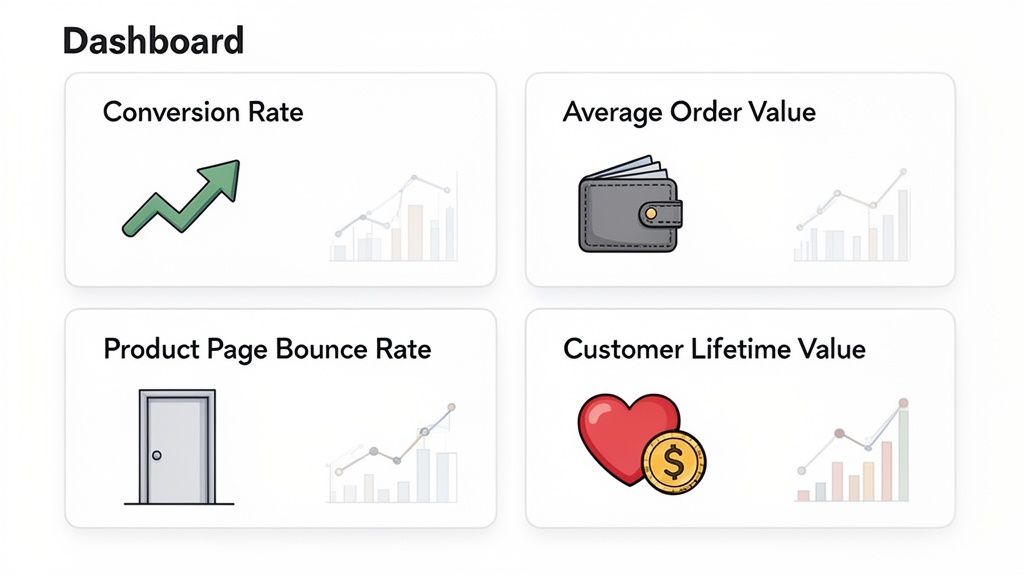
Great e-commerce merchandising isn't about guesswork or just making things "look nice." It's a data-driven science. If you want to know if your strategies are actually moving the needle, you have to track the right numbers—your key performance indicators (KPIs).
Think of these metrics as the language of your online store. They tell you exactly what your shoppers are doing, where they’re getting stuck, and what finally makes them click "buy." Your analytics dashboard is your command center. Without it, you're flying blind, unable to tell a brilliant product display from one that's actively driving customers away.
Core Metrics That Tell the Story
While you could get lost in dozens of data points, a few core metrics give you the clearest picture of how your merchandising is performing. Focusing on these will give you the most bang for your buck.
- Conversion Rate: This is the big one—the percentage of visitors who actually make a purchase. If it’s low, it could be a red flag that your product pages lack compelling photos, the descriptions are confusing, or your site is just hard to navigate.
- Average Order Value (AOV): This tracks the average amount spent every time someone checks out. Smart cross-selling and product bundling are designed specifically to push this number up.
- Product Page Bounce Rate: This is the percentage of people who land on a product page and leave without doing anything else. A high bounce rate might mean your photos are low-quality, the price is unclear, or there’s a mismatch between your ad and the actual product.
- Customer Lifetime Value (CLV): This forecasts the total amount of money you can expect from a single customer over time. Great merchandising creates an experience that brings people back, which is the key to boosting CLV.
Tracking these metrics is like listening to your customers. A sudden drop in the conversion rate on a category page, for instance, is a clear signal that the way you're sorting or presenting products just isn't working for them.
Turning Data into Action
Data is only useful if you do something with it. Beyond just tracking, your merchandising choices directly impact KPIs like Average Order Value. For some proven tactics, you can explore how to increase Average Order Value for your own store.
This is especially critical in crowded markets. The United States, for instance, is a massive battleground where retail e-commerce sales are projected to hit $1.47 trillion next year. In that kind of environment, shoppers expect a very high standard for how products are presented.
By consistently keeping an eye on your metrics, you can spot trends, find the friction points in the customer journey, and double down on what’s working. This turns your merchandising from a static display into a dynamic system that constantly adapts to create a better shopping experience and, ultimately, drive more sales.
Your Top Ecommerce Merchandising Questions, Answered
Alright, so we've covered the what and the why. But as soon as you start trying to put this stuff into practice, the real questions pop up. It's one thing to understand the framework, but it's another to know exactly how it all fits together on your own site.
This is where the rubber meets the road. Let's clear up a few of the most common stumbling blocks that trip up store owners, so you can move forward with confidence.
Marketing vs. Merchandising: What's the Real Difference?
This one causes a ton of confusion, but the distinction is actually pretty simple once you see it. It all comes down to where the customer is in their journey.
Marketing gets people in the door. Think of all the ways you shout about your brand from the rooftops: social media ads, email newsletters, your SEO strategy. These are the activities that drive awareness and bring traffic to your online store.
Merchandising is what makes them stay and buy. Once they land on your site, it's all merchandising. The homepage layout, how you group products into collections, the photos you use, and the "you might also like" suggestions—that's all you, the merchant, creating a deliberate shopping experience. Marketing brings the traffic; merchandising converts it.
Think of it like a restaurant. Marketing is the flashy billboard on the highway that convinces you to pull over. Merchandising is the beautifully designed menu, the tempting daily specials board, and the waiter walking by with a sizzling dessert tray that convinces you to order a three-course meal.
How Can I Improve Merchandising on a Tiny Budget?
Good news: you don't need a huge budget to make a massive difference. In fact, some of the highest-impact improvements are completely free. Smart, focused effort beats a big spend every time.
Here are a few low-cost tactics that punch way above their weight:
- Master Your Photography: Seriously, your smartphone is probably all you need. Find a spot with good natural light, use a simple background (a plain wall or a piece of poster board works wonders), and focus on consistency. Crisp, clear photos are more important than fancy gear.
- Write Descriptions That Sell: Don't just list specs. Tell the story behind the product. Why is it great? What problem does it solve? Think about the questions a customer would have and answer them right there in the copy.
- Make Your Store Easy to Shop: Your product categories should be second nature to a new visitor. If you sell clothes, don't just dump everything under "Tops." Break it down into "T-Shirts," "Blouses," and "Sweaters." The easier it is to find something, the more likely someone is to buy it.
- Let Your Data Guide You: Every ecommerce platform has basic analytics. Dive in! See which products get the most views and put them front-and-center on your homepage. Find the pages where people leave most often—that's where you should focus your energy first.
How Often Should I Update My Merchandising Strategy?
Your store should feel alive, not like a dusty old catalog. A "set it and forget it" approach is a recipe for stale inventory and missed opportunities. The key is to adapt to customer behavior, seasonal trends, and what your sales numbers are telling you.
A simple tiered schedule can work wonders:
- Weekly Check-in: Take a quick look at your best-sellers and most-viewed products. Are they easy to find? Feature them on the homepage or in a "Trending Now" collection.
- Monthly Review: Dig into your sales data to spot what's not moving. It might be time to bundle those slow-movers, run a small promotion, or create a "Last Chance" collection to clear them out.
- Seasonal Overhaul: This is for the big stuff. Plan major refreshes around holidays, seasons, and big events like Black Friday. This means new homepage banners, themed collections, and gift guides that feel timely and relevant.
By keeping a regular pulse on your store, you create a fresh and responsive experience that keeps people coming back. You’re not just managing a store; you’re building a destination.
Ready to create scroll-stopping product images without the hassle of a photo studio? ProdShot uses AI to turn your simple smartphone photos into professional, on-brand visuals in seconds.
Elevate your store and boost your sales by visiting https://prodshot.net to start your free trial today.