
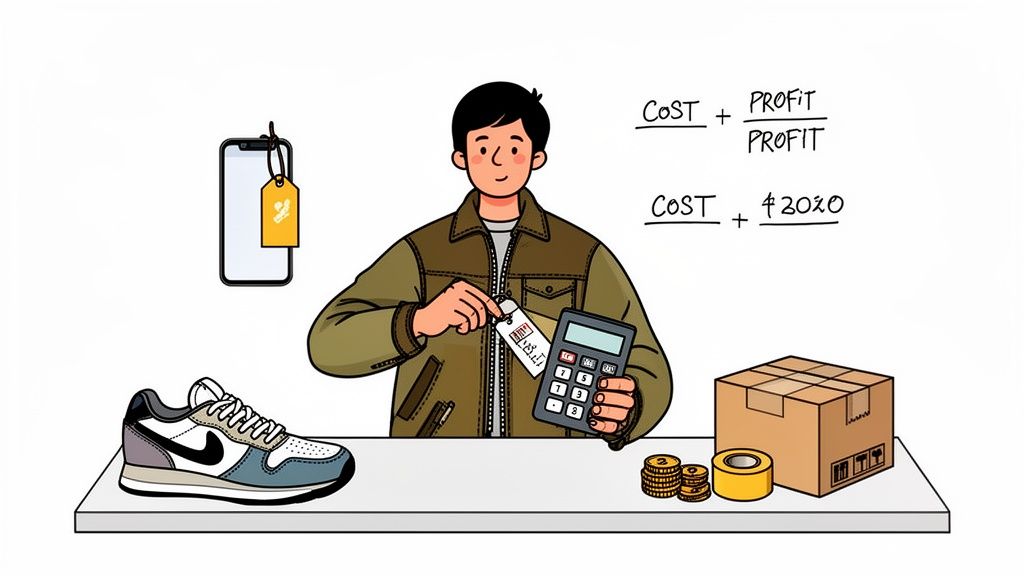
If you want to build a real resale business, you have to stop guessing what your items are worth. The most common mistake new sellers make is thinking profit is just the sale price minus what they paid for the item. That's a surefire way to end up working for free.
The real money is made by knowing your numbers inside and out. It all starts with a simple idea: Cost of Goods + Expenses + Desired Profit = List Price. Let's break down how to actually use this to build a profitable pricing strategy from day one.
Building Your Profitable Resale Pricing Foundation
Before you even think about listing that first item, you need a solid financial game plan. Pricing on a whim or just copying a competitor's price without knowing their costs is the fastest way to lose money or leave it sitting on the table.
The real challenge is translating what you paid for something into a smart list price that not only attracts buyers but actually pads your bank account. It’s the one thing that separates serious resellers from hobbyists who are just spinning their wheels.
What Is Your True Cost of Goods?
Your "Cost of Goods" goes way beyond the sticker price you paid at the thrift store. It's every penny you spent just to get that item into your hands and ready to sell.
Think about it this way:
- The Sticker Price: What you paid for the item itself.
- Sourcing Costs: The gas you used driving to three different garage sales, the entry fee for that flea market—it all adds up.
- Prep Costs: Did you have to buy special cleaner? A bottle of wood polish? New laces for those boots? That's part of your cost.
Let’s say you snag a great-looking leather jacket for $15. You spend $5 on some leather conditioner to bring it back to life and figure you used about $2 in gas on your sourcing trip. Your actual Cost of Goods isn't $15. It's $22. Getting this number right is the foundation for everything else.
Don't Forget the "Hidden" Expenses
Profit has a nasty habit of disappearing right before it hits your wallet. These "hidden" expenses—the costs you pay after the sale—are what silently kill your margins. You absolutely have to account for them upfront in your list price.
The biggest profit killers are almost always platform fees and shipping supplies. A 15% final value fee on a $50 item is $7.50 gone instantly. Throw in $2 for a good box and some bubble wrap, and your profit just shrank by nearly $10.
A smart pricing model anticipates these costs before you ever list the item. Getting a handle on all the potential variables is key, and it's a universal challenge in the resale world. Learning from established methods, like those in A Guide to Maximizing Profits through pricing for estate sales, can give you a structured framework no matter what you're selling.
Setting Your Target Profit Margin
Okay, you've tallied up your true cost and accounted for all the fees and expenses. Now for the fun part: deciding on your profit.
You might hear about the "3x rule" (pricing an item at three times what you paid for it). It's a decent starting point, but a much sharper way to operate is to aim for a specific profit margin.
The resale market is absolutely exploding—it's projected to nearly double from $177 billion in 2022 to $350 billion by 2027. To get your piece of that pie, you need to be strategic. A healthy target gross margin for many resellers is around 50% after all costs are paid.
This means if your total costs (your true cost of goods + all those hidden expenses) come out to $25, you should aim to have $25 left over as pure profit. That leads you to a list price of $50 (plus whatever the customer pays for shipping). This simple math ensures you're building a sustainable, profitable business with every single sale.
Calculating Your True Costs to Set Healthy Profit Margins
Let’s talk about profit. It’s not the number you see when a customer clicks "buy." Real profit is what's left in your pocket after every single expense, big and small, has been paid. Honestly, failing to grasp this is the single biggest mistake that holds resellers back and keeps them stuck in a loop of being busy but broke.
To build a business that actually pays you for your time, you have to become a detective, uncovering all the costs tied to each item you sell. This means looking past the obvious thrift store price tag and finding the less-visible expenses that silently eat away at your earnings. This isn't just about good bookkeeping; it’s about creating a pricing model that guarantees you a real profit on every single sale.
Identifying Every Single Cost
The first thing you need to nail down is your total Cost of Goods Sold (COGS). This number is so much more than what you paid for the item itself. It’s your financial starting line, the sum of all direct expenses needed to get your item ready to sell.
Think of it like this:
- Sourcing Cost: The price you paid for the item, whether at a garage sale or a high-end consignment shop.
- Inbound & Prep Costs: This is where the hidden costs start. It’s the gas money for your sourcing trip, the special detergent for a vintage dress, the glue for a small repair, or any replacement parts needed to make the item perfect.
Let's say you snag a vintage jacket for $10. You spend $3 on a special cleaner to get a small stain out and figure you used about $2 in gas on your sourcing run that day. Your COGS isn't $10—it’s $15. That’s your true cost before any marketplace ever takes a cut.
This flow chart breaks down the basic components that build up to your final resale price.

As you can see, your final list price has to be built on a solid foundation of your initial cost and all those related expenses. Only then can you start thinking about the good part: your profit.
Uncovering the Hidden Profit Killers
The moment an item sells, a whole new set of costs pop up. I call these the "profit killers" because if you haven't planned for them, they can turn what looked like a great sale into a break-even headache.
Here are the usual suspects:
- Platform Fees: Marketplaces like Etsy, eBay, and Poshmark all take a piece of the pie. This is usually a percentage of the total sale price, which often includes what the buyer paid for shipping. Expect fees anywhere from 10% to 20%.
- Payment Processing Fees: On top of platform fees, companies like PayPal or Stripe charge for handling the money. This is typically around 3% plus a small fixed amount per transaction.
- Shipping & Handling Supplies: Don’t forget about the boxes, bubble mailers, tape, printer ink, and labels. These small amounts feel like nothing but can easily add up to a few dollars per package.
- Marketing & Listing Fees: Some platforms charge a small fee just to list an item, or they'll offer paid promotions to boost your visibility.
Pro Tip: Your time is a cost, too. While you might not bake an hourly wage into every price, you have to be mindful of it. If an item takes you hours to clean, photograph, and list for a tiny profit, it just might not be worth the hustle.
Even creating your product photos has a cost, though smart tools can keep it low. For more on balancing photo quality with your budget, check out our guide on the cost of professional product photography.
Calculating Your Breakeven and Profit Margin
Okay, you've tallied up all your costs. Now it's time for the most important math. First, figure out your breakeven price—this is the absolute minimum you can sell an item for without losing a single cent.
Breakeven Price = COGS + All Fees + Shipping Supplies
Let’s go back to that $15 jacket. We want to list it for $50 on Etsy.
- COGS: $15.00
- Estimated Etsy Fees (Transaction + Ad Fee + Listing + Payment): roughly $8.45
- Shipping Supplies: $2.50
Your total expenses are $25.95 ($15.00 + $8.45 + $2.50). That’s your breakeven point. By selling it for $50, you’re left with a profit of $24.05. That's a healthy 48% profit margin.
Most experienced resellers aim for margins between 50-70%, which gives you a buffer for unexpected costs or the need to run a sale. Doing this math puts you in control, letting you price strategically instead of just guessing.
Mastering Market Research for Smart Pricing
Trying to price your items without knowing the market is like flying blind. You might land eventually, but you'll probably miss the runway and leave a lot of money on the table. To get your pricing right, you have to become a bit of a market detective, focusing on what items actually sell for, not just what people are asking.
So many sellers make the mistake of basing their prices on other active listings. That’s a trap. An active listing only tells you what someone hopes to get for an item. The real gold is in the sold comps—the hard data on what real buyers have already paid.
Finding the True Market Value
Your first job is to figure out what your item is genuinely worth to a customer today. This means digging into the sales history on the platform you’re selling on.
- On eBay: This is the king of sold comps. Search for your item, then head to the filters and check the "Sold Items" box. You'll see every similar item sold in the last 90 days and, most importantly, the final price.
- On Poshmark: It’s just as easy. After you search, filter "Availability" to "Sold." This gives you a direct look at what the Poshmark community is paying.
- On Mercari: Same deal. Search for your item and tap the "Sold" filter to see all the recent sales.
These built-in tools are your absolute best friends. They give you concrete proof of an item's current value, pulling your pricing strategy out of the clouds and planting it firmly in reality.
One of the biggest lessons for any reseller is that market value is always in motion. A vintage t-shirt might have sold for $50 six months ago, but if that band just announced a reunion tour, its value could have doubled overnight. Always look at the most recent data.
Expanding Your Research Toolkit
What happens when you have a unique item with no recent sales on your go-to platform? Don't just guess. It's time to broaden your search.
Google Lens is a surprisingly powerful ally here. Just snap a picture of your item, and Google will scour the web for visually similar products. This is a great way to identify a brand you didn't recognize or find listings on smaller, niche websites, giving you more data to work with.
Once you have a solid grasp of your item's cost, combining that with smart market research is how you build a profitable pricing formula. A great guide on how to price used items for maximum profit can walk you through turning that research into real numbers.
Just look at the luxury resale market for a masterclass in data-driven pricing. That market, which hit $33 billion globally in 2022, runs entirely on deep research. Pricing a designer handbag depends heavily on its brand, rarity, and authenticity—proof that good data is everything.
A Competitor Analysis Checklist
Looking at sold listings is more than just glancing at the price. I run through a quick mental checklist to break down why a specific item sold well.
- Price Range: What’s the absolute highest and lowest price this item sold for in a similar condition? This gives you the ceiling and the floor for your own pricing.
- Condition Notes: How did the seller describe it? Were there flaws? An item sold "for parts" is a world away from one listed as "like new," and the price will reflect that.
- Keyword Usage: What words did the top-selling listings use in their titles? I look for specific terms about the style, era, or model that seem to be hitting the mark with buyers.
- Photo Quality: Let’s be real—how good were the pictures? Were they bright, clear, and shot against a clean background? Great photos almost always command a higher price. If you need help here, our guide on improving eBay product photos has some simple, effective tips.
With this intel, you can position your item like a pro. You'll know exactly where the market is and can confidently price your item to sell, or even justify a premium if your product’s condition and presentation are a cut above the rest.
How Great Photos Increase Perceived Value and Price
When you’re selling online, your photos do all the talking. They’re your digital storefront and your number one salesperson, working 24/7 to convince a buyer to click "add to cart." Pricing isn't just a numbers game; it’s about perception. And nothing shapes a buyer's perception more than a fantastic photo.
A killer picture can take a $10 thrift store find and make it feel like a $100 boutique piece. This isn't about being deceptive—it's just smart presentation. When buyers see an item that’s well-lit, crisp, and professionally shot, they automatically trust the seller and the product more. That trust directly translates into a willingness to pay a higher price.

On the flip side, a cluttered background, bad lighting, or blurry photos scream "low value." It tells the buyer that maybe the item—and the seller—aren't worth a premium price. A great photo builds an emotional connection before they even get to your description.
From Smartphone Snap to Studio Shot
Here's the best part: you don't need to be a pro photographer with a fancy DSLR to pull this off. The biggest headache for most sellers is getting that clean, consistent look without a dedicated studio. This is where modern editing tools have become a complete game-changer.
You can now use AI-powered photo editors to turn a basic smartphone picture into a pro-level shot in seconds. These tools are amazing for:
- Removing backgrounds to get rid of distracting clutter and create a clean, white backdrop.
- Fixing lighting by brightening up dark photos and eliminating weird shadows.
- Enhancing colors to make your product look vibrant and true-to-life.
This isn't just about making your stuff look pretty; it's a core business strategy. When you present your item like a high-end product, you get to price it like one.
The results are totally measurable. High-quality images can boost your conversion rates by up to 30%, turning more lookers into buyers. We've seen it happen time and again. One eBay seller started using AI to clean up their photos and saw their average sale price jump from $25 to $42. That’s a 68% increase in profit. You can dig into more stats like these in a detailed resale industry report from Gitnux.org.
A Mini Case Study: The Power of Presentation
Let's walk through a real-world example.
Before: A seller lists a vintage denim jacket they sourced for $12. The photo is taken on their messy bed, the light is dim, and the denim looks washed out. Looking at comps with similar bad photos, they price it at $28. After fees and shipping supplies, they’re looking at a profit of maybe $8.
After: The same seller snaps a new photo with their phone, this time against a plain wall. They run it through an AI editor to instantly remove the background, brighten the image, and make the blue denim pop. The jacket now looks crisp, clean, and way more desirable.
With that one simple fix, the seller can now confidently price the jacket at $45. It looks like a premium item, so buyers treat it like one. The potential profit is now over $25—more than a 3x return.
This isn't a fluke. By spending just a few seconds improving your visuals, you give yourself the power to price your items 15-20% higher than competitors with cluttered, low-effort photos. When your pictures are top-notch, you’re not just selling a used item—you’re selling a quality product, and you can command the price it deserves. If you want to dive deeper, check out our guide on professional product photo editing services.
Advanced Pricing Strategies and When to Adjust Them
Setting your price is just the opening move. The real game starts once your listing is live. This is where advanced pricing strategies come into play, and it’s what separates the casual flippers from the serious entrepreneurs. It’s less about "set it and forget it" and more about actively managing your listings to influence buyer behavior and keep your inventory moving.
These are the tactics that go way beyond a simple cost-plus-profit formula. We’re talking about tapping into buyer psychology and using the powerful tools on platforms like eBay, Poshmark, and Mercari to your advantage. You have to stay flexible and listen to what the market is telling you.

Pricing for the Human Brain
There’s a reason you see prices ending in .99 everywhere—it works. This classic retail trick, known as charm pricing, is just as effective online. Our brains are hardwired to see $49.99 as a significantly better deal than $50.00, even though it’s just a one-cent difference.
It’s all about the "left-digit effect." We anchor on that first number, so the "4" in $49.99 feels worlds away from the "5" in $50. This little psychological nudge creates a powerful perception of value. I’ve found this works best on items in the sweet spot of $20 to $100, where that jump from one ten to the next feels most significant to a buyer.
Another killer strategy is creating bundled deals. Got three video games from the same series? A set of four vintage coffee mugs? Package them together. This increases your average order value, gives the buyer a great deal, and honestly, it just makes your life easier with shipping.
How to Use Sales and Offers Without Giving Away the Farm
Running a sale or accepting offers can ignite interest in a stale listing, but you have to be smart about it. Go overboard, and you’ll just devalue your entire inventory.
- Strategic Sales: Don't just slash prices randomly. Time your sales around holidays or events to create a sense of urgency. A "Back to School Vintage Denim Sale" in August feels relevant and timely, pushing buyers to act now.
- The "Best Offer" Feature: I love this tool. On sites like eBay and Mercari, enabling "Best Offer" is a fantastic way to pull in buyers who are on the fence. Just make sure you price your item a little higher than your absolute minimum to give yourself negotiating room. It makes the buyer feel like they’re getting a special discount, which is a powerful motivator.
Don’t be afraid to use offers to gather data. If you get a flood of lowball offers on an item, that’s not an insult—it’s feedback. The market is telling you that your list price is out of sync with perceived value. That's crucial information.
Reading the Signs: When and How to Adjust Your Price
A listing isn't static; it's a living thing. You need to keep an eye on its performance and be ready to adapt. The key is knowing what the data is telling you.
High Views, No Sales
This is the most common pricing headache. If your item is getting tons of views and watchers but nobody is hitting "buy," your price is almost certainly the problem. People are interested, but the cost is scaring them off. A simple 10-15% price drop is often all it takes to convert those watchers into buyers.
The Instant Sale
It's a thrill when an item sells just minutes after you list it, but it's also a red flag. An instant sale usually means you priced it too low and left money on the table. Don't beat yourself up. Just make a note of it and price the next similar item higher. Every sale is a lesson that sharpens your instincts.
Managing Your Inventory Flow
Not all inventory is created equal, and some items have a shelf life. Your pricing needs to reflect this reality.
Seasonal Pricing
This one is straightforward, but so many sellers forget it. Price your winter coats and wool sweaters higher in the fall and early winter when demand is at its peak. On the flip side, you can clear out those last few summer dresses with an end-of-season sale in September. Anticipating these shifts is how you maximize profit.
Markdown Rules for Aging Inventory
An item that’s been sitting for months is dead money. It's tying up your capital and preventing you from investing in new, faster-moving products. It's far better to sell it at a smaller profit—or even a small loss—to get your cash back. Create a house rule for yourself, like a mandatory 20% markdown on any item that hasn't sold in 90 days. This keeps your inventory fresh and, more importantly, keeps your cash flowing.
Common Questions About Pricing Items for Resale
Even when you feel like you've mastered pricing, certain items will throw you for a loop. Let's run through some of the most common—and often frustrating—questions that pop up for resellers. These are the situations that can make or break a sale.
Think of this as the advice I share when another seller asks me, "What would you do?" Getting these scenarios right is the difference between an item that sells in a day and one that sits for months.
How Do I Price a Truly Unique Item?
Finding a true one-of-a-kind piece is both a thrill and a headache. When there are no direct sales comps to check, you have to put on your detective hat. You can't look up the exact item, so don't even try.
Instead, start by researching the broader category. Let's say you found a strange piece of art pottery. Look up sold prices for other items by the same artist. If you can't find that, search for pieces from the same era or in a similar style. This helps you establish a ballpark value range, even if it's a wide one.
Once you have a range, you have two solid paths forward:
- Price High and Wait: Start your listing at the high end of your estimated value. The crucial part here is to turn on the "Best Offer" feature. This invites buyers to start a conversation and lets the market itself tell you what the item is actually worth.
- Run an Auction: For items you know are rare or have a cult following, a 7-day auction on a platform like eBay is often your best bet. An auction creates urgency and lets interested buyers compete, often pushing the price to its true market value—or sometimes, even higher.
What Is the Best Way to Price Bundles?
Bundling is a brilliant way to increase your average order value and clear out inventory. But the magic only works if the bundle feels like an undeniable bargain.
A great starting point is to add up the individual prices of all the items, then knock 15-20% off the total. For instance, if you have three video games you’d normally list at $15 each ($45 total), pricing the bundle at $38 makes it an easy choice for the buyer.
The goal is to make the buyer feel smart for choosing the bundle. They get more for their money, and you get a larger sale with less work. It's a classic win-win.
This is a core strategy for so many successful sellers. The US resale apparel market alone hit $53 billion in 2023, and a huge driver of that growth is sellers who are experts at creating perceived value. Bundling is one of the most powerful tools in that toolbox. You can dive deeper into this explosive growth with a report from Gitnux.org about resale industry statistics.
Should I Offer Free Shipping?
Ah, the great "Free Shipping" debate. It's a constant topic in every reseller group for a reason. Psychologically, buyers are wired to love it, and e-commerce platforms often reward listings that offer it with better visibility in search results.
Of course, shipping is never actually free; you're the one paying for it. The trick is to bake the shipping cost directly into your asking price. If you have a shirt you want to get $20 for and you know it costs $5 to ship, you simply list it for $25 with free shipping.
This strategy works best for lightweight items that ship via USPS First Class, where costs are low and predictable. For anything heavy, bulky, or awkward, using calculated shipping is almost always the safer move. It protects you from losing your entire profit margin just because a buyer lives on the other side of the country.
Ready to elevate your listings and justify those higher prices? Great photos are non-negotiable. ProdShot uses AI to transform your simple phone pictures into stunning, studio-quality product images in just seconds. Help your items sell faster and for more money. Try it for free at ProdShot.net and see the difference for yourself.