
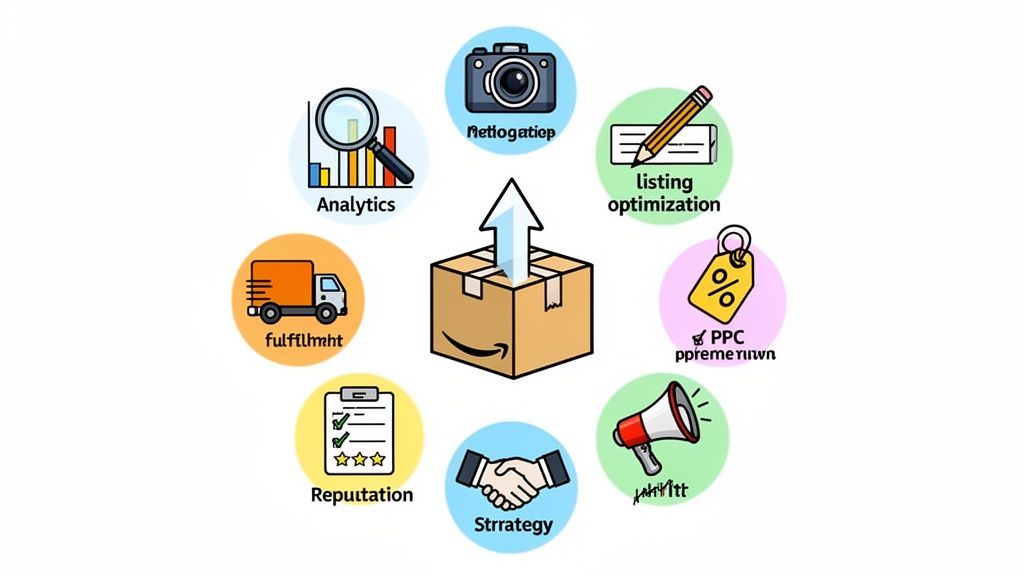
Succeeding on Amazon requires more than just listing a product; it demands a precise, multi-faceted strategy. In a marketplace where millions of sellers compete for consumer attention, simply having a presence is not enough to guarantee sales. The difference between a stagnant storefront and a thriving business often comes down to a handful of well-executed tactics that influence visibility, conversions, and customer loyalty. This guide cuts through the generic advice to deliver actionable amazon seller tips that address the core pillars of e-commerce performance.
Each point in this listicle is a practical lever you can pull to improve your results. We will cover everything from mastering the visual appeal of your listings with high-quality images and A+ Content to implementing a data-informed advertising and pricing strategy. You will learn how to effectively manage customer reviews, choose the right fulfillment method, and monitor key performance metrics to ensure sustainable growth.
Whether you're a new seller aiming to make your first sales or an established brand looking to scale, these proven strategies are designed for immediate implementation. Consider this your blueprint for moving beyond the basics and building a truly competitive Amazon operation. Let’s explore the specific techniques that top sellers use to dominate their categories.
1. Optimize Product Images and Leverage A+ Content
High-quality visuals are your digital storefront on Amazon, often being the single most influential factor in a customer's decision to click "Add to Cart." Professional product images and detailed A+ Content (formerly Enhanced Brand Content) work together to tell a compelling story, answer questions visually, and build trust. This combination is a powerful amazon seller tip that can directly increase conversion rates by making your listing more engaging and informative than competitors.

Actionable Steps for Implementation:
Start by perfecting your image stack. To effectively optimize product images and leverage A+ Content, mastering the latest Amazon Images Requirements is fundamental. Your main image, set against a pure white background, is your first impression in search results. Fill all available image slots with high-resolution photos showing different angles, features, and scale. Crucially, include at least one lifestyle image that shows your product in a real-world context, helping customers visualize it in their own lives.
For brand-registered sellers, A+ Content allows you to move beyond basic descriptions. Use its modules to create a rich, magazine-style layout with comparison charts, benefit-focused graphics, and brand stories. For example, GoPro uses A+ Content to justify its premium price with detailed comparison charts and action-packed videos.
Pro Tip: Focus your A+ Content on explaining why a feature matters to the customer, not just listing what it is. Instead of saying "10,000 mAh battery," show an image of a person happily using their device all day on a single charge with the text "All-Day Power for Your Adventures." Learn more about creating compelling visuals by exploring professional Amazon product photography techniques.
2. Implement Strategic Keyword Research and SEO Optimization
Think of Amazon as its own search engine. The A9 algorithm, which powers Amazon's search results, relies heavily on keyword relevance to connect customers with the right products. Mastering keyword research and strategically embedding those terms into your listing is a critical Amazon seller tip for gaining organic visibility. Sellers who invest time in this process see significant boosts in search ranking, leading to more traffic and sales without an increased ad spend.
Actionable Steps for Implementation:
Your goal is to find high-volume, relevant keywords with manageable competition. Start by using a dedicated tool like Helium 10 or Jungle Scout to identify both broad terms and specific long-tail keywords. For example, a seller targeting the highly competitive term "laptop" can capture high-intent buyers with less competition by optimizing for "best budget laptop under $400."
Place your single most important keyword phrase within the first 80 characters of your product title for maximum impact. Weave three to five secondary keywords and their variations naturally throughout your bullet points. Don't just list features; describe benefits using customer-centric language. The brand GrooveLife effectively captured a niche audience by optimizing for terms like "wedding ring alternative" and "waterproof ring," moving beyond the generic "silicone ring."
Pro Tip: Don't forget the backend search term fields in Seller Central. This is the perfect place for keywords that don't fit naturally into your visible listing copy, including common misspellings, synonyms, or competitor brand names (use with caution). Regularly review your Search Term Reports in your advertising console to discover new, high-converting customer search queries.
3. Master Review Generation and Social Proof Strategies
Social proof is the currency of trust on Amazon, and customer reviews are its most potent form. The platform's algorithm heavily favors listings with a high review count and a strong star rating, as these signals indicate customer satisfaction and product quality. A product with over 50 reviews and a rating of 4.5 stars or higher often sees a direct increase in visibility and sales, making review generation an essential part of any successful Amazon seller tips playbook.

Actionable Steps for Implementation:
Start by ensuring your product quality is exceptional, as authentic reviews will always reflect the actual customer experience. To proactively gather feedback, time your review requests to arrive 5-7 days after delivery, giving customers ample time to use the product. If you're eligible, the Amazon Vine program is a powerful tool to jumpstart your review count, often taking a new product from zero to dozens of verified reviews quickly.
Brands like Anker built their reputation by consistently delivering quality and following up professionally, accumulating thousands of positive reviews. To truly master review generation and improve your offerings, understanding what makes compelling feedback is key. Explore these good product review examples and tips on how to get them to refine your strategy.
Pro Tip: Proactively manage your reputation by responding to all negative reviews within 24-48 hours. A professional, helpful response not only shows you care but can also influence potential buyers who see that you stand behind your product and address customer concerns directly.
4. Price Strategically Using Competitive Analysis and Demand Dynamics
Pricing on Amazon is not a "set it and forget it" task; it's a dynamic process that directly influences your sales velocity, Buy Box ownership, and profitability. A strategic pricing model considers competitor movements, seasonal demand shifts, and your own inventory levels to find the optimal balance between attracting customers and protecting your margins. This approach is a critical amazon seller tip that allows you to react to market changes in real time, maximizing revenue during peak periods and maintaining sales during slower months.
Actionable Steps for Implementation:
The first step is to establish your pricing boundaries. Before using any repricing tool, calculate your absolute minimum price by factoring in your cost of goods, Amazon fees, shipping, and desired profit. Set this as your floor to prevent a "race to the bottom" that erodes your profitability. Similarly, set a maximum price to avoid losing sales by appearing overpriced. Actively monitor key competitors at least two to three times weekly, increasing this frequency during high-traffic events like Prime Day or the holiday season.
This proactive analysis allows you to make informed decisions. For instance, electronics sellers often use dynamic pricing to capitalize on new product launches, while supplement brands might increase prices by 30-45% during the New Year's resolution period to meet surging demand. If your product reviews and seller feedback are significantly better than the lowest-priced competitor, price your item slightly higher; many customers are willing to pay a premium for a trusted product. Remember that pricing also impacts perceived value, which is closely linked to visual presentation. Exploring the cost of professional product photography can be a worthwhile investment to justify a premium price point.
Pro Tip: Use pricing psychology to your advantage. Instead of a permanent price cut during a slow period, run a limited-time coupon or promotion. This creates a sense of urgency and drives sales without devaluing your product in the long term. Also, consider bundling a slower-moving item with a bestseller to increase the average order value and clear out stagnant inventory.
5. Optimize Logistics with FBA vs. FBM Strategy
Your fulfillment method is a cornerstone of your Amazon business, directly influencing profitability, customer experience, and search ranking. The choice between Fulfillment by Amazon (FBA), where Amazon handles storage, packing, and shipping, and Fulfillment by Merchant (FBM), where you manage the entire process, is not a one-time decision. A hybrid strategy, where you intelligently select the right method for the right product at the right time, is one of the most effective amazon seller tips for scaling efficiently.
Actionable Steps for Implementation:
Start by analyzing your product catalog against fulfillment costs. For high-volume, standard-sized bestsellers, FBA is often the clear winner due to the Prime badge and Amazon's logistics network. However, for bulky or heavy items, FBM is almost always more profitable by avoiding expensive dimensional weight fees. Similarly, sellers of subscription boxes often prefer FBM to control the custom packaging and unique unboxing experience that defines their brand. A fashion retailer might use FBA for peak holiday demand and then switch to FBM for slower post-season inventory to avoid long-term storage fees.
The key is to remain flexible and analytical. For new product launches, start with FBM to test market demand without the upfront cost and risk of sending inventory to an Amazon warehouse. Once sales are validated, you can transition the product to FBA to scale.
Pro Tip: Regularly calculate the break-even point for your products. Monitor your inventory turnover; if an item sits in an FBA warehouse for more than 90 days, the storage fees may erase your profit margin. Consider moving such slow-sellers to an FBM model to regain control over storage costs.
6. Build a Comprehensive Amazon Advertising Strategy (Sponsored Ads)
Amazon's pay-per-click (PPC) advertising platform is essential for gaining visibility in a crowded marketplace, especially for new products or those in competitive niches. Sponsored Products, Brands, and Display ads allow you to place your listings in front of high-intent shoppers actively searching for what you sell. This makes a well-managed ad strategy one of the most effective amazon seller tips for accelerating sales velocity, improving organic keyword ranking, and launching new items successfully.
Actionable Steps for Implementation:
Start with an automatic Sponsored Products campaign to let Amazon’s algorithm identify relevant customer search terms for you. After a week or two, analyze the search term report to find high-performing keywords and add them to a new manual campaign where you can set specific bids. At the same time, add irrelevant, low-converting search terms from the report as negative keywords to prevent wasted ad spend. For instance, a new supplement brand might accept a higher initial Advertising Cost of Sale (ACoS) of 40-50% to gain traction, then aim for a more sustainable 25-35% as organic rankings improve.
Ensure your product detail page is fully optimized before driving paid traffic to it. Your images, title, bullet points, and reviews must be compelling enough to convert the clicks you pay for. A common budget allocation for growing sellers is 10-30% of total revenue. For example, top beauty brands often budget over $50,000 monthly for ads during peak seasons to maintain visibility and achieve a Return on Ad Spend (ROAS) of 200-300%.
Pro Tip: Structure your campaigns methodically. Create separate campaigns for different match types (broad, phrase, exact) to maintain precise control over your budget and bidding strategy. Regularly review your search term reports to continuously refine your keyword targeting and discover new opportunities for growth.
7. Monitor and Manage Seller Metrics and Performance Indicators
Your Amazon Seller Central account health is the foundation of your business's stability and growth potential. Amazon meticulously tracks seller performance across several Key Performance Indicators (KPIs), such as Order Defect Rate (ODR), Late Shipment Rate, and Cancellation Rate. Maintaining excellent metrics is not just about avoiding suspension; it's a critical amazon seller tip that directly influences your search ranking, eligibility for programs like the Buy Box, and overall profitability.
Actionable Steps for Implementation:
Start by making the Account Health dashboard your first daily check-in. To maintain account integrity, you must keep your ODR below 1% and your Late Shipment Rate under 4%. Don’t wait for Amazon's warnings; proactive management is key. For instance, a seller whose ODR climbed to 4% reported it took nearly two months of flawless operations to recover their account standing. Top performers often maintain a Late Shipment Rate below 2% by building buffer time into their handling estimates and having backup shipping carriers ready.
To put this into practice, automate alerts for any negative trends in your metrics. If you see customer feedback mentioning damaged goods, immediately review your quality control and packaging processes. Set clear expectations with professional product imagery to minimize returns and negative feedback. By consistently monitoring these performance indicators, you can identify and resolve potential issues before they escalate into serious account health problems, ensuring long-term success on the platform.
Pro Tip: Train your customer service team to respond to all feedback, especially negative comments, with professional empathy. A prompt and helpful response can often lead a customer to update their review, directly improving your metrics and demonstrating excellent service to future buyers.
8. Create a Scalable Content Calendar and Seasonal Strategy
Top-performing Amazon sellers operate proactively, not reactively. They anticipate demand by planning content, promotions, and inventory 60-90 days in advance. A scalable content calendar and seasonal strategy is one of the most effective amazon seller tips because it positions you to capture massive sales volume during peak shopping windows instead of missing out due to poor preparation.
Actionable Steps for Implementation:
Begin by creating a master calendar that maps out major holidays, seasons, and industry-specific events relevant to your products. Analyze sales data from the previous year to identify demand patterns and forecast inventory needs. If you're a new seller, research your category's historical trends on platforms like Google Trends to understand when customer interest peaks. For example, fitness equipment sellers should anticipate a 300%+ sales spike in January and plan their inventory orders in October or November to account for shipping and FBA check-in times.
Next, align your content and promotional activities with this calendar. Schedule A+ Content updates and listing description refreshes at least 30 days before a major season to highlight relevant benefits. Plan your promotional schedule, including discount percentages and timing, eight weeks before major holidays like Christmas or Mother's Day. For instance, a home decor brand should be finalizing Halloween product designs in June to ensure production and delivery for an August or September launch.
Pro Tip: Don't just plan for the peak; use the "shoulder seasons" (the periods just before and after) to your advantage. Test new product variations or marketing messages during these lower-stakes times to gather data and refine your strategy before demand skyrockets. Also, build a safety stock of your best-sellers to avoid stockouts from unexpected demand surges.
9. Differentiate Through Product Quality, Packaging, and Customer Experience
In a crowded marketplace, competing solely on price is a race to the bottom. A more sustainable amazon seller tip is to create a superior brand experience that commands loyalty and justifies a premium price. By focusing on exceptional product quality, thoughtful packaging, and proactive customer service, you can build a memorable brand that encourages repeat purchases, generates positive word-of-mouth, and earns glowing reviews. This strategy moves your product from a simple commodity to a complete, satisfying experience.

Actionable Steps for Implementation:
Start by investing in the unboxing experience. Your packaging is the first physical interaction a customer has with your brand. Design it to be protective, reflect your brand's values, and feel premium. For instance, direct-to-consumer apparel brands often include personalized thank-you notes, while supplement companies might add detailed usage guides to build trust and show expertise. These small touches make the customer feel valued and can turn a routine delivery into a shareable social media moment.
Beyond the initial unboxing, the quality of the product itself must meet or exceed expectations. Implement strict quality control checks during manufacturing and source high-grade materials that communicate value. Follow up with customers a few weeks after their purchase to ensure they are satisfied and to gently request feedback or a review. This proactive communication shows you care about their experience long after the sale is complete.
Pro Tip: Your premium packaging is a key marketing asset. Use professional photography to showcase the unboxing experience in your product listing. Highlight the texture of the box, the branded tissue paper, and any special inserts. Quality visuals are essential, and using expert product photo editing services can make these images stand out and effectively communicate the premium feel of your brand.
10. Leverage Data Analytics and Testing to Continuously Optimize
The most successful Amazon sellers treat their business like a science, not a guessing game. By systematically testing variables like images, titles, and pricing, you can make informed decisions that directly improve performance. This data-driven approach, a cornerstone amazon seller tip, involves analyzing results to continuously refine your strategy, ensuring you stay ahead of competitors who rely on static, outdated listings.

Actionable Steps for Implementation:
Begin by establishing baseline metrics for your key products, such as conversion rate, session count, and unit session percentage. This data serves as your control. Next, form a hypothesis. For example, you might believe that a lifestyle image as your main photo will increase your click-through rate. Test only this single variable for a minimum of one to two weeks to collect enough data for a meaningful comparison.
Use tools like Helium 10, Jungle Scout, or Amazon's own "Manage Your Experiments" feature to run A/B tests. Document every test, noting your hypothesis, the changes made, the results, and key insights. For instance, some top electronics sellers test three to five title variations quarterly, implementing the winners to maintain a competitive edge. This consistent cycle of testing and implementation is what separates good sellers from great ones.
Pro Tip: Focus your initial testing efforts on your highest-traffic products. A small conversion rate improvement on a best-seller will have a much larger impact on your bottom line than a big improvement on a slow-moving item. Once a test concludes, immediately implement the winning variation and move on to testing the next variable.
10-Point Amazon Seller Strategy Comparison
| Strategy | Implementation Complexity 🔄 | Resource Requirements ⚡ | Expected Outcomes 📊 | Ideal Use Cases 💡 | Key Advantages ⭐ |
|---|---|---|---|---|---|
| Optimize Product Images and Leverage A+ Content | Moderate–High: professional photography, design, A+ approvals | High: photography/editing, design skills or ProdShot to reduce cost | ↑CTR ~27%+, ↑Conversion 20–30%, fewer returns | Branded listings, premium products, launches, listing refreshes | Stronger conversions, trust, visual differentiation |
| Implement Strategic Keyword Research and SEO Optimization | Moderate: ongoing research and updates | Low–Medium: keyword tools + time | Improved organic visibility and qualified traffic | All listings, new products, niche targeting | Cost-effective sustained visibility, targets high-intent buyers |
| Master Review Generation and Social Proof Strategies | Moderate: compliant follow-up flows and program management | Low–Medium: outreach tools, time, Vine (if eligible) | ↑Review volume and rating → better conversion and visibility | New products, competitive categories, reputation building | Builds credibility, increases conversion, provides product feedback |
| Price Strategically Using Competitive Analysis and Demand Dynamics | Moderate: repricer setup and strategy rules | Medium: repricing tools and analytics | Optimize Buy Box wins, margins and revenue during demand shifts | Competitive categories, variable demand SKUs, margin-sensitive items | Data-driven pricing, profit optimization, flexible promotions |
| Optimize Logistics with FBA vs. FBM Strategy | Moderate–High: forecasting, fulfillment setup, policy management | Variable: FBA fees vs. FBM shipping/customer service costs | Trade-off between visibility (Prime) and margin; improved fulfillment efficiency | Size/weight-sensitive items, seasonal inventory, hybrid portfolios | Prime visibility (FBA) or greater control/margin (FBM) |
| Build a Comprehensive Amazon Advertising Strategy (Sponsored Ads) | High: campaign structure, bidding, and continuous optimization | High: ad budget (typ. 10–30% revenue) and management tools | Immediate visibility, scalable traffic, measurable ROI | New launches, competitive categories, traffic scaling | Fast visibility, measurable results, keyword insights for SEO |
| Monitor and Manage Seller Metrics and Performance Indicators | High: continuous operational discipline and monitoring | Medium: dashboard/tools + customer service resources | Protect account health, maintain eligibility, preserve ranking | All sellers, high-growth accounts, risk-averse operations | Risk mitigation, account stability, improved buyer trust |
| Create a Scalable Content Calendar and Seasonal Strategy | Moderate: forecasting and coordination across teams | Medium: inventory investment and content refresh resources | Better peak-season capture, fewer stockouts, timely promotions | Seasonal categories, planned promotions (Prime Day, holidays) | Preparedness for peaks, improved sales timing, fewer emergency costs |
| Differentiate Through Product Quality, Packaging, and Customer Experience | High: sourcing, QC, packaging design and fulfillment consistency | High: higher COGS, packaging and QC investment | Premium pricing, higher repeat purchase rate, UGC/unboxing virality | Premium brands, DTC entrants, high-competition categories | Brand loyalty, price premium, memorable customer experiences |
| Leverage Data Analytics and Testing to Continuously Optimize | Moderate–High: testing frameworks, hypothesis management | Medium: analytics/A/B tools and analyst time | Incremental improvements compounding (e.g., 15–30% conversion gains) | High-traffic SKUs, performance-driven sellers, CRO initiatives | Evidence-based wins, faster iteration, reduced guesswork |
Turning Tips into Sustainable Growth
The path to success on Amazon isn't a single event; it's a continuous process of learning, applying, and refining. The collection of Amazon seller tips we've covered provides a detailed roadmap, but simply reading them is not enough. True growth comes from turning this knowledge into consistent, deliberate action. From optimizing your product titles with precise keywords to strategically balancing your FBA and FBM fulfillment, each tip represents a lever you can pull to influence your store’s performance.
The sheer number of tasks can feel overwhelming, but progress is made through focused effort, not by trying to do everything at once. The key is to avoid analysis paralysis and start implementing. Treat your Amazon business as a dynamic system where small, consistent adjustments in areas like ad spend, pricing, and customer feedback management create a powerful compounding effect over time. This approach moves you from being a reactive seller, merely responding to problems, to a proactive business owner who directs the trajectory of their brand.
Your Action Plan for Momentum
To translate these concepts into tangible results, start by selecting just two areas from this guide for immediate focus. For example, you could commit this month to a complete overhaul of your main product images and a deep dive into your keyword strategy.
- Audit Your Visuals: Critically assess your product photography and A+ Content. Are your images sharp, compelling, and telling a clear story? Do they answer customer questions before they are asked?
- Refine Your SEO: Re-evaluate the keywords you're targeting. Are they driving qualified traffic, or are you spending money on clicks that don't convert? Use analytics to identify gaps and opportunities.
By concentrating your energy on these high-impact areas first, you build momentum and generate measurable improvements. As you master one set of skills, you can then shift your focus to the next, whether that's mastering PPC campaigns or fine-tuning your review generation system.
The Long-Term Vision
Mastering these individual Amazon seller tips does more than just increase short-term sales. It builds a resilient, adaptable business capable of thriving in a competitive marketplace. Understanding your performance metrics, differentiating through superior customer experience, and making data-backed decisions are the pillars of a sustainable brand. This commitment to continuous improvement is what separates fleeting success from long-term market leadership. The journey is ongoing, but with this framework, you are well-equipped to build a profitable and scalable brand that stands the test of time.
Ready to elevate your product listings without the complexity and cost of a professional photoshoot? ProdShot generates high-quality, realistic product images in minutes, giving you the power to create stunning visuals for your A+ Content and main listings. Visit ProdShot to see how you can apply one of the most critical Amazon seller tips and upgrade your visual branding today.