

If you're looking for the best products to resell online, you might be chasing after things like brand-name electronics, rare collectibles, or niche vintage clothing. And while those can be great, real success isn't about finding one magic product. It's about building a repeatable strategy you can use to spot profitable opportunities over and over again.
Your Blueprint for Finding Profitable Products to Resell
Jumping into the world of online reselling can feel like being a treasure hunter without a map. You know there are golden opportunities out there, but where do you even begin to dig? The secret isn't in chasing every fleeting trend you see on social media; it’s about building a solid, reliable framework to evaluate any potential product. This turns pure guesswork into a smart, data-driven process.
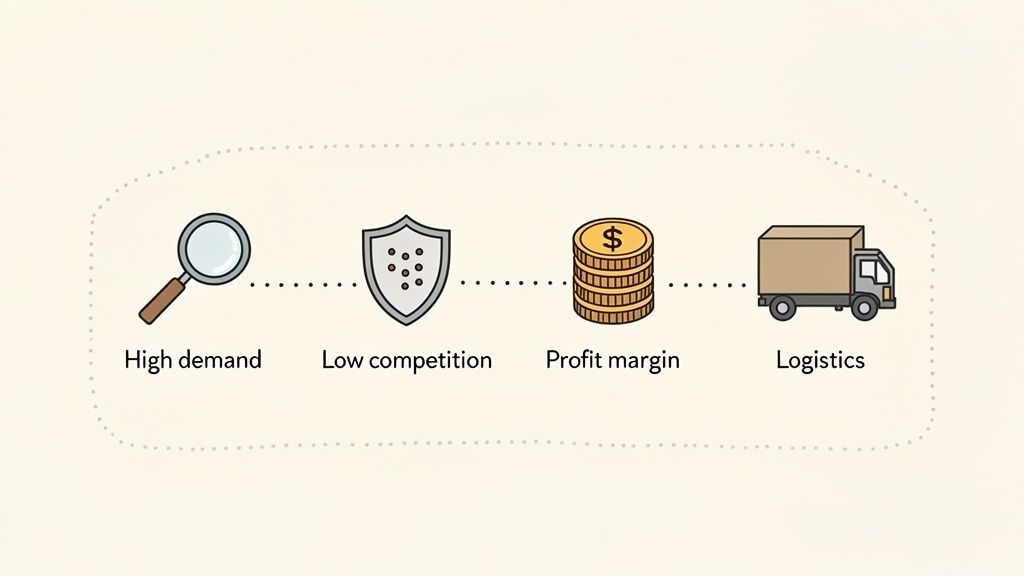
Think of your product-finding strategy as a sturdy table built on four legs. Each one is absolutely essential for supporting a profitable and sustainable business. If a product you're considering is wobbly on even one of these legs, it’s likely to collapse into a pile of dead inventory.
The Four Pillars of Profitable Reselling
The most seasoned resellers have these four principles burned into their brains. They apply this mental checklist to every single sourcing decision.
- High Demand: Is there a real, verifiable group of people actively looking for this item? High demand is what ensures your inventory actually moves off the shelf.
- Low Competition: How many other sellers are listing the exact same thing? Diving into a massively oversaturated market is just a race to the bottom on price, leaving you with razor-thin profits.
- Strong Profit Margins: After you account for platform fees, shipping, packaging, and what you paid for the item, is there enough cash left to make it all worthwhile? A product isn't really profitable until every single cost is factored in.
- Manageable Logistics: Is the item small, light, and durable? Can it be shipped easily without a headache? Big, heavy, or fragile items can destroy your profits with crazy shipping costs and the risk of damage.
This simple flowchart shows how these pillars—Demand, Competition, and Margin—all work together. It’s a constant balancing act.
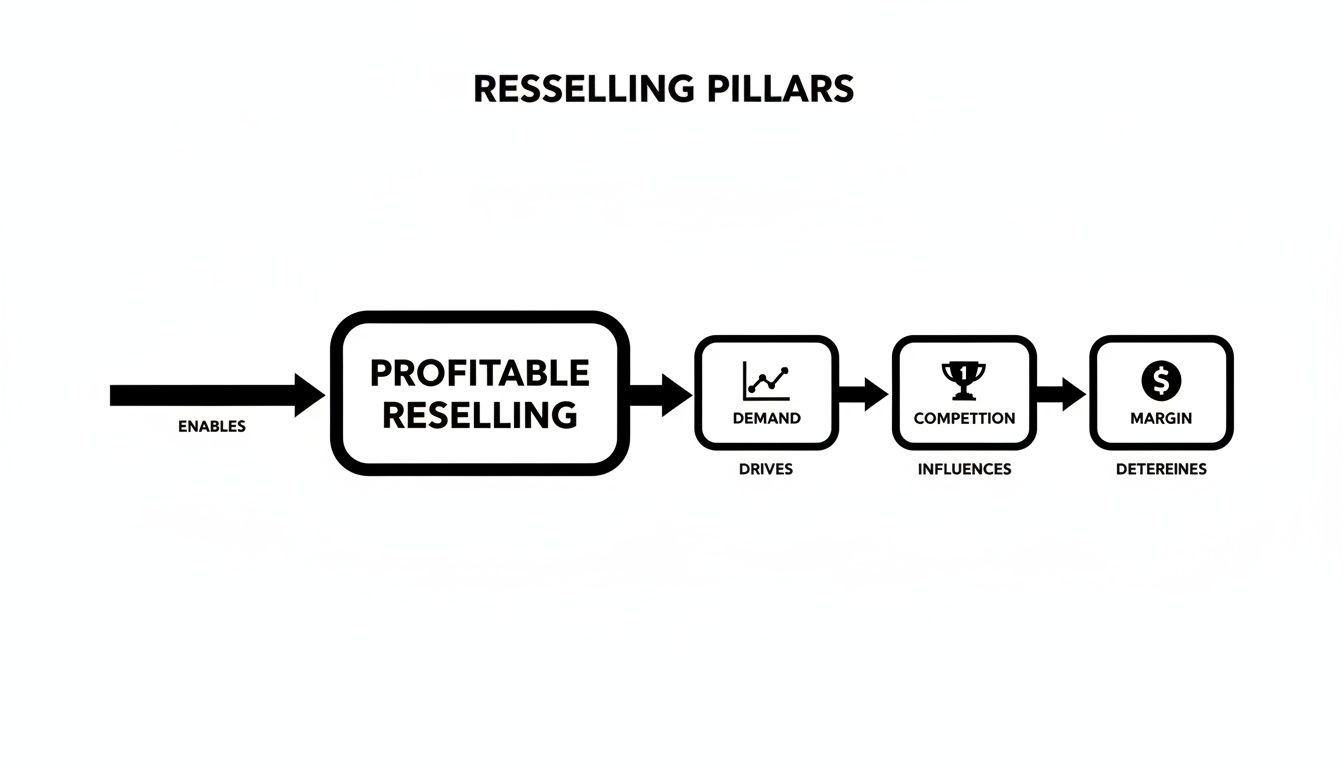
As you can see, high demand naturally attracts more competition. When competition heats up, it puts downward pressure on your prices and squeezes your profit margins. That’s why finding the right balance is so critical.
Getting this framework right is more important than ever. The online resale market is absolutely booming, with the U.S. market alone projected to grow at an average of 13% every year for the next five years. This isn't just a trend; it's a fundamental shift in how people shop, especially younger buyers who see reselling as both a smart financial move and an eco-friendly choice. You can dig deeper into the numbers with these thrifting statistics.
Quick-Look Product Category Profitability Matrix
To help you get a feel for how different categories stack up, here's a quick comparison. This isn't gospel—markets change!—but it’s a great starting point for seeing where opportunities might lie based on our four pillars.
| Product Category | Demand Level | Average Profit Margin | Sourcing Difficulty | Shipping Complexity |
|---|---|---|---|---|
| Brand-Name Electronics | Very High | Low to Medium | Medium | Low |
| Vintage Clothing | High | High | High | Low |
| Rare Collectibles | Medium | Very High | Very High | Medium |
| Used Books (Niche) | Medium | Medium to High | Low | Low |
| Home Goods & Decor | High | Medium | Medium | High |
| Kids' Toys & Games | High | Low to Medium | Low | Medium |
Use this matrix to guide your initial research. If you have a knack for finding rare items, the high margins in collectibles might be worth the sourcing challenge. If you prefer a faster, higher-volume model, electronics could be a better fit, even with lower margins.
Key Takeaway: The best products to resell aren't just trendy—they are the ones that check all the boxes in a simple formula: high demand, manageable competition, healthy profit margins, and simple logistics. Mastering this framework is your first real step toward building a successful ecommerce business.
How to Uncover and Validate Your Reselling Niche
Finding the best products to resell online can feel a lot like panning for gold. You could just scoop up random gravel and hope for a lucky break, or you can learn where the rich veins of opportunity are actually hidden. The most successful resellers I know are market detectives, not just trend chasers. They follow a repeatable process to find untapped niches and then validate them with cold, hard data—all before spending a single dollar on inventory.
Following this kind of framework is what separates a gambler from a calculated investor. Instead of buying a bunch of stuff based on a gut feeling, every single sourcing decision is backed by real-world demand and a clear path to actually making money. Let's dig into the hands-on techniques you can use to uncover and confirm your next winning niche.
From Broad Ideas to Specific Opportunities
Starting out with a massive category like "vintage clothing" is a classic rookie mistake, and honestly, a recipe for failure. It’s just too competitive and completely unfocused. The real key is to niche down until you find a specific, underserved group of buyers who are hungry for what you have.
Think of it like using a microscope. You start with a wide view, then slowly turn the dial to increase the magnification until a whole hidden world snaps into focus.
Here’s what that process looks like in practice:
- Start Broad: Your initial idea might be something huge, like "home goods."
- Add a Sub-Category: You narrow it down to "kitchenware." Better, but still a battlefield.
- Get More Specific: Now, you focus on "vintage kitchenware." The competition starts to thin out.
- Drill Down to a Niche: You finally land on something specific like "mid-century modern glassware." Bingo. That’s a real niche with a passionate, built-in audience.
This focused approach lets you become the go-to expert in a small market, build a solid reputation, and face way less competition than the sellers trying to be everything to everyone.
Using Free Tools to Spot Real Demand
Once you've brainstormed a few niche ideas, it's time to find out if anyone is actually looking for them. This is where a few powerful, and totally free, tools come into play. Your mission here is to find solid evidence of consistent, or even growing, interest over time.
A fantastic place to start is Google Trends. This tool is brilliant because it shows you exactly how search interest for a topic changes over the years. You're looking for keywords with a steady upward climb, not a sudden, dramatic spike that screams "fleeting fad." For instance, a quick search for "athleisure sets" reveals a 350% increase in interest over the last five years—a clear signal of sustained, growing demand.
Pro Tip: When you're in Google Trends, don't ignore the "Related queries" section. It's a goldmine for long-tail keywords and product ideas you might not have thought of, helping you niche down even further.
Validating Profit Potential with Platform Data
Spotting demand is only half the battle. Now you need to confirm that your niche is actually profitable on the platform where you plan to sell. That means rolling up your sleeves and digging into real sales data to see what items are actually selling for and how often.
For eBay sellers, Terapeak is an absolute game-changer. It's an indispensable research tool that comes with a Basic Store subscription and lets you see the sales history for pretty much any product over the past year, including:
- Average Sold Price: What buyers are really willing to pay, not just what sellers are asking.
- Sell-Through Rate: The percentage of listed items that actually sold. A high rate is a neon sign for strong demand.
- Shipping Costs: The average amount buyers paid for shipping, which helps you price your own items competitively.
For example, you could use Terapeak to research "80s concert t-shirts." You might find that while common band shirts have a pretty low sell-through rate, shirts from specific tours or more obscure bands are selling for $100+ with a 70% sell-through rate. This is the exact kind of actionable data that separates a profitable niche from a pile of dead-end inventory. By validating both general demand and platform-specific profitability, you build a solid, data-backed foundation for your reselling business.
Where to Source Products for Maximum Profit
Once you’ve nailed down your niche, the real hunt begins. Finding a great product is one thing, but getting your hands on it at a price that actually leaves room for profit? That’s the game.
Your sourcing strategy is the engine of your entire reselling business. It dictates your inventory, your profit margins, and ultimately, whether you can turn this side hustle into a full-blown operation.
Think of it like fishing. You could just cast a line into any random pond and hope for a bite, or you could learn which lakes are stocked with the biggest fish. Each sourcing method is a different lake, with its own rules, challenges, and rewards. Let's break down the best spots to find your next winning product.
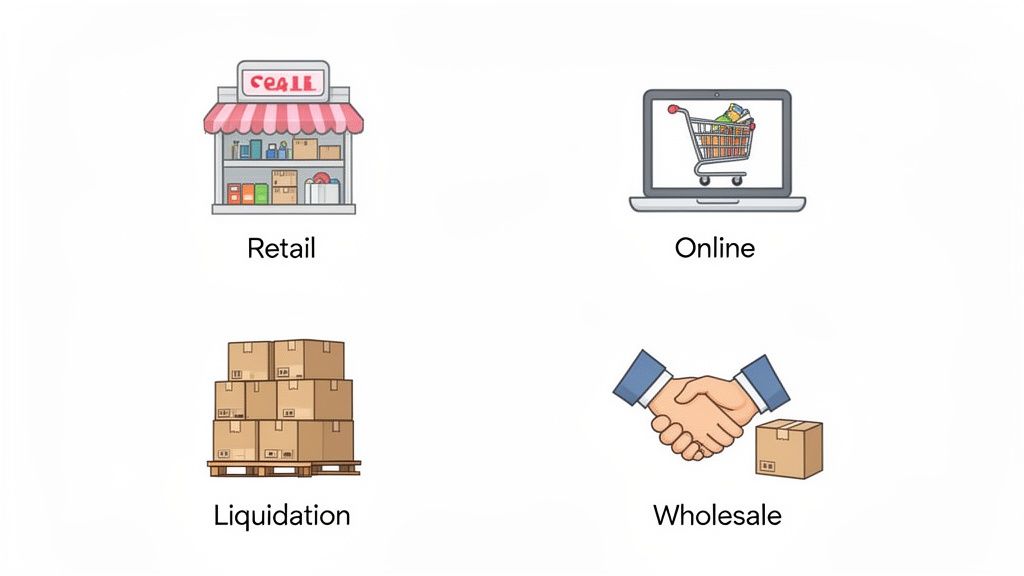
H3: Retail and Online Arbitrage
Arbitrage is the classic “buy low, sell high” model, and it’s all about spotting price differences between what you can buy something for and what someone else is willing to pay for it online. It's the most popular starting point for new resellers because you don't need a business license or special supplier connections—just a keen eye for a bargain.
-
Retail Arbitrage: This is good old-fashioned treasure hunting. You're physically heading into stores like Target, Walmart, or home goods outlets and hitting the clearance aisles. You’re scanning barcodes, looking for items marked down so low that you can flip them for a nice profit online. Success here is all about timing and knowing which brands hold their value.
-
Online Arbitrage: Same idea, but you do it all from your computer. Instead of driving around town, you're scouring the websites of major retailers for killer sales, clearance events, and even the occasional pricing mistake. It's far more scalable and way less draining than retail arbitrage.
For instance, you might spot a popular brand of wireless headphones on the clearance rack for $30. A quick search on eBay's sold listings shows they're consistently going for $75. That $45 gap (before fees and shipping) is your gross profit. It’s a simple, powerful way to get your feet wet.
H3: Wholesale and Direct From Brand
Once you’ve got some momentum, you’ll want a more reliable and scalable way to get inventory. That’s where wholesale comes in. Instead of buying one-off clearance items, you start purchasing products in bulk directly from a distributor or even the brand itself.
The per-unit cost drops significantly when you buy this way.
Landing a wholesale account transforms your business from a hustle into a real, stable operation. You get access to a predictable stream of popular products, and buying in volume gives you the leverage to negotiate even better prices. It definitely requires more cash upfront, but the profit margins and ability to scale are on another level compared to arbitrage.
Key Insight: Moving from arbitrage to wholesale is the natural next step for any serious reseller. Arbitrage teaches you what actually sells in the real world. Wholesale lets you scale up on those proven winners with predictable inventory and much healthier margins.
H3: Liquidation and Overstock Pallets
Ready for a little more risk for a potentially massive reward? Welcome to the world of liquidation. When big-box retailers need to offload customer returns, shelf-pulls, or last season's overstock, they often bundle it all onto pallets and sell it for pennies on the dollar.
Buying a liquidation pallet is a bit of a gamble. You often don't know the exact condition of every single item inside. But the upside can be huge. A pallet of home goods that costs you $500 might contain over $3,000 worth of sellable products.
This sourcing method is perfect for sellers who have the space to store and process a truckload of inventory and aren't afraid to sort through a mix of new, used, and sometimes damaged goods to find the hidden gems.
H3: Comparing Your Sourcing Options
Choosing the right sourcing method really boils down to your budget, how much risk you're comfortable with, and what your long-term goals are. There's no single "best" way to do it. In fact, most successful resellers I know use a hybrid approach, mixing and matching a few different methods to keep their inventory fresh and diverse.
To help you decide, let's break down the core differences between these popular sourcing channels.
Comparison of Product Sourcing Methods for Resellers
| Sourcing Method | Pros | Cons | Typical Profit Margin | Scalability |
|---|---|---|---|---|
| Retail & Online Arbitrage | Very low startup cost, easy to start, great for learning the market. | Time-consuming, inconsistent inventory, hard to scale. | 15-50% | Low |
| Wholesale | Consistent inventory, higher margins, highly scalable. | Requires more capital, business license needed, takes time to build relationships. | 30-60% | High |
| Liquidation Pallets | Extremely high potential profit margins, access to bulk goods for cheap. | High risk, unknown product conditions, requires physical space for storage. | 50-200%+ | Medium |
| Thrift & Secondhand | Unique, one-of-a-kind items, very low cost of goods. | Not scalable, requires "treasure hunting," condition varies wildly. | 100-1000%+ | Very Low |
| Direct from Manufacturer | Best possible pricing, potential for private labeling, full control. | Very high minimum order quantities (MOQs), requires significant capital. | 50-100%+ | Very High |
By understanding these different avenues, you can make a strategic choice that fits your business model right now. A great path is to start small with arbitrage to learn the ropes, then reinvest your profits into more scalable channels like wholesale or even liquidation. That’s how you build a real, long-term, and profitable reselling business.
Calculating Your True Profit Margin on Every Sale
Finding a great product is just the first domino. The real make-or-break moment for your reselling business is knowing your numbers, cold. Too many new sellers get blinded by a high selling price, only to discover a bunch of hidden costs ate up all their potential profit.
Think of it like baking a cake. The sale price is the frosting—it looks great, but it’s not the whole story. Your actual profit is what’s left after you subtract the cost of flour, eggs, sugar, and even the electricity for the oven. If you aren't counting every single ingredient, you have no idea if you’re actually making money.
Deconstructing Your Costs
Before you list anything, you need to get brutally honest about every single expense. Looking at gross profit—the simple difference between your sale price and what you paid—is a surefire way to mislead yourself. The only number that truly matters is your net profit.
Here are the sneaky, often-forgotten costs you have to track:
- Platform Fees: Marketplaces like eBay and Amazon take their cut from the final sale price, and yes, that often includes the shipping cost. This can easily be 10% to 15% or more.
- Payment Processing Fees: Services like PayPal or Shopify Payments usually charge around 2.9% + $0.30 for every transaction.
- Shipping & Handling: This is more than just the postage. You have to account for boxes, bubble mailers, tape, and labels. It all adds up.
- Marketing & Ad Spend: If you’re running promoted listings or ads to get eyes on your product, that money comes directly out of your margin.
Getting a handle on how to calculate profit margins for your online store is what separates a casual hobby from a real, scalable business.
A Practical Example: Refurbished Headphones
Let's walk through a real-world scenario to see how this plays out. Say you snag a pair of popular refurbished headphones from a liquidation sale.
- Cost of Goods Sold (COGS): You bought the headphones for $30.00.
- Sale Price: You list and sell them on eBay for $80.00, plus $10.00 for shipping. Your total revenue is $90.00.
Looks good so far. Now, let's pull back the curtain and subtract all those hidden costs.
- eBay Final Value Fee (13.25% of $90): -$11.93
- Payment Processing (built into fee): $0
- Actual Shipping Cost: -$8.50
- Shipping Supplies (box, tape, etc.): -$1.50
Total Costs: $30.00 (COGS) + $11.93 (Fees) + $8.50 (Shipping) + $1.50 (Supplies) = $51.93
Finally, let's see what you actually walk away with.
Net Profit = Total Revenue – Total Costs
$90.00 – $51.93 = $38.07
Your true net profit is $38.07, which works out to a very healthy net profit margin of 42.3%.
This calculation isn't optional; it's the foundation of a profitable business. It lets you price with confidence, knowing every single sale is actually building your bottom line. As you grow, you might also factor in the cost of professional product photography, as better images can boost your sale price and more than pay for themselves.
What Actually Sells? High-Performing Product Categories and Why They Work
Theory is great, but let's get down to brass tacks. Seeing real-world examples is what makes the lightbulb go on. Instead of just a random list, we’re going to dig into a few categories that consistently make resellers money and unpack why they’re such goldmines.
Think of each category like its own little ecosystem. Each has its own rules for demand, sourcing, and profit. Once you understand these patterns, you'll start seeing similar opportunities everywhere.
The Consistent Power of Electronics
There's a reason electronics and accessories are the bread and butter for so many resellers. It's a sweet spot: massive demand, predictable product cycles, and logistics that won't give you a headache. Unlike trendy clothes, the hunger for big tech brands doesn't just vanish—it just shifts to the next big thing.
This whole category runs on a few simple, powerful truths:
- Brand Loyalty: People who love Apple or Sony tend to stay loving them. That means a built-in audience is always looking for both the latest gear and older, refurbished models.
- The Upgrade Cycle: Every single time a new iPhone or PlayStation drops, it instantly creates a huge secondary market for the last generation. It's a gift that keeps on giving.
- Easy to Ship: Most gadgets, like smartwatches or gaming controllers, are small, tough, and simple to pack and ship. That keeps your overhead low and your life easy.
You're looking at one of the most reliable reselling gigs out there, with average profit margins sitting between 25-35% and inventory flying off the shelves in 30-45 days. The real beauty is in the structure of the market—items like Apple accessories, gaming gear, and phone cases have a steady hum of demand without insane competition.
Vintage Fashion and Niche Apparel
If electronics are about predictable cycles, vintage fashion is the polar opposite. It’s all about scarcity. Here, the value isn't in new tech, but in the rarity, nostalgia, and story woven into each piece. This is where a good eye and deep knowledge of specific eras can translate into wild profit margins.
The trick to selling vintage is understanding what you're really selling. Someone flipping 80s band t-shirts isn't just selling cotton; they're selling a tiny piece of cultural history to someone who desperately wants it. It’s not uncommon to find something for a few bucks at a thrift store and sell it for $100 or more.
The Real Secret: The top vintage sellers don't just find old clothes. They become the go-to expert for a tiny micro-niche—think 1970s denim, 90s sportswear, or retro band tees—and build a reputation as the most trusted source for the real deal.
The Treasure Hunt for Niche Collectibles
Collectibles are where scarcity drives value to its most extreme. We’re talking about everything from rare Pokémon cards and old comic books to discontinued LEGO sets and limited-run sneakers. The profit potential is astronomical, but it's also the category that requires the most homework.
A single rare trading card you snag at a garage sale could literally be worth thousands. But make no mistake, this market is brutal for beginners. Your success lives or die on your ability to spot fakes, understand grading systems, and see the hidden gem that everyone else walked past. Sourcing is a true treasure hunt, digging through estate sales, flea markets, and obscure online forums.
To win here, you have to become a student of your niche. Learn the history. Learn what makes one item junk and another a jackpot. It's high-risk, high-reward, but for the resellers who master it, the payoff is second to none.
No matter what you're selling—gadgets, jackets, or grails—your photos make or break the sale. Check out our guide on how to take amazing electronics product photos to make sure your listings get the clicks they deserve.
You’ve done the hard work. You found the perfect products, ran the numbers, and calculated your profit margins down to the last cent. Now comes the part that makes or breaks the sale: your product listing.
In the world of ecommerce, your product photos and descriptions are your entire sales pitch. They’re the digital equivalent of a customer picking up an item in a store, feeling its weight, and examining it from every angle. If they can’t do that, you have to build trust another way.
That trust is built almost entirely on visuals. A blurry, poorly lit photo doesn't just look bad; it screams unprofessionalism. It makes a potential buyer question the quality of your product and whether your business is even legitimate. On the flip side, a crisp, clean, well-lit image instantly builds confidence. It tells the customer you’re a serious seller who cares about quality.
The Psychology of a Great Product Photo
Great product photography isn’t just about showing what an item looks like. It’s about making the buyer feel confident enough to click "Add to Cart." High-quality visuals do a few critical things that are absolutely essential for getting that click.
- They Build Credibility: Professional images make you look like a professional operation. This subconscious link is incredibly powerful and is often the deciding factor between a sale and a bounce.
- They Answer Questions Visually: A good set of photos shows the product from every angle, highlights key features, and gives a sense of scale. This clears up uncertainty and removes friction from the buying process.
- They Justify Your Price: Premium photos create a perception of premium value. This makes customers far more willing to pay your asking price without a second thought.
The numbers don't lie. Studies show that 75% of online shoppers rely on product photos when deciding whether to make a purchase. This stat highlights a fundamental truth of reselling: your images are doing all the heavy lifting.
From Smartphone Snap to Sales Machine
Here’s the good news: you don't need a fancy DSLR camera and an expensive studio to compete anymore. Modern tools have completely leveled the playing field, letting you create stunning, professional-grade product photos with nothing more than the phone in your pocket.
Services like ProdShot use AI to take a simple, raw photo from your smartphone and instantly turn it into a polished, marketplace-ready image. The process is almost laughably simple, yet incredibly effective.
- Snap a Decent Picture: Just place your item on a neutral, uncluttered surface and take a clear photo. Natural light from a nearby window is your best friend here.
- Upload to an AI Editor: Pop the image into the platform.
- Let AI Do the Work: The tool automatically strips out the background, fixes the lighting, sharpens the details, and sets your product on a perfect, clean white or custom-colored backdrop.
This whole workflow takes just a few seconds and gives you images that look like they came straight out of a professional studio. You can learn more about nailing this process in our guide on professional Amazon product photography. To really dial in your listings and see how they’re performing, it’s also a great idea to use a conversion rate calculator.
Key Takeaway: In online reselling, your product photos aren't just a part of the listing—they are the listing. By using modern, accessible tools, you can create high-converting images that build trust, answer questions, and drive sales, giving you a massive competitive edge without breaking the bank.
Got Questions? Here Are Some Answers.

Jumping into reselling always kicks up a few questions. Let's tackle the big ones I hear all the time so you can get started with confidence and sidestep those painful (and expensive) rookie mistakes.
How Much Money Do I Really Need to Start Reselling?
Honestly, you can get the ball rolling with less than you think. Plenty of successful resellers I know started with retail arbitrage and a budget under $100. They'd hit the clearance aisles, flip their finds, and pour every penny of profit right back into buying more inventory. It's the ultimate lean startup.
A more comfortable starting point is probably in the $300 to $500 range. That gives you enough breathing room to snag a decent haul from thrift stores or online deals without betting the farm. The golden rule here? Start small, learn what moves, and then scale up.
Which Reselling Platform Is Best for a Beginner?
For anyone just dipping their toes in, eBay is almost always the answer. The barrier to entry is super low, you can list a massive range of items (both new and used), and you have total control over your listings from day one. It's the perfect training ground.
Amazon FBA is a powerhouse, no doubt, but it comes with a much stricter rulebook and higher fees. It’s a better fit once you’ve found a steady supply of new-in-box products. Etsy, on the other hand, is a niche world—it’s strictly for vintage goods (20+ years old) or handmade items. Get your feet wet on eBay first; you'll learn the fundamentals of online sales there.
How Do I Handle Shipping and Returns Without Losing My Mind?
Getting your shipping process dialed in is a game-changer. You don't need much: a simple postage scale and a measuring tape are your best friends. They'll save you from the gut-punch of underestimating shipping costs at the post office. And always use a service with tracking—it protects you and gives the buyer peace of mind.
When it comes to returns, just set a clear and fair policy from the start. Nobody loves dealing with returns, but handling them like a pro builds trust and safeguards your seller rating. Offering a 30-day return window is pretty standard and can actually boost your sales.
What Are the Biggest Mistakes New Resellers Make?
The number one killer of a new reselling business is miscalculating costs. It's so easy to forget about platform fees, payment processing fees (which are usually around 3%), the cost of shipping supplies, and the potential for returns. All those little things nibble away at your profit until there's nothing left.
Another classic blunder is going all-in on an unproven product. Don't buy a hundred of something before you've sold one. Test small batches of different items to see what people actually want to buy. And finally, never, ever underestimate the power of good photos. Your images are your entire sales pitch in an online world.
Great product photos aren't just nice to have; they're the engine of your reselling business. With ProdShot, you can turn basic smartphone pics into professional images that actually convert. Stop letting bad photos kill your sales. Start creating listings that stand out by visiting https://prodshot.net.