
When you hear "ecommerce photo retouching," what comes to mind? It's the professional wizardry that turns your standard product photos into images that actually sell. This isn't just about cropping or brightening; it's everything from removing the background to correcting colors and making a product look so good online that people have to have it.
Think of it as the digital polish that transforms a simple snapshot into your most powerful sales tool.
The Unseen Engine Behind Online Sales
Let's use an analogy. Your raw product photos are like quality ingredients. On their own, they have potential, but they aren't quite ready to be served at a five-star restaurant. Photo retouching services are the master chefs who take those raw ingredients and turn them into a stunning dish that customers can't wait to try.
This process is so much more than a quick cosmetic fix—it’s a core part of your business strategy. In a world where customers can't physically hold or inspect your products, your images have to do all the heavy lifting. They're your 24/7 digital salesperson, communicating quality, detail, and value without saying a word.
Building Trust Through Visual Consistency
When a shopper lands on your site, they're subconsciously looking for signs of professionalism. If the lighting is different in every photo, backgrounds are all over the place, or the colors look off from one product to the next, it creates a feeling of unease. It can make your store feel amateurish, causing a potential buyer to click away.
Professional retouching solves this by creating a strong, uniform look across your entire store. Every single product is presented under the same perfect conditions, which builds a cohesive brand experience that feels trustworthy. This isn't just about looking good; it's about giving a customer the confidence they need to hit "add to cart."
High-quality, consistent images are non-negotiable in ecommerce. They bridge the gap between seeing a product on a screen and imagining it in real life, giving customers the visual proof they need to buy with confidence. It's the bedrock of trust in online retail.
Why Polished Images Are Essential for Growth
The ecommerce world is crowded. It's a constant battle to stand out. Let's be honest, generic or poorly edited photos just blend in with all the other noise online. But a beautifully presented product image? That can stop someone mid-scroll. It instantly elevates how people see your product and your brand as a whole.
This is exactly why investing in professional ecommerce photo retouching services is a must for any brand that's serious about growing. The impact on your bottom line is direct and measurable:
- Higher Conversion Rates: A polished, clear, and attractive image is simply more persuasive. It makes people want to buy.
- Fewer Product Returns: When color correction is on point and details are clear, customers know exactly what they're getting. This dramatically cuts down on costly returns from mismatched expectations.
- A Real Competitive Edge: Let's say you and a competitor sell similar products. Superior visuals will make yours look far more desirable every time.
At the end of the day, professional image editing isn't just another business expense. It's a direct investment in your brand's credibility and, ultimately, your profitability.
From Basic Fixes To Complete Visual Transformations
When you send your product photos off to a professional, what exactly are they doing? Ecommerce photo retouching isn't a single, one-size-fits-all service. It's actually a whole spectrum of edits, from the foundational tweaks every single image needs to the more artistic touches that build a powerful brand identity. Let's peel back the curtain and see what's really involved.
This diagram shows how it all fits together—how simple, professional edits are the bedrock for building customer trust, creating a consistent brand, and ultimately, driving more sales.
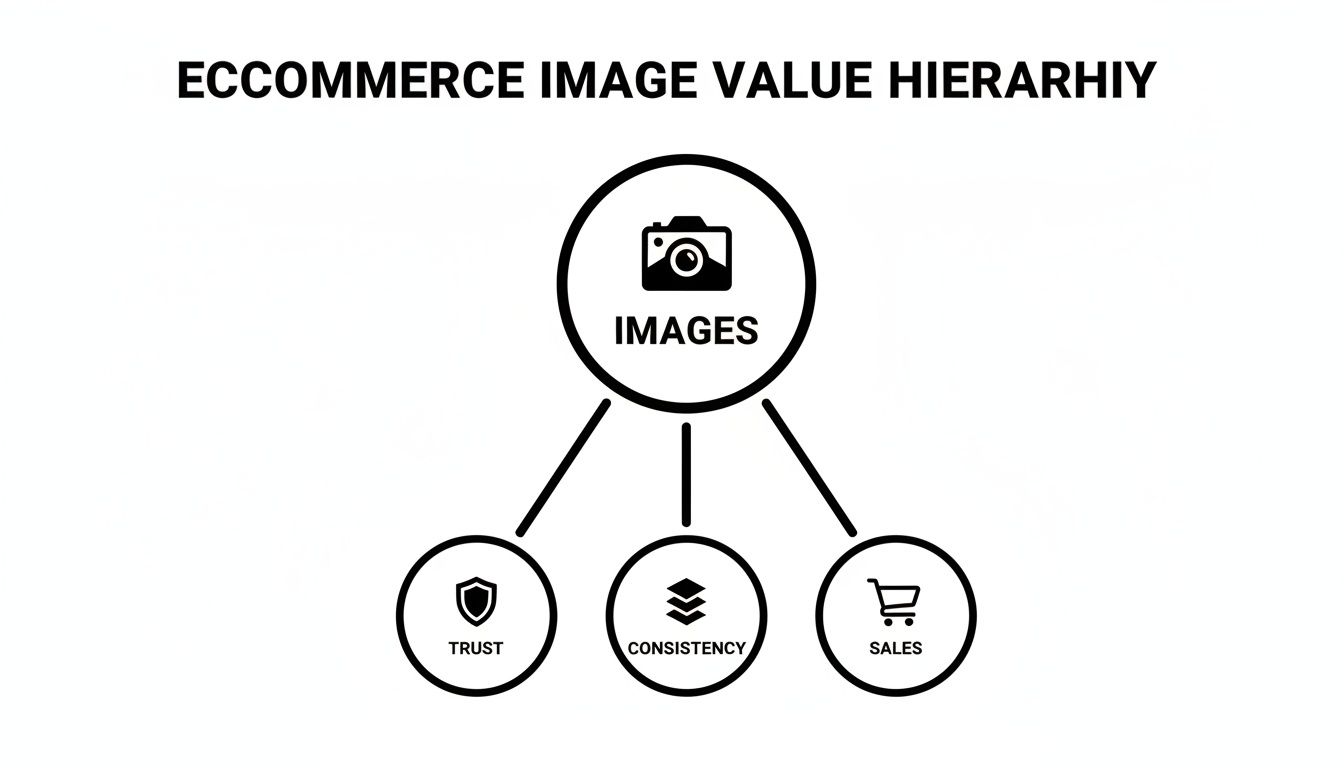
As you can see, high-quality images aren't just for show. They're the starting point for building an online store that people trust and want to buy from.
Foundational Retouching Tasks
Think of these as the must-haves—the non-negotiable edits that give your store a baseline level of professionalism. They’re all about creating clarity, consistency, and a shopping experience free from distractions.
- Background Removal: This is the big one. An editor carefully traces your product to lift it from its original background, then places it on a clean, pure white or transparent one. This makes the product the hero of the shot and is often a hard requirement for marketplaces like Amazon.
- Color Correction: What you see is what you should get. Color correction ensures the product's colors on the screen are a perfect match for the real thing. It’s all about adjusting the white balance, saturation, and hue to get it just right, which is a game-changer for cutting down on returns.
- Blemish and Imperfection Removal: A stray dust speck on the lens, a tiny scuff mark on the product—these little things can make a product feel cheap. A good retoucher will meticulously hunt down and remove every distracting flaw, presenting a picture-perfect version of your item.
These core edits are the foundation of a great product gallery. And the market reflects their importance: the global e-commerce product photography market, valued at $0.85 billion, is on track to hit $2.38 billion. Much of that growth is driven by fashion brands, where 76.1% use custom backgrounds that absolutely depend on professional cleanup to look sharp. You can dig into more data on the ecommerce photography market to see how top brands are nailing their visual game.
Advanced Creative Enhancements
Once you've got the basics down, you can start using more advanced techniques to make your images truly stand out. These edits are less about fixing and more about elevating—adding realism, highlighting key features, and creating a vibe that feels genuinely premium.
An image should do more than just show a product; it should tell its story. Advanced retouching techniques like shadow creation and the ghost mannequin effect help narrate that story by adding depth, context, and a sense of realism that static images often lack.
The goal here is simple: help the customer imagine the product in their own life.
To better understand how these services directly impact your business, let's look at the connection between common retouching tasks and their tangible benefits.
Common Retouching Services and Their Business Impact
| Retouching Service | Description | Primary Business Benefit |
|---|---|---|
| Background Removal | Isolate the product on a clean, neutral background (usually white or transparent). | Improves product focus and ensures compliance with marketplace (e.g., Amazon, Shopify) standards. |
| Color Correction | Adjust colors to match the physical product accurately. | Reduces returns from customers who feel the product didn't match the online photos. |
| Blemish Removal | Eliminate dust, scratches, or other minor imperfections on the product or background. | Increases the perceived quality and value of the product. |
| Shadow Creation | Add a natural-looking drop shadow or reflection under the product. | Adds realism and depth, making the product look more tangible and professional. |
| Ghost Mannequin | Combine multiple photos to show clothing's fit and shape without a visible model. | Provides a clear view of the garment's structure, improving customer understanding and conversion. |
| High-End Retouching | Perform detailed edits like smoothing surfaces, enhancing textures, and perfecting reflections. | Essential for luxury goods (jewelry, watches) to convey premium craftsmanship and justify a higher price point. |
Each of these services plays a specific role in turning a simple photo into a high-performing asset for your brand.
Crafting Realism And Showcasing Form
Advanced edits are where the real artistry comes in. They're less about fixing mistakes and more about adding value through skill and creativity.
- Shadow Creation: Adding a soft, natural-looking drop shadow or a subtle reflection stops a product from looking like it’s just floating in space. It’s a small detail, but it adds a crucial sense of depth that makes the product feel more real and grounded.
- Ghost Mannequin Effect: This is a must for any apparel brand. The technique involves stitching together multiple photos to create a 3D, "hollow" view of a garment, as if an invisible person is wearing it. It’s hands-down the best way to show off a piece's fit and shape without a distracting model or mannequin.
- High-End Retouching: For luxury items like jewelry, watches, or cosmetics, this is non-negotiable. It involves incredibly detailed work—polishing metal to a perfect shine, making gemstones sparkle, smoothing skin textures, and perfecting every reflection to scream premium quality.
By blending foundational fixes with these creative enhancements, professional ecommerce photo retouching services turn basic snapshots into your most powerful sales tools. Every edit, from the simplest cleanup to a complex reconstruction, is a deliberate step toward building a more compelling and profitable online store.
The Tangible ROI Of Professional Image Editing
Let's be honest: investing in professional ecommerce photo retouching isn't just about making your products look pretty. It's a strategic financial move that delivers a real, measurable return. Think of it this way: when a customer can’t physically pick up and examine your product, your images are doing all the heavy lifting. They become the single most important factor in their buying decision.
A blurry, poorly lit, or inconsistent product photo sends a subtle but powerful message: your brand might be untrustworthy or unprofessional. On the flip side, a crisp, clean, and color-accurate image inspires confidence and makes the customer feel secure hitting that "buy now" button. The direct line between image quality and consumer trust is where your return on investment truly begins.
Boosting Conversions And Perceived Value
Professionally retouched photos have a direct, almost immediate impact on your conversion rates. When a product is shown with perfect lighting, true-to-life colors, and zero distracting flaws, it just looks more appealing and valuable. This elevated presentation doesn't just get you more clicks; it makes customers more willing to pay what you're asking.
The psychology here is critical. A high-quality image can make a $50 product feel like it's worth $75, while a quick amateur photo can make that same item seem overpriced. It's all about managing perception, and professional editing gives you total control over how your products land with your audience. The initial investment in visual excellence is often a fraction of the long-term cost of lost sales from so-so imagery, a key point to remember when figuring out the overall cost of professional product photography.
Reducing Costly Product Returns
One of the biggest, and often hidden, drains on an ecommerce business is product returns. A huge chunk of those returns happens for one simple reason: the item the customer received doesn't look like the photo they saw online. This is a massive issue for products where color and texture are everything, like clothing, cosmetics, and home decor.
When a customer has to return an item, you lose more than just the sale. You lose money on shipping, absorb restocking costs, and risk damaging your brand's reputation. Accurate images are your first and best line of defense against preventable returns.
Professional photo retouching services are masters of precise color correction. They ensure that the vibrant red sweater on your website is the exact same vibrant red when it arrives at your customer's door. By setting accurate expectations from the start, you dramatically slash your return rates, saving money and keeping your customers happy.
Driving Success On Competitive Marketplaces
On platforms like Amazon and Etsy, you’re not just competing—you’re fighting for attention against thousands of other sellers. In that environment, your main product image is your one chance to make a potential buyer stop scrolling. A professionally edited image with a clean white background and realistic shadows just pops. It looks far more credible than a photo hastily snapped on a kitchen table.
This isn't just about looking good; it's a strategic necessity. Listings with superior images get more clicks, which tells the platform's algorithm that your product is popular. This boosts your visibility in search results, creating a positive feedback loop of more engagement and more sales.
The demand for this level of quality has caused the market to explode. The global photo retouching service market, valued at $1.5 billion, shot up to $3.2 billion in just two years and is projected to hit $5.1 billion. This growth is happening for a reason—it’s directly tied to the expansion of ecommerce and proves how essential these services have become. You can dig deeper into the photo retouching market's rapid expansion on Verified Market Reports. Ultimately, investing in retouching isn’t an expense; it’s your ticket to play and win in a very crowded digital space.
How To Choose The Right Retouching Partner
Picking the right retouching partner can feel a bit like dating. You’re looking for a team that just gets your brand’s needs for quality, speed, and budget. Think of it less like a transaction and more like hiring a key member of your creative team.
The right partner slots right into your workflow, understanding your aesthetic and consistently delivering images that actually sell. A bad fit, on the other hand, means blown deadlines, wildly inconsistent quality, and endless, frustrating revision loops.
Start with the Portfolio and Specialization
First things first: look at their work. A strong portfolio is more than just a gallery of pretty pictures; it’s hard proof of their technical skills and real-world experience. Look for examples that line up with what you sell. Are you a fashion brand? See if they’ve mastered the ghost mannequin effect. Selling jewelry? Get close to the screen and scrutinize how they make metals gleam and gems sparkle.
Choosing a retouching partner is about finding a specialist, not a generalist. A service that’s incredible at high-end jewelry retouching might not be the best fit for churning out high-volume apparel edits, and vice versa. Their portfolio should tell you exactly where their expertise lies.
A service with deep experience in your niche already knows the common pitfalls and visual standards you need to meet. That specialized knowledge means a faster start, fewer back-and-forths, and a final product that hits the mark with customers from day one.
Evaluate Turnaround Time and Scalability
In ecommerce, time is literally money. The faster you get those product photos live, the faster you start making sales. So, you need to ask potential partners about their standard turnaround times. Any reputable service should be able to deliver high-quality edits within 24-48 hours for most projects.
Just as important is their ability to scale up with you. Your photo needs will change, especially during busy seasons or when you’re launching a new collection. Can they handle an order of 3,000 images with the same care and speed as an order of 30? A partner with a solid, tech-driven workflow can absorb those spikes without breaking a sweat, preventing bottlenecks that mess up your launch schedule.
Understand Pricing Models and Revision Policies
Money talk is crucial. Pricing for ecommerce photo retouching usually comes in one of three flavors: per-image, hourly, or a monthly retainer. Knowing the difference helps you find a setup that fits your budget and how you work.
- Per-Image Pricing: This is perfect if your image volume is all over the place. You only pay for what you need, which is why it’s such a flexible and popular choice.
- Hourly Rate: Best for those complex, creative jobs that need serious hands-on artistry—think campaign hero shots or high-end beauty retouching.
- Monthly Retainer: A fantastic option for brands with a steady, high volume of images. You often get a discounted rate, and it makes budgeting way more predictable.
Before you get too excited about the price, though, you need to dig into the details. Here's a quick comparison to help you weigh the options.
Comparing Retouching Service Pricing Models
This table breaks down the three most common pricing structures to help you figure out the best fit for your budget and needs.
| Pricing Model | Best For | Potential Drawback |
|---|---|---|
| Per-Image | Businesses with fluctuating or unpredictable image volumes. | Can become costly for very high-volume, repetitive tasks. |
| Hourly Rate | Complex, creative projects requiring significant artistic input. | Less budget predictability; costs can add up on long projects. |
| Monthly Retainer | Brands with a steady, high volume of consistent image work. | May not be cost-effective during slower months if volume drops. |
Beyond the initial price tag, get crystal clear on their revision policy. A good partner will include at least one or two rounds of revisions for free to make sure you’re happy. A vague or non-existent policy is a huge red flag that could lead to surprise costs and headaches later.
Request a Free Trial to Test the Waters
At the end of the day, the only way to truly know if a partner is the right fit is to see how they handle your products. Before you sign any contracts, always ask for a free trial or a small sample edit. It's your chance to check out their quality, communication style, and ability to follow your brand guide without spending a dime.
Send them a few of your typical images along with a clear creative brief. Pay close attention to how they take your feedback and how easily they adapt to your brand's look and feel. This simple test will tell you everything you need to know to make a smart decision and kick off a great partnership.
Integrating AI Into Your Retouching Workflow
Artificial intelligence isn't some far-off concept anymore; it's a real tool that’s completely changing how ecommerce photo retouching services get the job done. Think of AI as the ultimate assistant for your creative team. It’s brilliant at chewing through the high-volume, repetitive tasks that eat up so much time, which lets human artists focus on what they do best: the creative, subtle tweaks that give a brand its unique feel.
This isn't about replacing skilled editors. It’s about letting AI handle the foundational stuff—like background removal, basic color adjustments, and image cropping—with incredible speed and consistency. For any business with a big, constantly changing product catalog, this is a game-changer. AI can process thousands of images overnight, making sure every single shot meets the same high standard without any human error or fatigue.
The Hybrid Model: Automation Meets Artistry
The smartest way to work today is to combine the raw power of AI with the irreplaceable skill of a human editor. This hybrid model creates a workflow where AI does the initial grunt work, and a professional retoucher steps in for the final, critical touches that make an image pop.
- AI's Role (The Heavy Lifting): Automatically zaps the backgrounds from hundreds of photos, applies consistent color profiles across an entire collection, and crops images to the exact specs needed for any marketplace.
- Human Editor's Role (The Creative Finish): Adds realistic drop shadows, gets rid of tiny blemishes on highly reflective jewelry, and makes those subjective creative calls that really dial up a product's appeal.
This partnership gives you the best of both worlds: the speed and scale of automation and the creative judgment of a professional. For brands wanting to create visuals from scratch, an AI product photo generator can even whip up initial concepts or lifestyle scenes, giving you a fantastic starting point for further fine-tuning.
Why This Matters For Your Bottom Line
The financial and operational wins from bringing AI into the mix are huge. The market for AI photo editors is expected to jump from $2.1 billion to $8.9 billion, with AI image editing becoming the fastest-growing software category out there. Businesses that have adopted AI solutions have seen up to a 25% increase in sales, and in the fashion world, AI-enhanced images have boosted conversion rates by an incredible 60%.
AI handles the science of retouching—consistency, repetition, and speed. This allows human artists to master the art—creativity, nuance, and brand storytelling. The result is a faster, more efficient, and more creative post-production pipeline.
By automating those routine tasks, you're not just cutting costs; you're also dramatically shortening delivery times, which means you can get your products online and selling faster than ever. If you're looking to explore more tools that can enhance visual creation, it's worth digging into the world of AI image generators. Embracing AI in your workflow isn't just about staying current; it’s about grabbing a serious competitive advantage in a market that moves at lightning speed.
Optimizing Images For Major Ecommerce Platforms
If you're selling on big marketplaces like Amazon, Shopify, or Etsy, you have to play by their rules—especially when it comes to your product photos. Each platform has its own distinct playbook for what makes a great, compliant image. It's best to think of these guidelines not as annoying restrictions, but as a clear blueprint for what actually works on each channel.
Following these rules isn’t just about staying out of trouble; it's about getting seen. The search algorithms on these platforms are designed to favor listings that nail their image specs, giving you a serious leg up on the competition. This is where professional ecommerce photo retouching services really shine—they’re experts at tailoring your images to meet these precise, often nitpicky, requirements.
Mastering Platform-Specific Image Requirements
Every marketplace has its own vibe and a unique set of technical and creative standards to match. An image that looks fantastic on your Shopify store might get your listing buried on Amazon if it breaks their strict background rules.
-
Amazon: This is the big one, and they are famously strict. Your main product images must have a pure white background (that’s RGB 255, 255, 255) with the product filling at least 85% of the frame. It’s a clean, no-nonsense look that’s absolutely non-negotiable if you want shoppers to find you.
-
Shopify: You get a lot more creative breathing room here. Shopify is totally fine with varied backgrounds and lifestyle shots on your product pages. That said, the most successful stores stick to a proven strategy: keep it consistent with clean backgrounds and uniform sizing to create a professional, trustworthy feel. If you need a hand with that, a dedicated Shopify photo editor can make sure your images are both beautiful and built to convert.
-
Etsy: This platform is all about creativity and telling your brand's story. While you absolutely need clear, crisp product shots, Etsy actually encourages you to use lifestyle images and unique backgrounds that show off your brand's personality. The trick is to balance that artistic flair with total clarity so shoppers know exactly what they’re getting.
To really dig into the details and make sure your images perform, it pays to master the specifics outlined in guides like this Amazon Image Requirements: A Performance Guide.
Strategic Use of Secondary Image Slots
Your main image earns the click, but it's your secondary images that seal the deal. This is your chance to go beyond the basic product-on-white shot and tell a compelling story, answering customer questions before they even have to ask.
Your primary image must follow the rules to get discovered. Your secondary images must break the rules to build desire and drive conversion. Use this space to connect with your customer emotionally and practically.
Think of this as your opportunity to build trust and show your product in its element.
Beyond the Basics: Infographics and Lifestyle Shots
Use those extra image slots to show off different sides of your product and your brand.
-
Lifestyle Photos: Show someone using your product in a real-world setting. This is huge. It helps customers picture it in their own lives, forging an emotional connection that a sterile studio shot just can’t replicate.
-
Infographics: Create simple, clean graphics that call out key features, dimensions, or materials. This is a brilliant way to communicate important selling points at a glance, cutting down on customer confusion and hesitation.
-
Detail Shots: Get up close and personal. Use macro shots to highlight the quality, texture, and craftsmanship of your product. This is especially vital for things like jewelry, apparel, and high-end electronics where the little things matter.
When you tailor your image strategy for each platform and use every available slot to your advantage, you turn a simple product page into a high-powered sales funnel. This approach doesn't just prevent your listings from getting suppressed—it actively boosts your search ranking, driving more traffic and sales on every single channel you sell on.
Your Ecommerce Photo Retouching Questions Answered
Jumping into the world of ecommerce photo retouching can feel a bit murky. There are a lot of services out there, and getting clear answers is the only way to make a smart choice for your shop.
Let's cut through the noise and tackle the most common questions head-on so you can move forward with confidence.
How Much Should I Expect To Pay For Photo Retouching?
Honestly, there’s no one-size-fits-all price. The cost can swing from less than a dollar for a quick background removal to $10 or more per image for really detailed work on things like jewelry or a stunning hero shot.
A few key things will move the price needle:
- The Job's Complexity: A simple background cleanup on a product with clean lines is always going to be cheaper than creating a "ghost mannequin" effect, which involves carefully stitching multiple photos together.
- How Many Photos You Have: Like buying in bulk, volume matters. Editing 1,000 images a month will land you a much better per-image rate than just sending over 10.
- How Fast You Need It: Need your images back in a few hours? That rush job will cost more than a standard 24-hour turnaround. It’s a classic trade-off between speed and cost.
What Is A Standard Turnaround Time?
For most everyday ecommerce photo edits, a 24-hour turnaround is the industry gold standard. Many professional services are built like well-oiled machines, able to get high-quality images back to you within a day so you can get your products listed without missing a beat.
Of course, this isn't set in stone. If you're dropping off a massive order of several thousand images or need some highly artistic, complex retouching, it's going to take a bit longer. Just make sure you confirm the delivery timeline with your partner before you kick off a big project to avoid any surprises.
Think of photo retouching like a professional kitchen. A simple dish can be ready in minutes, but a complex, multi-course meal takes more time and expertise. Clear communication about your needs ensures your order is delivered exactly when you expect it.
Can Retouching Actually Fix A Bad Photograph?
Here's the hard truth: photo retouching is powerful, but it’s not magic. A skilled editor can work wonders—correcting colors, cleaning up smudges, and sharpening details—but they can't salvage a fundamentally flawed photo.
Things like severe blur, extreme over- or under-exposure, or a subject that's completely out of focus are usually beyond saving. The best results always, always start with a good source file. For your store, that means providing a sharp, well-lit photo from the get-go. Think of retouching as the final polish that takes a good image to great, not a rescue mission for a bad one.
How Do I Prepare My Images For A Retouching Service?
Want to guarantee you get amazing results back? The best thing you can do is set your retouching partner up for success. A little prep work on your end makes the whole process smoother for everyone.
- Use the Right File Format: Always send the highest quality file you have. RAW files are the dream ticket because they hold the most data for an editor to work with. If you don't have those, a high-resolution JPEG or TIFF is the next best thing.
- Provide a Clear Brief: Don't leave your editor guessing what you want. A simple style guide or a clear brief with examples of what you like is incredibly helpful. Specify the background you need (e.g., pure white #FFFFFF), point out specific flaws to fix, and share your brand's overall aesthetic.
- Organize Your Files: This sounds simple, but it's a huge time-saver. Give your files logical names and sort them into folders if you're sending a big batch. This little bit of organization prevents mix-ups and makes sure every image gets the right treatment.
Following these tips helps build a seamless workflow with your chosen ecommerce photo retouching services partner and ensures you get exactly what you paid for.
Ready to transform your product photos without the hassle? ProdShot uses AI to turn simple snapshots into professional, sales-driving images in seconds. Try it for free and see the difference. Learn more at https://prodshot.net.