
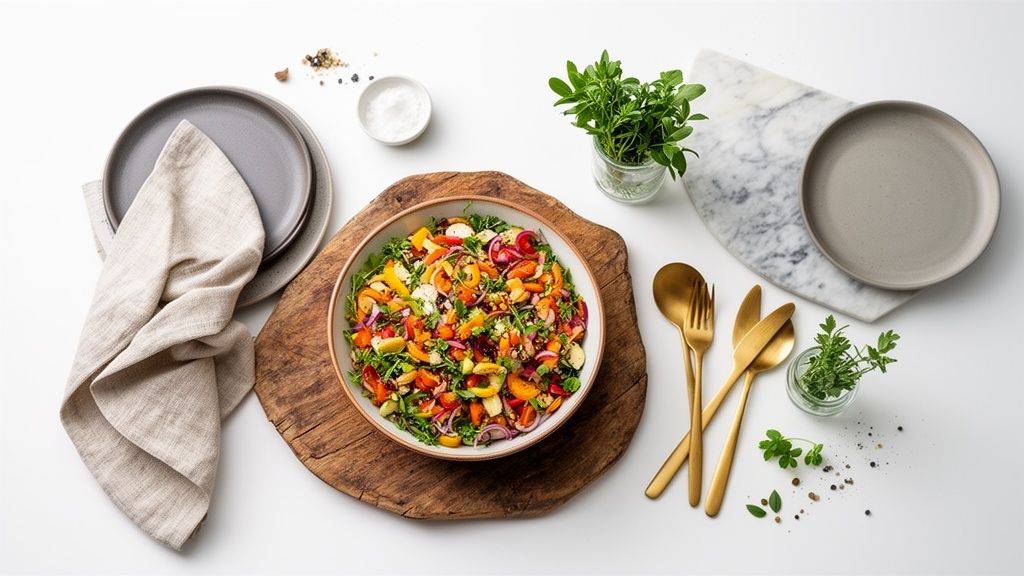
Props are the secret sauce in food photography. They’re everything in the shot besides the food itself, working together to build a scene, tell a story, and set a mood.
Think of them as the supporting cast that makes your star—the food—truly shine.
Why Props Are Your Most Powerful Storytelling Tool
Imagine your beautiful plate of pasta sitting all by itself. It might look delicious, but the photo feels a bit empty, doesn't it? It's just… food on a plate.
Now, picture that same pasta on a rustic, hand-thrown ceramic plate. Add a crumpled linen napkin, a vintage fork, and a half-full glass of red wine in the background. Suddenly, you've transported your customer to a cozy trattoria in Italy. That's the power of props.
For anyone selling on platforms like Shopify or Etsy, getting this right is the difference between a potential customer scrolling past and one who stops, clicks, and buys. Your props are silent salespeople, working hard to:
- Forge a Brand Identity: Consistent prop choices—whether minimalist and modern or rustic and cozy—create a signature look that customers will instantly recognize as yours.
- Create an Aspirational Vibe: The right props can turn a simple brownie into a moment of pure, decadent indulgence or a salad into a vibrant, healthy lifestyle choice.
- Direct the Viewer’s Gaze: A strategically placed spoon, a dusting of flour, or a sprig of mint can act as a visual roadmap, leading the eye exactly where you want it: right to your product.
This isn't just about making a pretty picture. It’s about building a narrative that makes your food utterly irresistible.
Props turn a static image of food into a compelling visual story. They answer the questions a customer might not even know they're asking: Who is this for? What does this brand stand for? Why should I crave this?
To help clarify how these elements work together, let's break down their strategic roles.
The Strategic Role Of Props In Food Photography
This table summarizes how props function as more than just decoration; they are a core part of your visual sales strategy.
| Function | Impact On A Food Photo | E-commerce Goal |
|---|---|---|
| Context & Storytelling | Creates a scene (e.g., rustic brunch, modern dinner). | Connects emotionally with the target customer. |
| Mood & Emotion | Sets the tone (e.g., cozy, fresh, luxurious). | Makes the product feel aspirational and desirable. |
| Brand Consistency | Establishes a recognizable visual style. | Builds brand recognition and customer loyalty. |
| Compositional Balance | Fills negative space and guides the eye. | Focuses attention on the product, improving clarity. |
| Scale & Texture | Provides a sense of size and enhances sensory appeal. | Helps customers better understand the product, reducing uncertainty. |
Ultimately, every prop you choose should have a purpose that supports your end goal: making the sale.
The industry is leaning heavily into this idea. As of 2026, the biggest trend is a move away from cluttered, over-styled shots. Instead, successful brands are building curated, minimal prop collections. Think a few matching plates, simple cutlery, and a couple of unique surfaces. This approach screams authenticity, favoring "realness"—with crumbs, drips, and all—over sterile perfection. Today's customers crave that human touch.
Building Your Essential Food Photography Prop Kit
Stepping into the world of food photography props can feel overwhelming. It’s a bit like stocking a new kitchen—where on earth do you even start? The secret isn't to buy everything at once. It's to build a small, versatile kit that works for almost any dish you shoot.
Every prop you choose should have a job. Its role might be to help tell a story, set a specific mood, or simply draw the viewer's eye right where you want it to go.
This is how all those elements—story, focus, mood, and visual details—fit together.

As you can see, nothing is random. Each choice you make feeds directly into the story and the feeling your final shot creates. So let's break down the absolute essentials for your starter kit.
Surfaces and Backgrounds
Think of your surface and background as the stage for your food. They set the scene and establish the entire mood of the photo before you’ve even placed a fork. To build a flexible kit, start with neutral options that let the colors of your food do the talking.
- Matte Finishes are Your Best Friend: Shiny surfaces are a nightmare. They create harsh, distracting reflections and glare that pull focus away from the food. Always choose matte or non-reflective materials for your main surfaces.
- Contrasting Colors: You'll want at least one light surface (like a faux white marble or light gray) and one dark surface (like a slate tile or dark wood). This gives you the power to create dramatic high-contrast shots or soft, low-contrast scenes depending on the dish.
- Subtle Textures: Think weathered wood planks, a slab of aged metal, or even just a simple piece of linen. Texture adds a tactile quality and a sense of depth that makes an image far more engaging.
Honestly, a couple of large foam boards from a craft store—one white, one black—are an incredibly cheap and effective starting point. You can use them as backgrounds or to bounce light.
Tableware: The Frame For Your Food
The plate, bowl, or glass your food sits in is your most critical prop. It's the one piece that directly interacts with your star, and the wrong choice can completely overpower the dish.
The best plates for food photography are often the ones you barely notice. They should complement the food, not compete with it. Your goal is to frame the dish, not overshadow it.
Start your collection with a few neutral, quiet pieces. Look for plates and bowls in muted tones like off-white, gray, charcoal, or earthy beige. A smaller size, often around 8-10 inches in diameter, is your sweet spot. It makes a standard portion look generous and full, avoiding that sad, empty look.
And again, matte finishes are everything. A shiny, glazed plate will throw light everywhere and create distracting hotspots. Thrift stores are absolute gold mines for this stuff. You can find unique, inexpensive plates with beautiful, worn-in textures that look incredible on camera.
Choosing Props That Reinforce Your Brand Story
Once you’ve got the basics, it’s time to think less like a photographer and more like a brand strategist. Every prop you choose—from the plate your food sits on to the tiniest spoon in the corner of the frame—is a decision. It’s a choice that either strengthens your brand's story or muddles it.
What you're really doing is building a visual language that makes your products instantly recognizable, whether a customer sees them on your site, on social media, or in an e-commerce marketplace.
Think about it this way: a high-end chocolatier isn't just going to grab any old plate. They'll use sleek, dark surfaces, maybe with a hint of gold, to make you feel the luxury. On the other hand, a brand selling organic granola will reach for earthy tones, wooden bowls, and natural fabrics to give off a wholesome, back-to-nature vibe. These aren't just pretty pictures; they're deliberate branding choices.
Aligning Texture With Emotion
The texture of your props plays a surprisingly big part in the emotions they trigger. Different materials send different subconscious signals to your audience.
- Smooth & Polished: Think glossy ceramics, clean marble, or polished metal. These textures scream sophistication, modern design, and cleanliness. They’re perfect for fine dining concepts or minimalist brands.
- Rough & Natural: Now, picture weathered wood, raw linen, or unglazed pottery. These textures create a feeling of authenticity, comfort, and tradition. They work beautifully for rustic, farm-to-table, or artisanal food products.
Getting this right is more important than ever. The global photography props market hit an estimated $500 million in 2025 and is expected to grow at a 7% compound annual growth rate through 2033. This boom is fueled by e-commerce, where incredible visuals are non-negotiable for anyone serious about selling online.
This means your ability to nail a consistent, professional brand look is a massive competitive advantage.
Building Your Brand’s Color Palette
Color is one of the most powerful tools for building brand recognition. When your color palette is consistent, a customer scrolling through a crowded Instagram feed immediately knows a photo is yours.
Start by defining three to five core colors that capture your brand’s personality.
For instance, a brand selling fresh, vibrant salads might build a palette around bright white, leafy green, and a pop of sunny yellow. A cozy bakery, in contrast, would probably lean on warm creams, deep chocolatey browns, and maybe a soft, muted blue.
Your prop collection is where this palette comes to life. When you’re sourcing tableware, textiles, and backgrounds, actively hunt for items that fit your color scheme. This is how you create a strong, unified visual identity that sticks.
When sourcing your props, the aesthetic of a quality tableware set is foundational to telling that brand story. It makes styling so much simpler when your plates and bowls already match your color and texture goals. Finding the best tableware set that balances style with durability is a huge first step. This kind of consistency builds trust and helps your brand pop in a visually saturated market.
How to Find Amazing Props Without Breaking the Bank
Great food photography isn't about having a warehouse full of expensive props. In fact, some of the most compelling shots come from a place of resourcefulness and creativity. You can build an incredible prop collection that looks high-end without the painful price tag.
It all starts with knowing where to look and training your eye to see the potential in everyday objects. Your own home is the best place to start your treasure hunt. That quirky mug you never use, the mismatched plates at the back of the cabinet, or that old wooden cutting board with tons of character? They're all props-in-waiting.
Once you’ve exhausted your own kitchen, antique stores and flea markets are your next stop. These places are gold mines for unique, budget-friendly finds that have a story and texture you just can't buy new.

Get Crafty: DIY Props and Creative Sourcing
Getting creative is your single biggest advantage. Some of the most stunning props are handmade or cleverly repurposed from items you'd never expect. Here are a few simple DIY ideas that deliver a premium look on a shoestring budget.
- Create Custom Backgrounds: Grab a large foam board from any art supply store. Paint one side a light, neutral color and the other a dark, moody shade. Just like that, you have two versatile backgrounds in one.
- Fake Expensive Surfaces: Use affordable, self-adhesive contact paper with patterns like marble, wood, or concrete. Apply it to a sturdy piece of plywood or foam board for a lightweight, realistic surface that’s a breeze to store.
- Find Interesting Textiles: Look beyond the linen aisle. Fabric stores are full of cheap scraps of cheesecloth, canvas, or even denim that can double as beautifully textured napkins or placemats.
The cost difference between a smart DIY approach and buying everything new is staggering.
In the food photography world, prop costs can swing wildly from $0.40 to over $500 per image, with full-scale professional shoots running into the thousands. This massive range is exactly why smart sourcing is a game-changer for small businesses.
Splurge vs. Save: Building Your Prop Collection
While being thrifty is key, it’s smart to invest in a few high-quality "hero" props. These are the versatile, timeless pieces you'll reach for again and again. Think of a beautiful, neutral-colored ceramic bowl or a single high-quality linen napkin. These core pieces can elevate your entire collection of budget finds.
To help you decide where to put your money, here’s a quick guide on where to invest and where you can get creative to save.
Prop Sourcing Guide: Where To Splurge And Save
| Prop Category | Where To Invest (Splurge) | Where To Save (Budget-Friendly) |
|---|---|---|
| Surfaces & Backgrounds | A large, high-quality real wood or stone slab if it’s central to your brand identity. | DIY painted boards, contact paper surfaces, thrifted cutting boards, and fabric scraps. |
| Tableware | 1-2 timeless "hero" plates or bowls in neutral colors (white, gray, beige) with a matte finish. | Mismatched plates from thrift stores, simple glassware from dollar stores, and single pieces from discount home goods stores. |
| Linens & Textiles | A few high-quality linen or cotton napkins in neutral, versatile colors. | Scraps from fabric stores (cheesecloth, canvas), old T-shirts for texture, and discounted tea towels. |
| Utensils | A classic set of matte-finish cutlery (gold, black, or silver) that you’ll use constantly. | Vintage or mismatched silverware from flea markets, unique wooden spoons, and rustic chopsticks. |
For most items, especially trendy or single-use props, saving is always the better strategy. The goal is to make the food the star of the show, not to curate a museum of expensive tableware.
By balancing a few strategic investments with clever, low-cost solutions, you can produce professional-looking images on any budget. If you're also mapping out your total investment, getting familiar with the typical cost of professional product photography can give you a valuable benchmark.
Styling Your Scene For Maximum E-commerce Impact
Having a box full of great food photography props is one thing. Knowing how to use them to build a scene that actually sells is where the real work begins. Your mission is to arrange a shot that looks beautiful and effortless, but secretly guides your customer’s eye right to the product.

Think of yourself as the director of a tiny film set, and your food is the star. Every prop, from a massive wooden background to a single scattered crumb, has a part to play in telling the story. This isn't just about scattering items around a plate; it's about building a visual narrative that makes someone stop scrolling and think, "I want that."
Create Depth By Building Layers
A flat, one-dimensional photo is a boring photo. The fastest way to get that professional polish and draw a viewer in is by building layers into your shot. It creates a tangible sense of depth that makes the entire scene feel more real and inviting.
Start from the ground up. Your surface is the foundation—maybe it’s a rustic cutting board or a clean marble slab. Next, add a textile. A slightly crumpled linen napkin or a sheet of parchment paper under the main dish can break up hard lines and add softness.
Now, bring in the star of the show: your food. The layers underneath should frame it, not fight it for attention. Finally, place smaller supporting props like a fork, a glass, or a small bowl of ingredients. Tuck them slightly behind or to the side of the main dish to push that feeling of depth even further.
Guide The Eye With Compositional Rules
Composition isn’t about following rigid instructions. It’s about using proven guidelines that create balance and focus. For e-commerce food photos, two of the most powerful tools you have are the rule of thirds and leading lines.
- Rule of Thirds: Picture your frame divided by a 3×3 grid. Instead of sticking your product dead center, try placing it along one of the lines or at an intersection point. This simple shift creates a more dynamic and visually engaging shot.
- Leading Lines: Use your props strategically. A fork, the handle of a pan, or even the edge of a napkin can create lines that point directly toward your food. It’s a subtle but powerful trick that tells the viewer’s brain exactly where to look.
The best compositions feel completely natural, but they are almost always the result of careful, deliberate choices. The goal is to make the food the undeniable hero of the shot.
Ultimately, your styling choices have a direct line to your sales. As you set up, keep asking yourself: "Where does my eye go first?" If the answer isn't your product, it's time to rearrange. Mastering how to plate and position your food is a huge asset, and our guide on creating perfect https://prodshot.net/restaurant-menu-photos dives even deeper into making food look irresistible.
To really push your styled shots over the finish line, look into how e-commerce product photo enhancement can help. After you’ve captured the perfect scene, smart post-processing can make it pop, ensuring it performs at its best online.
Using AI To Create Perfect Product Shots Instantly
Building a collection of props is one of the most creative parts of food photography, but let’s be honest—it takes a lot of time, space, and money. What if you could get stunning, on-brand results without owning a single physical prop? This is where AI completely changes the game.
AI tools today can take a simple photo from your phone and, in just a few seconds, transform it into a shot that looks like it came straight from a professional studio. We’re not talking about a simple filter. This is a complete visual makeover powered by smart software.
Imagine you just snapped a quick photo of your freshly baked cookies on your kitchen counter. With an AI tool, you can instantly erase the clutter, fix the lighting to look perfect, and drop your cookies into a totally new, professional scene.
The Power of Virtual Props and Scenes
This technology opens up a world of possibilities for e-commerce sellers. Instead of spending hours hunting for the perfect props, you can create them digitally on the fly.
- Virtual Environments: Instantly place your dish on a rustic wooden table, a clean marble countertop, or against a bold, solid-color background that pops.
- AI-Generated Props: Add realistic virtual touches, like a sprinkle of fresh garnish, elegant silverware, or even a wisp of steam rising from a hot dish to make it irresistible.
- Flawless Consistency: Apply the exact same style, background, and lighting across your entire product line. This gives your online store a cohesive, high-end look that builds trust.
For sellers, this is huge. You can create a polished, consistent brand identity with almost no effort, which directly leads to more customer engagement and sales. You can try our AI product photo generator to see just how fast it works.
This approach dramatically cuts down on the cost and headache of traditional photoshoots. You no longer need to buy, store, and painstakingly style a mountain of physical props.
Tools like ProdShot can slash photography costs by up to 95%, handling 80-90% of your daily image needs for as little as $0.40 per photo. The software seamlessly removes backgrounds, perfects the lighting, and adds virtual props, making it a lifesaver for anyone needing on-brand visuals without a studio. It’s like having a full photo studio right on your computer.
Your Top Food Photography Prop Questions, Answered
Diving into the world of food photography props can feel a little overwhelming at first. You've got questions, and that's a good thing! Let's walk through some of the most common hurdles to get you styling your shots like a seasoned pro.
What Are The Biggest Prop Mistakes Beginners Make?
The number one mistake I see is choosing props that scream for attention. Beginners often grab brightly colored plates or backgrounds with busy patterns, thinking it adds energy. Instead, it just distracts from the food. Your dish is always the hero of the shot.
Another classic slip-up is just doing too much. It's easy to get excited and fill every spare inch of the frame with cool stuff, but this creates visual chaos. The best shots are often the simplest. Every single prop needs a reason to be there—whether it's to add a touch of texture, set a mood, or guide the viewer's eye.
How Do I Build A Good Starter Prop Kit?
You don't need a warehouse full of props to get started. Just focus on a few key, versatile pieces.
- Plates & Bowls: Start with 2-3 small plates or bowls (think 8-10 inches) with a matte finish. Neutral colors like off-white, light gray, or earthy tones work with almost anything.
- Surfaces: Grab two solid backgrounds. A simple light-colored board and a dark one are all you need. You can even make these yourself with painted foam core or just buy a couple of vinyl backdrops.
- Linens: A couple of neutral linen or cotton napkins in a color like beige or charcoal will instantly add softness and a professional layer of texture.
- Utensils: Find one set of simple, non-shiny cutlery. Vintage forks and spoons from a thrift store are fantastic for adding a bit of character without a distracting glare.
Your goal isn't to accumulate more props, but to acquire the right props. A small, carefully chosen kit is far more powerful than a large, mismatched collection.
How Do I Choose Props For Different Types Of Food?
Think about the story your food is telling, and choose props that fit that narrative. If you're shooting a hearty, rustic soup, lean into that feeling. Use a chunky earthenware bowl, a dark wood background, and a rough-textured linen napkin. The colors and textures should feel warm and comforting.
Now, flip the script for a delicate dessert like a meringue. Go for a fine porcelain plate, a light and airy background, and maybe a single, elegant silver fork. This keeps the mood sophisticated and lets the dessert's light structure shine. The food will always tell you what it needs.
Ready to skip the props and create perfect product shots instantly? ProdShot uses AI to turn your simple photos into studio-quality images in seconds. Try it for free at prodshot.net.