
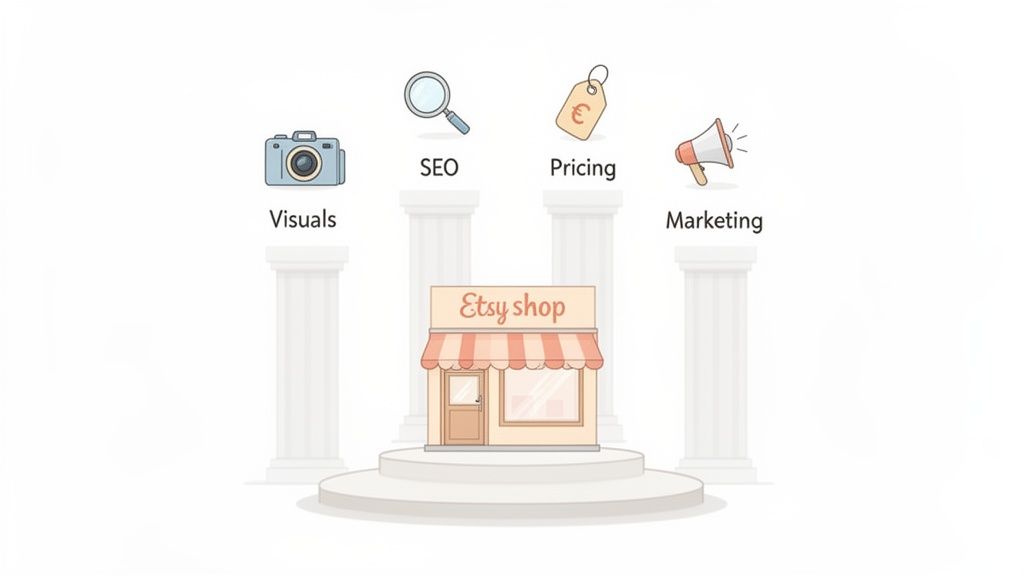
If you're serious about boosting your Etsy sales, you need to stop thinking like a hobbyist and start thinking like a business owner. It really boils down to mastering four core areas: compelling visuals, smart SEO, strategic pricing, and proactive marketing. Nailing these is the fastest way to get from random, unpredictable sales to a steady, growing income stream.
Your Framework for Growing Etsy Sales
Think of this guide as your playbook for turning that creative passion into a real, profitable business. In a marketplace as packed as Etsy, just having a cool product isn't going to cut it. You need a strategy.
Let's start with the hard truth: Etsy is huge. There are over 100 million items all vying for the attention of nearly 90 million active buyers. The platform's bounce rate is a sobering 44.52%, which means almost half of all visitors click away after viewing just one page. That first impression has to be powerful, or they're gone.
Think of this section as the "why" behind the tactics. It provides the strategic foundation needed before we dive into the specific "how" to transform your shop’s performance and increase your sales on Etsy.
Let's break down the core pillars that support a successful Etsy shop.
This table gives you a high-level look at where we're going. It's a simple framework to keep you focused on what truly moves the needle.
Your Etsy Sales Growth Framework
| Pillar | Primary Objective | Key Actions |
|---|---|---|
| Listing Optimization & SEO | Get Found by Shoppers | Keyword research, optimized titles & tags, detailed descriptions |
| Compelling Visuals | Stop the Scroll & Build Trust | High-quality photos, lifestyle shots, product videos |
| Strategic Pricing & Shipping | Close the Sale & Ensure Profit | Competitive analysis, cost-plus pricing, free shipping offers |
| Proactive Marketing & Service | Build a Brand & Earn Loyalty | Social media promotion, email marketing, stellar customer support |
By focusing your energy on these four areas, you create a system where each part strengthens the others. Great visuals pull people in from search, strong SEO gets you in front of them in the first place, smart pricing seals the deal, and fantastic service brings them back for more.
For a deeper dive into the broader principles that apply across all online stores, this guide on How to Improve Ecommerce Sales is a fantastic resource to explore alongside our Etsy-specific tactics.
Mastering Etsy SEO to Get Found by Buyers
Think of Etsy's search engine as a really good matchmaker. Its only job is to connect a buyer looking for a "rustic leather journal" with your beautifully crafted notebook. Your job is to send all the right signals so that matchmaker picks you out of the crowd. This is the heart of Etsy Search Engine Optimization (SEO), and it's how you go from just hoping for traffic to building a reliable stream of customers.
A common mistake I see sellers make is guessing at keywords or using terms that are way too broad. A keyword like "necklace" is like shouting into a hurricane—you'll get lost in the noise. But something like "minimalist silver mountain necklace" targets a specific person who knows what they want and is ready to buy. That’s the game-changer.
Think Like a Shopper
Before you even think about editing a listing, you have to get inside your customer's head. What words are they actually typing into that search bar? I can tell you from experience, it's often way more conversational than you'd think. People don't just search for product categories; they're searching for solutions, gifts, and a certain vibe.
- For a gift: They'll search for things like "personalized gift for new dad" or "boho bridesmaid proposal box."
- For an aesthetic: You’ll see searches for "dark academia decor" or "coastal grandmother art print."
- For a specific use: Think "durable dog walking leash for large dogs" or "ergonomic wooden crochet hook."
Take a few minutes and just brainstorm five to ten core phrases your ideal customer would use. Don't edit yourself, just get them all down. This little list is the foundation for your entire SEO strategy.
The Anatomy of an Optimized Etsy Listing
Okay, once you have your list of phrases, it's time to put them to work. You need to place them strategically where Etsy's algorithm and your customers will see them. Every part of your listing has a distinct role to play in telling Etsy what your product is all about.
Titles That Attract Clicks
Your title is, without a doubt, the most valuable piece of SEO real estate on your listing. It needs to be clear, descriptive, and loaded with your most important keywords right at the very beginning. The key is to make it sound like a natural, readable phrase, not a jumbled mess of words.
- Weak Title: Cute Mug
- Strong Title: Funny Cat Mom Coffee Mug | Custom Pet Portrait Cup | Gift for Cat Lover | 11oz Ceramic Mug
See the difference? The strong title hits on multiple high-intent keywords ("funny cat mom coffee mug," "custom pet portrait cup") that capture different searches, all while telling the shopper exactly what they're getting.
Using All 13 Tags Effectively
Your tags are your direct line to the Etsy search algorithm. You get 13 tags per listing, and trust me, you need to use every single one. Each tag is another open door for a buyer's search to find its way to you.
My Pro Tip: Don't just repeat the exact same keywords from your title in your tags. Etsy combines your title and tags for search, so repeating them is a totally wasted opportunity. Use your tags to cover synonyms, related ideas, and different long-tail variations.
Let's say you're selling a handmade soy candle with a lavender scent.
| If your title uses… | Then your tags can explore… |
|---|---|
| "Lavender Soy Candle" | "Aromatherapy Gift," "Relaxation Candle," "Hand Poured Candle" |
| "Calming Home Decor" | "Self Care Gift Box," "Natural Home Fragrance," "Eco Friendly Decor" |
| "Gift for Her" | "Housewarming Gift," "Cozy Home Accent," "Stress Relief Gift" |
This simple strategy multiplies your reach, letting you show up in a much wider variety of searches that are still relevant to your product.
The Final Pieces: Attributes and Descriptions
Attributes are those filters shoppers use on the left side of the search results page—things like color, size, material, and style. Filling these out is completely non-negotiable. If a buyer filters for "blue" wall art and you haven't selected "blue" as an attribute, your listing is invisible to them, no matter how perfect the rest of your SEO is.
Finally, your product description. This is written mostly for your human buyer, but it's another great place to naturally weave in your keywords. This is where you tell the story of your product. Talk about the materials, the process, and the feeling it evokes. A well-written description doesn't just help with SEO; it answers questions, builds trust, and converts a curious browser into a happy customer.
Creating Product Photos That Stop the Scroll
On Etsy, your photos are your entire sales pitch. Think about it: before a shopper even glances at your title, description, or glowing reviews, they see your main image. That single picture has to do all the heavy lifting—it needs to grab their attention, scream quality, and make them want to click. It's the digital equivalent of a customer picking your product up off a physical shelf.
Nothing sinks a potential sale faster than bad photography. If your images are blurry, poorly lit, or cluttered, it immediately signals "amateur." That erodes trust and makes buyers second-guess the quality of your actual product. To really boost your sales, you have to present your work with the professionalism it deserves.
The Core Principles of Great Product Photos
Before we get into fancy tools, let's nail the basics. You don't need a high-end camera to take great product photos; you just need to understand light, composition, and context. These fundamentals are what separate a quick snapshot from an image that actually drives sales.
Since buyers can't physically hold your item, your photos need to do that for them. Show your product from every important angle. Get in close to highlight the beautiful texture and craftsmanship. Include a shot for scale (placing it next to a familiar object works wonders) and an "in-use" or lifestyle photo to help customers imagine it in their own lives.
Here’s a simple shot list that every single one of your listings should have:
- The Hero Shot: This is your star. A crisp, clean, well-lit image of your product, usually on a simple, uncluttered background. This will be your main thumbnail.
- Detail Shots: Zoom in on what makes your product special. Show off the unique materials, the intricate details, or the quality of your handiwork.
- Scale Shot: Give a clear sense of size. A photo next to a coin, a hand, or a coffee mug can prevent customer confusion and returns.
- Lifestyle Shot: Put your product in a real-world setting. This helps buyers connect with it emotionally and see how it fits into their world.
- Packaging Shot: If your packaging is a key part of the experience, show it! Beautiful packaging adds a layer of professionalism and boosts the perceived value.
For a visual marketplace like Etsy, getting a handle on the fundamentals is a must. If you want to dive deeper, learning more about what is product photography can help your listings truly pop.
A Smarter Workflow with AI-Powered Tools
Not long ago, getting studio-quality photos meant shelling out for expensive equipment, wrestling with complex lighting, and spending hours editing. It was a massive hurdle for most sellers. Thankfully, AI-powered tools have completely changed the game, making it possible to create incredible visuals with just your smartphone.
This is especially helpful for the 80% female seller base on Etsy, many of whom are juggling their shops alongside other major life responsibilities. With 95.5 million active buyers on the platform, presenting your products professionally and efficiently is how you grab a piece of that market without needing a huge budget.
A better visual workflow means you can list new products faster, refresh old listings with killer new images, and maintain a consistent, professional look across your entire shop with a fraction of the effort.
This flowchart shows how the whole process fits together. Good SEO gets you found, but it's your photography that seals the deal.
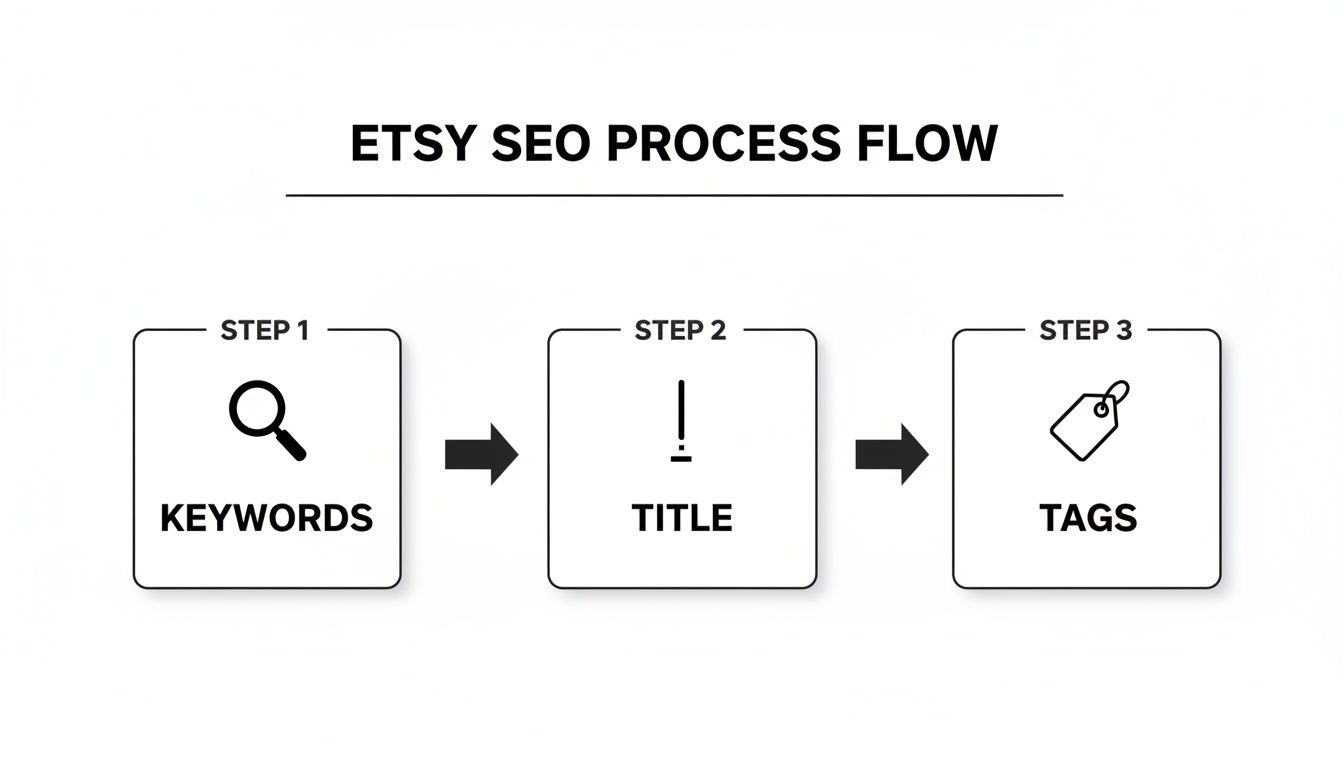
As you can see, keywords and tags get your product in front of people, but it’s the visuals that stop the scroll and turn a casual browser into a happy customer.
From Smartphone Snap to Pro-Level Shot
Let's walk through how this actually works with a tool like ProdShot. Instead of a complicated, multi-day ordeal, you can get professional results in just a few minutes. It's a massive leap forward that levels the playing field for small sellers. You can learn more about this in our guide to professional Etsy product photography.
The new workflow is incredibly simple:
- Take a basic photo: Just grab your smartphone and snap a clear picture of your product in a well-lit room. Don't stress about the messy background.
- Upload it to an AI tool: Pop the image into the platform. The AI will instantly and perfectly remove the background.
- Generate a new scene: Pick from a library of studio-quality backgrounds, lifestyle settings, or solid colors that fit your brand. The tool intelligently adds realistic lighting and shadows to make it look completely natural.
- Download and go: Your brand new, professional-grade photos are ready to be uploaded straight to your Etsy listing.
To give you a clearer picture, here’s a look at the massive difference between the old way of doing things and the new AI-powered approach.
Traditional vs AI-Powered Product Photography Workflow
| Factor | Traditional Photography | AI-Powered Solution (e.g., ProdShot) |
|---|---|---|
| Setup & Equipment | Requires DSLR camera, lenses, tripods, professional lighting, backdrops, and a dedicated space. | Uses just a smartphone camera. |
| Time Investment | Hours to days for setup, shooting, and extensive post-production editing in software like Photoshop. | Minutes from photo to final, downloadable image. |
| Cost | $500 – $5,000+ for equipment, or $50 – $200+ per photo for a professional photographer. | Low monthly subscription fee, often starting around $10 – $30. |
| Skill Requirement | High. Requires expertise in photography, lighting, composition, and advanced editing skills. | Low. No technical or design skills are needed. The process is intuitive and automated. |
| Consistency | Difficult to maintain a consistent look and feel across different shoots and products. | Easy to achieve brand consistency by using saved templates and preferred backgrounds. |
The takeaway is pretty clear: AI tools dramatically reduce the time, cost, and skills needed to produce the kind of high-quality images that used to be out of reach for most Etsy sellers. It’s a game-changer for anyone looking to up their game quickly and affordably.
Nailing Your Pricing and Shipping for More Sales
Let's talk about the final two hurdles a customer has to jump over before they click "buy": your price and your shipping cost. You can have the best product photos and the most dialed-in SEO on the planet, but if a buyer gets to checkout and is hit with a surprisingly high number, they're gone. This isn't just about covering your costs; it's about making the buying decision as easy and painless as possible.
Honestly, setting your price feels like walking a tightrope. Go too low, and you're not just hurting your bottom line, you're telling the world your work isn't valuable. Go too high without a good reason, and you'll scare people away before they even appreciate what you've made.
Choosing Your Pricing Model
To get off the "guesswork" treadmill, you need a solid framework. I've found that the most successful Etsy sellers I know use a mix of three core strategies to land on that perfect price.
- Cost-Plus Pricing: This is your starting block. You add up all your costs—materials, your time, Etsy fees—and then tack on a markup for your profit. It's straightforward and guarantees you don't lose money on a sale, but it completely ignores what the market is willing to pay.
- Competitor-Based Pricing: This is your reality check. You hop on Etsy, see what similar items are going for, and position your product somewhere in that range. It keeps you competitive, but you have to be careful not to get sucked into a race to the bottom. Don't devalue your work just to be the cheapest.
- Value-Based Pricing: This is where the magic happens. Here, you price based on what your item is worth to the customer, not what it cost you to make. If you have a one-of-a-kind piece, solve a unique problem, or have an incredible brand story, you can—and should—charge more.
The best approach is to blend all three. Start with cost-plus to find your floor. Use competitor research to find the ceiling. Then, use value-based thinking to find your sweet spot right in the middle.
The Psychology of Shipping Costs
I can't overstate this: people hate paying for shipping. It's a huge psychological hurdle. In fact, unexpected shipping costs are one of the biggest reasons people ditch their carts—we're talking an average cart abandonment rate of over 70%. Think of it as a massive leak in your sales funnel that needs to be plugged, fast.
The secret isn't actually about whether shipping is free—it's about whether the customer perceives it as free. Etsy’s “free shipping guarantee” on orders over $35 is one of the most powerful tools they give us. They even tend to boost listings with it in search results.
This doesn't mean you have to eat the cost. The smart play is to simply roll your average shipping cost into your item's price. If your product is $28 and shipping usually runs you $7, just list it for $35 with free shipping. The total is the same for the customer, but the psychological pull of "free" is incredibly powerful. You can play around with different pricing models to see what works best for your margins; a tool like ProdShot's pricing plans can help you model this out.
Setting Up Smart Shipping Profiles
Don't treat your shipping profiles like an afterthought; they are a key part of your sales strategy. Take a few minutes to set up different profiles for your various products based on their size and weight.
Here’s a simple setup that works for most shops:
- Domestic Profile: This is where you'll offer that "free shipping" guarantee for US buyers on any order over $35.
- International Profile: Always use calculated shipping for international orders. This makes sure you're charging accurate rates based on the buyer's location so you don't lose your shirt shipping something to the other side of the world.
- Upgrades: Make sure you offer upgrades like Priority or Express mail. You'd be surprised how many people are willing to pay extra for speed, especially during the holidays.
By pricing your products thoughtfully and turning shipping from a roadblock into a bonus, you're fixing one of the biggest drop-off points in the entire buying process. It builds trust, cuts down on abandoned carts, and is a surefire way to see your Etsy sales climb.
Driving Traffic Beyond Etsy Search
While mastering Etsy SEO is an absolute must, relying on it alone is like building your business on borrowed land. If you want to build a truly resilient shop and seriously boost your sales, you need to start creating your own streams of traffic. It's about proactively bringing interested buyers to your listings, not just waiting for them to stumble upon you.
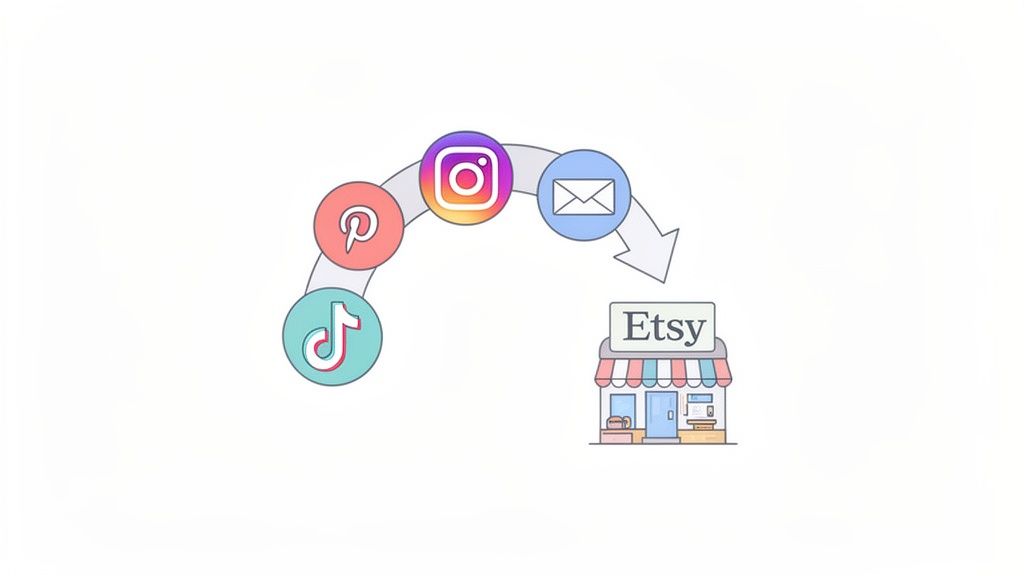
Think of it this way: you're creating multiple pathways that all lead directly to your products. When you have some control over your traffic, you gain stability and can ride out those inevitable tweaks and shifts in Etsy's search algorithm. You're building a brand, not just a shop.
Go Where Your Customers Are: Social Media
Social media isn't just for posting pretty pictures. It's about figuring out where your ideal customers are already hanging out and showing them exactly what they’ve been looking for. Don't spread yourself thin trying to be everywhere at once. Just pick one or two platforms that feel like a natural fit for your products and dive deep.
For anything visual—art, home decor, fashion, jewelry—Pinterest is an absolute powerhouse. It functions more like a visual search engine than a social network. People are there specifically to find inspiration and things to buy.
Instagram is fantastic for building a community and telling your brand's story. Use a mix of polished feed photos, candid behind-the-scenes Stories, and engaging Reels that show your products in real life. Let people see the human behind the brand.
And don't sleep on TikTok. The algorithm can give new accounts incredible reach. It's the perfect place for quick, fun videos showing how your product is made or used. The trick is to create content that feels native to the platform—ditch the stuffy corporate ad vibe.
The whole point of social media is to guide people from a post they love directly to your Etsy listing. Make it easy for them. Put a clear, clickable link to your shop in every profile and mention it often.
Build Your Most Valuable Asset: An Email List
I'll say it again for the people in the back: your email list is the single most valuable marketing asset you will ever build. Full stop. Unlike your social media followers, who are at the mercy of an algorithm, your email subscribers have explicitly given you permission to pop into their inbox. That's a direct, powerful line to your biggest fans.
Getting started is easier than you think. Offer a simple incentive, like a 10% off coupon code, in exchange for an email address. You can promote this offer right on your Etsy shop banner, weave it into your listing descriptions, and shout it out on your social media profiles.
Once people subscribe, treat that relationship like gold. Send out a regular newsletter that gives them real value, not just a constant sales pitch.
A few ideas to get you started:
- First Look: Give subscribers the first peek at new product drops.
- Exclusive Deals: Offer a special discount just for them as a thank you for being on the list.
- Behind the Curtain: Share snippets of your creative process or a tour of your workspace.
- Insider Tips: Show customers new ways to use or care for their purchases.
This kind of consistent, valuable communication builds a genuine community, encouraging repeat business and turning one-time buyers into loyal advocates.
A Smarter Way to Use Etsy Ads
Etsy Ads can definitely kickstart your growth, but only if you have a game plan. Just switching them on and hoping for the best is a fast track to a drained bank account. You need to treat them as a targeted investment, not a lottery ticket.
Start small with a daily budget you're comfortable with. Even $3 to $5 a day is enough to start gathering crucial data. Don't waste money advertising your entire shop. Instead, pour your budget into your proven bestsellers—the listings that already have a solid conversion rate.
Let it run for a week or two, then put on your detective hat and dig into your ad analytics. See which listings are getting clicks but no sales? Those might need better photos or a punchier description. Pinpoint the listings that are actually delivering a positive return on ad spend (ROAS) and consider giving those winners a slightly bigger budget.
The goal is to constantly tweak and refine. Turn off what's not working and double down on what is. This data-driven approach is what turns Etsy Ads from a gamble into a predictable sales machine.
Got Questions About Boosting Your Etsy Sales? We’ve Got Answers.
As you start putting these strategies into practice, you’re bound to have a few questions pop up. It’s completely normal. Let's walk through some of the most common hurdles sellers face so you can keep moving forward with confidence.
How Long Does It Really Take to See More Sales After Making Changes?
I get this question all the time. While a fantastic new hero image or a flash sale can create a little buzz almost immediately, the real, lasting impact from your SEO work takes a bit of patience. You should expect it to take anywhere from 30 to 90 days for Etsy’s algorithm to fully recognize and reward your listing optimizations.
Think of it this way: you're building a foundation. It doesn't happen overnight. The key is to be consistent. Apply these SEO best practices to every single new listing you create and start chipping away at your older ones. Keep a close eye on your stats, and when you see a sudden spike in views on an item you recently updated, that’s your first sign that the momentum is building.
The Big Debate: Is Free Shipping Better Than a Discount?
Ah, the classic Etsy dilemma. Honestly, there's no single right answer—it really depends on your price point and what makes your ideal customer tick.
"Free shipping" is pure psychology. It’s a magic phrase that eliminates one of the biggest reasons shoppers abandon their carts. For many products, especially lower-priced ones, the promise of free shipping can easily outperform a percentage-off deal, even if the final cost to the customer is the same.
On the other hand, if you sell high-ticket items, a juicy 20% off discount can feel a lot more substantial and exciting.
So, how do you know for sure? You have to test it.
- Round 1: Run a "free shipping" promotion for a couple of weeks.
- Round 2: Switch to a 15% off sale for the next two weeks.
When you're done, don't just look at revenue. Dig into your profit margins and conversion rates. The numbers will tell you what truly motivates your specific audience and what’s healthiest for your business.
Why Am I Getting Tons of Views But No Sales?
This is incredibly common, and it’s a direct sign that your conversion rate needs work. When you've got the traffic but not the transactions, the problem almost always boils down to one of these three things.
First, be brutally honest about your product photography. Are your photos even a little blurry? Is the lighting kind of dim? Do they fail to show your product in action or from all the important angles? In e-commerce, great photos build trust. If you're struggling here, it's worth understanding the cost of professional product photography to see how investing in better visuals—either with a pro or with new tools—can pay for itself.
Next, it's time to scrutinize your pricing and shipping costs. Is your price way higher than your competitors without a clear reason why? Or, more likely, is a surprisingly high shipping fee scaring people away at the last second? This is where that "free shipping" strategy (by rolling the cost into the item price) can be a total game-changer.
Finally, read your descriptions and reviews as if you were a brand-new customer. Does your description answer every possible question and get you excited about the product? And if you don’t have many reviews yet, that lack of social proof might be making shoppers too nervous to click "buy."
Just How Important Are Reviews for Getting More Sales?
They’re everything. Reviews are the single most powerful form of social proof you have. A shop full of glowing, five-star feedback signals trust to every new person who lands on your page, which can do wonders for your conversion rate. It might even give you a little boost in Etsy's search rankings.
Think about it: a shopper who is on the fence is far more likely to be swayed by the authentic praise of a past customer than by anything you can write in your description.
You need to be proactive about getting them, but without being pushy. A simple, beautifully designed "Thank You" card slipped into your package that kindly asks for feedback is a fantastic touch. You could also send a friendly follow-up message on Etsy about a week after the item was delivered. And always, always respond professionally to all reviews—the good and the bad. It shows everyone you're an engaged, reliable seller who stands behind their products.
Ready to create scroll-stopping product photos that turn browsers into buyers? With ProdShot, you can transform simple smartphone pictures into professional, studio-quality images in seconds. No camera equipment, no design skills, just beautiful photos that help you sell more. Try ProdShot for free and see the difference it makes for your Etsy shop.