
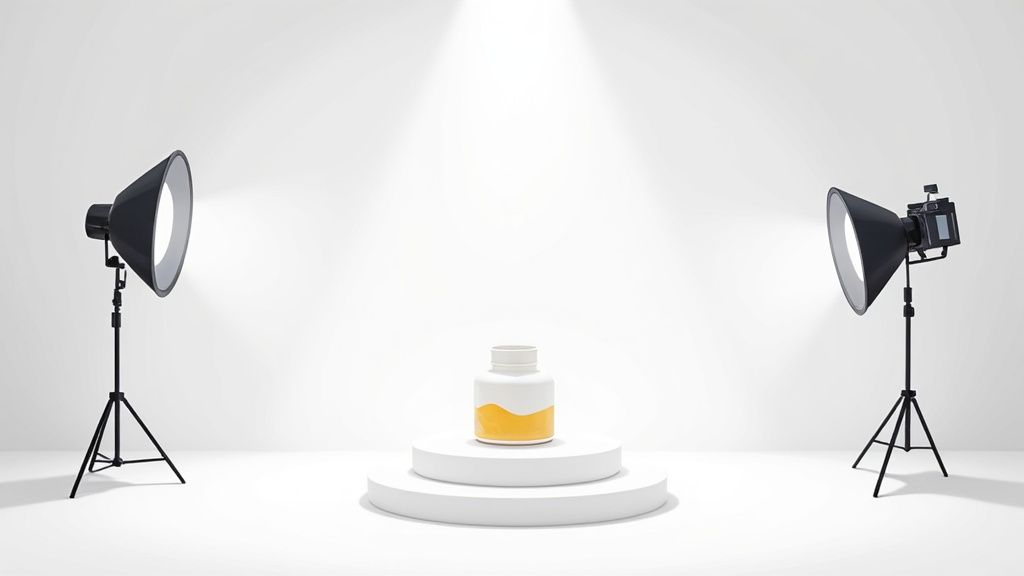
Think of product photography as your silent salesperson. It’s the first thing a customer sees, their first "hello" from your brand, and it does all the heavy lifting before they even read a single word of your description.
In a brick-and-mortar store, you can pick up a product, feel its weight, and check the quality. Online, your photos have to do all that work.
What Is Product Photography Really

Let's ditch the textbook definition. Product photography is how you communicate with someone who can't physically interact with what you're selling. It's your one chance to bridge the digital divide.
Good photos don't just show an item; they tell a story. They answer the questions a customer might not even know they have, building the confidence they need to make a purchase. They turn a "maybe" into a "yes."
More Than Just a Picture
Stop thinking of photography as a cost. It’s a direct investment in your sales engine. High-quality images give shoppers the visual proof they need to trust your product and your brand, making it that much easier for them to click "add to cart."
The market knows this, too. The global product photography industry was valued at $129 million in 2021 and is on track to hit $275 million by 2028. That explosive growth shows just how critical strong visuals have become for any online business.
The core purpose of product photography is to make the intangible tangible. It replaces the in-store experience by providing visual information that helps a customer make a confident purchasing decision.
Ultimately, your product photos are your digital storefront, and they’re working around the clock. They're doing three critical jobs at once:
- Educating the Customer: Great images show off the size, texture, and key features in a way words never could.
- Building Brand Perception: Professional, consistent photos send a clear signal: this is a brand that cares about quality and can be trusted.
- Driving Engagement: In a sea of online listings and social media feeds, fantastic photos are what make people stop scrolling.
For a deeper dive into how visuals can make or break an e-commerce brand, resources like Branditok's blog offer some great insights.
Why Great Images Are Non-Negotiable For Online Sales
In the world of e-commerce, your product photos are far more than just pretty pictures—they're your single most important sales tool. When a customer can’t physically pick up an item, your images have to do all the heavy lifting. They become the customer’s eyes and hands, bridging that crucial gap between a casual browse and a confident purchase.
Think of it this way: a crisp, detailed, and well-lit photograph sends a powerful message of professionalism and care. It tells the shopper you’re proud of your product and you respect their experience. This instantly creates a higher perceived value, laying the groundwork for a premium brand.
Building Trust Through Visuals
On the flip side, what does bad photography signal? Doubt. Grainy, poorly lit, or generic stock-style images can make even a fantastic product seem cheap or untrustworthy. That little seed of doubt is often all it takes for a potential customer to abandon their cart and click away.
Great product photography is all about eliminating that uncertainty. By showing your item from multiple angles and zooming in on key features, you're answering your customer's questions before they even have to ask. That kind of transparency is exactly what builds the confidence they need to hit the "buy" button.
A study found that 75% of online shoppers rely on product photos when deciding on a potential purchase. Your images are often the single deciding factor that pushes a customer to choose you over a competitor.
The Direct Impact On Conversions And Returns
This confidence doesn't just feel good—it has a real, measurable impact on your bottom line. When your photos are clear and accurate, customers know exactly what they’re getting. This simple act of setting correct expectations can dramatically slash your product return rates.
When expectations are met, satisfaction goes up, and you avoid the costly and time-consuming process of handling returns.
Ultimately, investing in great product photography is a direct investment in your sales. It's no surprise that the global e-commerce product photography market was valued at around USD 1 billion in 2024 and is expected to double by 2033. This explosion shows just how vital this piece of the puzzle has become for online success. You can discover more insights about this market growth on businessresearchinsights.com.
To dive deeper into the business impact of compelling visuals, exploring effective strategies for improving ecommerce conversion rates is a logical next step for any serious seller. It's not just about looking good; it's about building a sustainable, profitable online business.
The Main Types of Product Photography You Need to Know
When it comes to product photography, one shot is never enough. You're not just taking a picture; you're building a visual story that walks a customer from curiosity to checkout. Different photos have different jobs, and a great product page uses a mix of them to answer every question and build the confidence a buyer needs to click "add to cart."
Think of it like a conversation. You start with a simple introduction, then add interesting details, show how it fits into their life, and finally, clarify what's included. Each photo type is a crucial part of that dialogue.
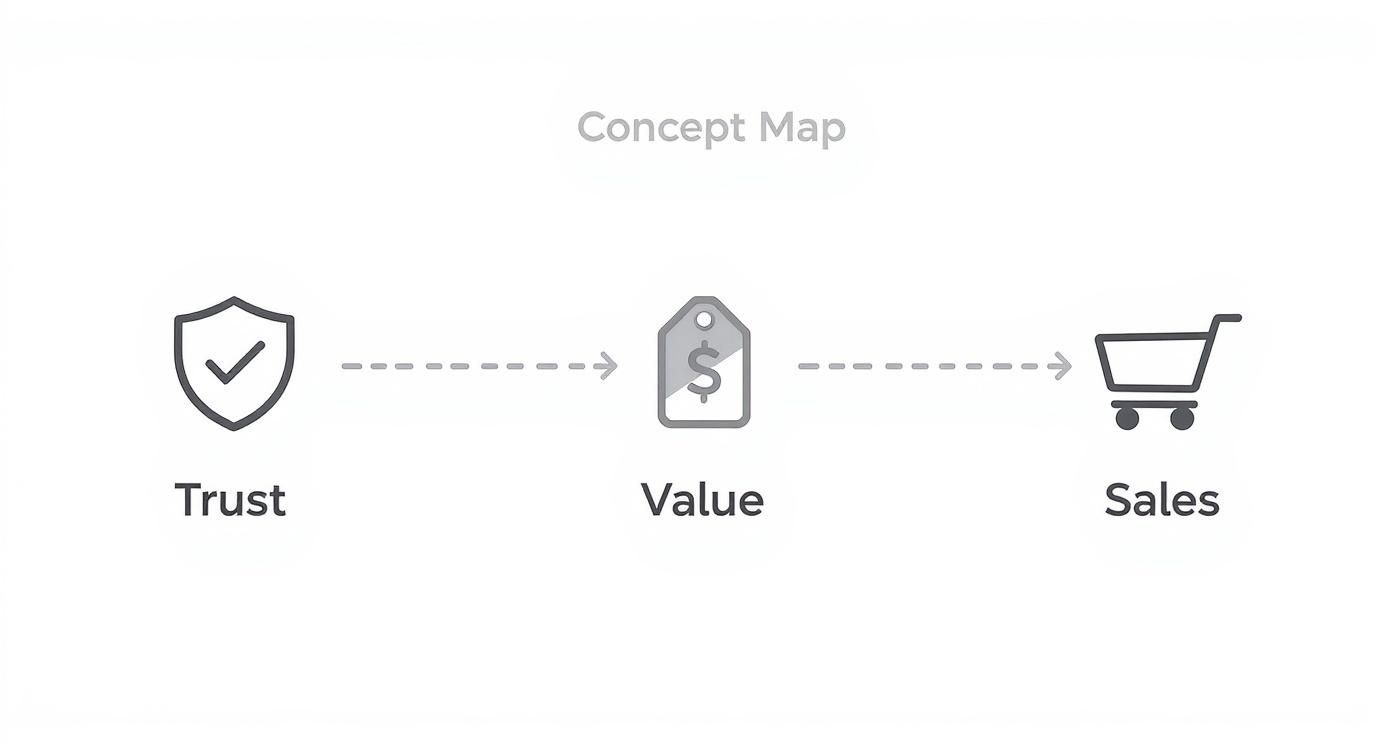
This journey from browser to buyer is paved with trust, and high-quality images are the foundation. Let's break down the essential photo types that get you there.
The Essential White Background Shot
This is your non-negotiable, must-have hero image. Sometimes called an "individual" or "studio" shot, it’s just your product, clean and clear, on a pure white background. No distractions, no fluff.
Its job is simple: to show the product exactly as it is. It's the most honest, straightforward picture you can provide, forming the backbone of your entire photo gallery. For anyone selling on big marketplaces, mastering professional Amazon product photography is key, as they have very strict rules for these main images.
The Aspirational Lifestyle Shot
If the white background shot informs, the lifestyle shot inspires. This is where you show your product in action, in a real-world setting, helping customers picture it in their own lives. Think of a durable backpack on a mountain trail, a sleek coffee maker on a modern kitchen counter, or a cozy blanket draped over a sofa.
Lifestyle photos create an emotional connection. You're not just selling an item; you're selling an experience, a feeling, or a solution. This is how you tell your brand’s story and make your product feel relatable and, most importantly, desirable.
The Informative Detail Shot
Get in close. A detail shot, sometimes called a "macro" photo, is an extreme close-up that puts quality and specific features under the microscope. This is your chance to show off the perfect stitching on a wallet, the brushed metal finish on a gadget, or the unique texture of a hand-woven fabric.
A detail shot acts as a magnifying glass, allowing the online shopper to inspect the craftsmanship and quality up close. This type of photo builds immense trust by proving you have nothing to hide.
The Comprehensive Group Shot
Group shots are all about context and clarity, showcasing multiple products at once. This approach is a powerhouse for a few specific goals:
- Product Lines: Displaying an entire collection so customers can see all available colors, scents, or styles at a glance.
- Kits and Bundles: Showing every single item included in a package, leaving no room for confusion about what they're buying.
- Scale Comparison: Placing your product next to a familiar object (like a phone or a coin) to give a clear and instant sense of its actual size.
Deciding which photo to use where can feel tricky, but it's really about matching the image to the customer's mindset at each stage of their journey.
Choosing The Right Photo Type For Your Goal
This table breaks down the primary job of each photo type and where they make the biggest splash.
| Photo Type | Primary Goal | Best Used For |
|---|---|---|
| White Background | To show the product clearly and without distraction. | The main "hero" image, search results, and comparison shopping. |
| Lifestyle Shot | To create an emotional connection and show context. | Social media, website banners, email marketing, and secondary gallery images. |
| Detail Shot | To build trust by highlighting quality and features. | Answering specific questions about craftsmanship, texture, and materials. |
| Group Shot | To showcase variety, contents, or scale. | Bundles, product lines with multiple options, and demonstrating size. |
By weaving these different shots together, you’re not just listing a product; you’re creating a comprehensive and persuasive visual pitch. Each image plays its part, working together to inform, inspire, and convince the customer they're making a great choice.
Mastering the Core Elements of a Great Product Shot

You don’t need a fancy studio or an expensive camera to create a product photo that actually sells. The secret isn't in the gear; it's in understanding a few key fundamentals. Once you nail these, even your smartphone can produce stunning results.
Think of it like making a great cup of coffee. You don't need a five-thousand-dollar espresso machine, just good beans and the right technique. In photography, your "beans" are light, composition, background, and the angle you shoot from.
Let's break down exactly what you need to focus on to see a real difference in your product shots, starting today.
The Power of Lighting
If there’s one thing to get right, it’s lighting. It’s hands-down the most important element in product photography. Lighting sets the mood, defines the texture and shape of your product, and makes key details pop. Get the lighting right, and you're already 80% of the way to a fantastic photo.
You'll generally work with two types of light:
- Hard Light: Imagine the sharp, direct sun at high noon. It creates dark, well-defined shadows. While it can be used for dramatic effect, it often looks harsh and can hide important details of your product.
- Soft Light: This is your best friend. It’s diffused, even light, like the kind that comes through a window on a cloudy day. It wraps gently around your product, softening shadows and showing it in the most flattering, clear way possible.
For e-commerce, soft light is the gold standard. It ensures your product’s colors are true to life and lets customers see every little detail without getting distracted by weird, dark shadows. A large window with indirect sunlight is a perfect—and free—source of soft light.
Crafting a Strong Composition
Composition is simply how you arrange everything in your photo. It’s what guides your customer's eye and makes the image feel balanced and professional. It might sound like a lofty art-school term, but you can start with one simple trick: the rule of thirds.
Just imagine your screen has a tic-tac-toe grid over it. The rule of thirds suggests placing your product not in the dead center, but along one of the lines or where the lines cross. It's a tiny shift that makes the image feel more dynamic and engaging.
Even for product listings that require a centered shot, understanding this rule helps you balance the negative space around your product, making it feel more intentional.
Choosing the Right Background
The background might seem like just a background, but it plays a huge supporting role. A cluttered or distracting background fights for attention, pulling focus away from the one thing you're trying to sell. The goal is to make your product the undeniable hero of the shot.
For most e-commerce photos, a plain, neutral background works best. A clean white or light gray background gets rid of all distractions, makes your product’s colors pop, and creates a consistent, professional vibe across your entire store. This is exactly why marketplaces like Amazon insist on it.
Once you have your clean, primary shots, you can get creative. But if getting those perfect backgrounds feels like a chore, exploring product photo editing services can save you a ton of time and get you professional results without the hassle.
Finding the Best Camera Angle
Finally, the angle from which you shoot can totally change how a customer perceives your product. Don't just point and shoot from one spot. Move around! Experiment a little to find the angles that show off your product's best features.
Here are a few common angles to try:
- Eye-Level: The classic, straight-on view. It’s honest, clear, and gives a true-to-life perspective.
- High Angle: Shooting down from above is great for showing details on the top of a product, like the face of a watch or the contents of a gift box.
- Low Angle: Shooting up from below can make a product feel more impressive, grand, or "heroic." Think of how they shoot sports cars in commercials.
By mastering these four elements—lighting, composition, background, and angle—you gain total control over how your products look online. You’ll be able to move beyond quick snapshots and start creating images that truly do the selling for you.
How AI Is Completely Changing the Game for Product Photos
Not too long ago, getting that perfect, polished product shot meant hours of painstaking work in Photoshop or shelling out a lot of cash for a professional. The whole routine of removing a background, fixing colors, and adding believable shadows was a massive headache for sellers. Today, that entire process is being turned on its head by artificial intelligence.
AI-powered editing tools have put professional-level results within reach for everyone, no matter their technical skill. Think of it less like learning a complex new software and more like hiring an expert assistant who happens to work at the speed of light. You can now snap a simple photo with your phone and let the AI do all the heavy lifting.
This isn't just a small change; it's part of a much bigger trend. E-commerce visuals are evolving fast, driven by AI photo editing, the need for super high-resolution images, and customer demand for things like 360-degree views. You can find more insights on these industry shifts and what they mean for sellers if you want to dig deeper.
From Manual Drudgery to Instant Magic
Forget about spending ages manually tracing the outline of your product to cut it out from its background. AI does it in a single click with stunning accuracy. This alone is a game-changer for creating those clean, white-background shots that marketplaces like Amazon and Shopify demand.
But it goes way beyond just removing backgrounds. These tools can instantly level up your images in a few key ways:
- Intelligent Lighting: The AI can look at your photo and automatically tweak the lighting and shadows. It knows how to make your product pop, adding a sense of depth and realism that's hard to get right manually.
- Smart Retouching: Got a tiny speck of dust or a minor scratch on your product? The AI can spot and remove those little imperfections without messing up the rest of the image.
- Scene Generation: This is where things get really impressive. AI can take your product and place it into entirely new, high-quality lifestyle scenes. This saves you the huge cost and effort of setting up a physical photoshoot.
The Power of an AI Product Photo Generator
Platforms like ProdShot have wrapped all this powerful technology into simple, user-friendly tools. By using an AI product photo generator, you can turn a single snapshot into a whole gallery of images—everything from standard e-commerce shots to creative pictures perfect for social media.
The real magic of AI isn't just about speed; it's about empowerment. It levels the playing field, letting small businesses and solo entrepreneurs create visuals that can go head-to-head with the big brands, all without the massive budget.
This technology lets you experiment with different backgrounds, themes, and styles in just a few minutes, helping you quickly figure out what look will get you the most sales. By automating the most tedious parts of photo editing, AI frees you up to focus on what actually matters: growing your business.
Answering Your Top Product Photography Questions
Even after you get the basics down, a few questions always seem to pop up. That’s completely normal. Diving into product photography can feel like you're learning a whole new skill, but getting clear answers is the fastest way to build your confidence.
This is where we tackle those common, practical questions that everyone has when they're starting out. Think of it as a quick-start guide to get you over those initial hurdles and feeling ready to shoot.
Do I Really Need an Expensive Camera?
Honestly? Absolutely not. While a fancy DSLR gives you more manual controls and lens options, the smartphone in your pocket is more than powerful enough to capture incredible, high-quality images for your store. The real secret to a great product photo has nothing to do with the price tag of your gear; it's all about how you use light, composition, and your background.
Think about it this way: a simple setup with your phone on a tripod next to a window with good natural light will give you far better results than a $2,000 camera used in a dark, messy room. Your first goal should be to master the techniques, not to collect expensive equipment.
The camera is just a tool. The real difference comes from how you control the environment around your product. A well-lit, well-composed photo from a phone will always outperform a poorly-lit shot from a professional camera.
What Is the Best Lighting for Product Photography?
For almost any e-commerce photo, soft, diffused natural light is the gold standard. This is the kind of light you get from a big window on a slightly overcast day. It’s even, it’s gentle, and it wraps around your product without creating those harsh, ugly shadows that hide details.
If you can't rely on the sun, you can easily replicate this effect with a lightbox or a softbox kit. The main thing to avoid is direct, hard light—like bright, direct sunlight or a bare lightbulb. That kind of light creates sharp, distracting shadows that can make your products look cheap and unprofessional.
How Many Photos Should I Have for Each Product?
There isn’t one magic number that fits all, but a great rule of thumb is to show enough photos to answer every question a customer might have before they even think to ask it. For most product listings, that sweet spot is somewhere between 5 and 8 photos.
Here's a mix that works wonders:
- 1 Hero Image: Your primary shot. Clean, clear, and usually on a white background.
- 3-4 Alternative Views: Show the product from all the important angles—the back, the side, the top, maybe a nice 45-degree angle shot.
- 1-2 Detail Shots: Get in close! Show off the texture, the quality of the stitching, or a key feature.
- 1-2 Lifestyle/Context Shots: Show your product being used. If it's a small item, place it next to something familiar (like a coin or a coffee mug) to give a sense of scale.
This kind of variety gives your shoppers a complete 360-degree view, building the trust they need to click "add to cart" without ever holding the item in their hands.
Can I Just Edit a Bad Photo to Make It Good?
While editing is a crucial final step, it’s not a magic wand. The old photographer's saying, "get it right in camera," really holds true here. Editing software is at its best when it's enhancing an already good photo—tweaking the brightness, cleaning up the white background, or sharpening a few details.
Trying to "fix" a photo that's blurry, poorly lit, or just plain boring is a massive time sink, and the results are almost never what you hope for. It's far better to spend your energy getting a great shot from the start. A few extra minutes adjusting your lighting or your composition will save you hours of frustration in front of a screen later.
Ready to stop wrestling with complicated editing software and start creating stunning, sales-driving images in seconds? ProdShot uses powerful AI to instantly transform your simple product photos into professional, marketplace-ready visuals. Try ProdShot for free and see how easy it is to elevate your brand.